The Politics of Terror


Harper new security Jan 2015“The world is a dangerous place and, as most brutally demonstrated by last October’s attacks in Ottawa and Saint-Jean-sur-Richelieu, Canada is not immune to the threat of terrorism.”

Or so Prime Minister Stephen Harper decreed on January 30th, flanked by Peter MacKay, Minister of Justice and Attorney General of Canada, Steven Blaney, Minister of Public Safety and Emergency Preparedness, and Julian Fantino, Associate Minister of National Defence, and the largest personal protective detail in the history of Canada.

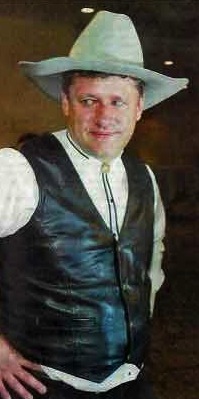
It would seem that Harper sees himself as a ‘war-time’ leader, who, in the run up to the next election, wants to project a manly, statesmanlike image. While cultivating a culture of fear, he is appealing to those who traditionally will cling to the political status quo in times of unrest.

And in one swell foop, the man who spent the Ottawa siege in a closet ramped up the anxiety harper in closetand fear of a nation, while simultaneously putting into place measures that many feel will result in further loss of civil liberties and reduction of freedoms.

By no means am I minimalizing the two horrible attacks . They were horrific, and shocking to Canadians who rightfully believe themselves to be a part of the world’s peace keepers. But these attacks increasingly seem to have been the acts of self-radicalized, troubled and confused young men, with no evidence connecting them to ISIS. Harper’s proposal sounds less like a desire to protect the nation, and more like the fear mongering of a politician desperate to keep his seat in power. MuzzlingScientists

So much for his vaunted and pious defense of Canada’s Freedom of Expression and Freedom of Speech after the recent Charlie Hebdo attack in France. Our Freedoms were already considered under attack, based on his own government’s track record of secrecy, muzzling, sneaky omnibus bills, a disdain for democratic Parliamentary rules, and the misleading of Parliament.

Ottawa Citizen reporter Ian MacLeod called the proposal “the most dramatic package of new laws since the Anti-terrorism Act of 2001.” But .. hang on … who flew into our towers? Three misguided fools in Canada took it upon themselves to mirror the acts of other misguided fools in the Middle East, whom we’ve done nothing but publicize in the media. The same media that attempts to inflame viewers by ramping up anxiety about events in other parts of the world in hopes of getting higher ratings, and very often has the issues completely wrong. fox apologizes

Ironically, terrorism is most effective when it’s target reacts disproportionately to fear. Perhaps those sweeping powers would be better used in policing how media is actually romanticizing terrorism, and making it seem glamorous to impressionable and disenfranchised people who believe they have no voice or impact upon their own democratic governments. There’s a huge difference between planned, organized and directed attacks (terrorism) and a misguided fool whipped up by web sites designed to muster support for a cause.

No matter how often the Conservatives tell us that the attacker of Ottawa’s Parliament was linked to a terrorist network, we’ve still not seen follow up information, or the RCMP background video we are told contains proof of such a link. It’s the politics of fear and terror.

NDP leader Thomas Mulcair was right when he questioned why Harper is proposing new legislation with far reaching consequences without so much as consulting with opposition parties. Canadian rights, already being pecked away by post-9/11 laws, look to be even more constrained under a grantingcsis_record2 of extraordinary power to Canada’s spy agency, the Canadian Security and Intelligence Service (CSIS), with a mandate to “investigate and disrupt” terrorist plots. Canada’s police services will be able to go after online terrorist propaganda.

The line between being branded as an activist or a terrorist is already grey. With these proposals, that line could be even more abused than it currently is, and in fact, simply obliterated. Could a government with a long list of enemies, including labour and environmental movements, simply capitalize upon already existing powers such as restricting the right to remain silent, laws allowing CSIS to spy on Canadians overseas, detainment without charges, and arrest without warrants?

In 2012, Joe Oliver, then Minister of Natural Resources, wrote an open letter to Canadians on the government’s commitment to the diversification of energy resources (i.e. the Northern Gateway, Alberta’s Tar Sands.) In it, he said “environmental and other radical groups threaten to highjack our regulatory system to achieve their radical and ideological agenda.” He claimed that these ‘radicals’ were employing AmeriJOE-OLIVER Natural Resourcescan tactics to “sue everyone and anyone to delay the project,” and that ‘slow, complex, and cumbersome regulatory processes’ were slowing down the government’s ability to push ahead their own unilateral decisions and agenda.

Those ‘radical’ environmentalists were concerned about 50 square miles of tailing ponds full of toxic chemicals, supposedly lined but actually leaking at the rate of 3 million gallons per day. (Pembina Institute.) Cancer rates are 100 times the norm for the First Nations living on the Athabaska River. Over 80% of BC residents have said NO to oil tankers on their coast, and coastal First Nations have declared a ban under their traditional laws. oliver oil sands copy-002Perhaps these are small concerns to Mr. Oliver, but they are of vital importance to those who actually live in the area.

These ‘radical’ environmentalists could now potentially be charged with terrorism.

(In March, 2014, Mr. Oliver was appointed Minister of Finance. Yes, the same Joe Oliver who recently had to delay our next budget, due to the unexpected downturn in the price of oil. The government had banked on a big payoff on the pipeline, but instead, low oil prices are going to cost provinces nearly $10-billion in lost royalties and tax revenue, and see the government lose $4.3 billion in expected revenues. )

Could there be a better time for the government to ramp up fear and politicize terror? Data Mining

When the Anti-terrorism Act of 2001 was due to expire, the Tories’ Combatting Terrorism Act of 2013 reinstated them, with yet more power, and this new legislation would continue to expand on an overbearing and intrusive presence by government controlled security forces , bringing us ever closer to becoming a surveillance state.

On Sunday, President Barack Obama told CNN’s Fareed Zakaria that it’s important “we maintain a proper perspective,” on ISIS, and that they are not “an existential threat to the United States or the world order.” He added that the U.S. needs to see the threat for what it is and respond to it in a way that doesn’t undermine American values. obama isis

“It means that we don’t approach this with a strategy of sending out occupying armies and playing whack-a-mole wherever a terrorist group appears, because that drains our economic strength and it puts enormous burdens on our military,” he said.

Contrast this with Harper’s “Stand Your Ground” stance on Canada’s presence in Iraq. As the opposition questioned if Canada was actually at war with Iraq, and what “advise and assist” actually mean to the Canadian soldiers “accompanying” Iraqi troops fighting against Islamic State soldiers, Harper said, safe_image.php

“Let me be clear. This is a robust mission. We’re there to make those guys effective so they can take on the Islamic State and deal with them and if those guys fire at us, we’re going to fire back and we’re going to kill them, just like our guys did.”

Look – I get it. We’re all scared. We’re afraid of ISIS and Ebola, of extreme weather and IEDs, of Monsanto and dirty bombs and oh my lawdy, what’s next! There’s too much crime, we’re told, and draconian systems of justice continue to be put into place at enormous cost, when in fact, crime rates are falling. While some American states legalize marijuana, those in opposition continue to pump out propaganda against pot, and institutionalizing people where the substance has not yet been legalized.

The truth is, “we may be living in the most peaceable era in our species’ existence,” as Stephen Pinker concluded in his 2012 book The Better Angels of Human Nature: Why Violence Has Declined. terrorist attacks globally
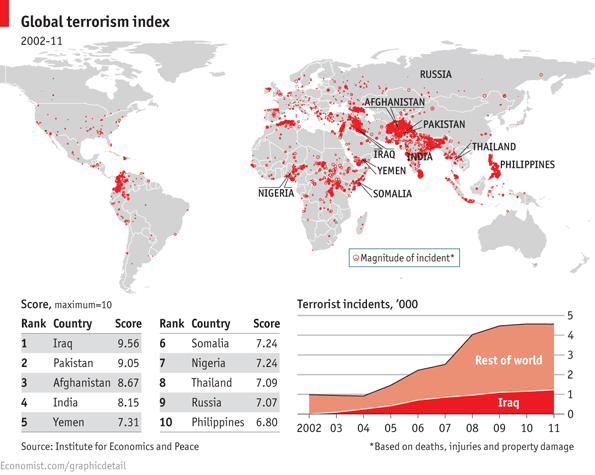
Terrorism peaked worldwide in the mid-1980s, and in North America around 1970. If you live in Canada or the United States your chances of being killed by terrorism are almost zero. We’ve been sold an exaggerated sense of danger about conflicts and events in other countries, which has allowed those in power to divide and conquer it’s people, alienate North America from war torn nations, engage in wars that profit only those in the military trade, and snip away at Canadians civil liberties, eroding our freedoms.

There are those who will say, “What do I care? I’m not a terrorist! Go get the bad guys!” Those people should perhaps have a chat with the innocent citizens caught up in the police actions taken against the G-20 demonstrators in 2010. g20protestMore than 20,000 police, military, and security personnel were involved in policing the protests, which at its largest numbered 10,000 protestors. Over a thousand arrests were made, making it the largest mass arrest in Canadian history. There were no ‘innocent until proven guilty’ dispensations; in fact, Toronto Police and the Integrated Security Unit (ISU) of the summit were heavily criticized for brutality during the arrests. harper controlling

You cannot hermetically seal a democratic society to protect it from violence; doing so actually reduces democracy. Despite the self-inflicted threat fear that Harper is trying to sell us, it’s our own government limiting our rights, not jihadists.  

Target’s Gain, Canada’s Loss


Attention Target Shoppers! Start your shopping carts as Target gets ready to liquidate stock from its 133 Canadian stores! Great news, right?

going out of bizNot quite, actually. In a continuance of mismanagement, and “whatever could go wrong, will,” Target will begin to sell off stock in early February, after receiving court approval of a liquidator. They will not, however, be advertising closing sales with “bankruptcy” or “going out of business” signs. You’ll have to pick through the goods to find the goodies.

But – what goods? Canadians have been faced with lacklustre merchandising from Target stores since they entered the market, with many stores being visibly under-stocked, and shelves either empty or with a few sad items lined up in single rows.

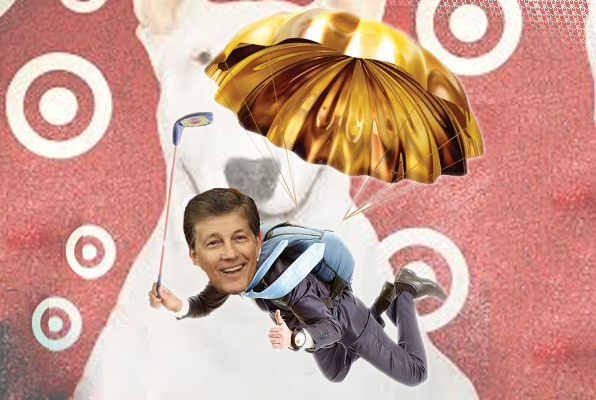
There’s been a problem with Target’s supply chain management since they first arrived in Canada, which resulted in Tony Fisher, the first president of its operation here, being fired in early 2014. CEO Gregg Steinhafel was asked to resign from Target Corp in Juntarget less for moree of 2014 – he’s the one that got a total severance and other benefits package worth about the same as the total amount being offered to all 17,600 of the chain’s Canadian employees.

(Steinhafel’s severance, which includes Gregg_Steinhafel_Golden_Parachuteprofit sharing and stock, will amount to $61 million USD, according to Fortune magazine, a sum greater than the severance package for all 17,600 Canadian Target employees combined ($58 million USD). Target Corp has now agreed to increase the employment trust to $90 million (CDN) to ensure the Canadian employees receive their full severance payout.)

empty-shelvesMark Schindele was parachuted in as president of Target Canada in May 2014 to try and fix the merchandise log jam, and pricing discrepancies that resulted from products arriving at warehouses with incorrect information, thus failing proper price comparison checks. In January 2015, he was quietly moved to Minneapolis to become SVP of Target Properties.

Target’s withdrawal from Canada is going to cost the corporation a bundle – they have said they estimate they’ll take a loss of $7 Billion. But what has been the cost to Canada?

<> on January 17, 2013 in New York City.The total amount of jobs gained across Canada in all industries for 2014 were 121,000 positions, down from the previous high figure of 186,000 reported in November. I’m not great at math, but the loss of 17,600 jobs at Target, spread across 133 stores, is a significant chunk of the pie. Also, our new jobs were concentrated around the oil industry, which is taking a beating as OPEC drops prices.

“The City of Edmonton’s chief economist says 80 per cent of new net jobs in Canada in the last year came from Alberta. “Over the past 12 months, Alberta has generated more new jobs than any other province in Canada and that includes Ontario, which is five times as large as we are,” said John Rose.” (Sept 11/14 http://globalnews.ca/news/1559263/40-of-all-new-jobs-in-canada-last-year-generated-in-edmonton/)

target-continues-to-failAdditionally, those 17,600 jobs were suspect to begin with. . When Target first arrived, they bought 200 Zellers stores, but did not honour the employees union in place. In fact, the first thing it did was ditch the union, eliminate seniority for long term employees, and drop all former Zellers employees to the bottom of Target’s pay scale. Because the majority of Target Canada’s workers were largely part-time, seasonal, or working irregular shifts, they will not qualify for Employment Insurance or other benefits.

The 133 stores, as well as office space leases and the three massive distribution centres in Milton, Calgary and Cornwall, will all be put up for sale at the same time, as early as March 5.

target distribution centreThe distribution centres alone represent a significant real estate investment; each warehouse covers some 1.5 million square feet, or about 26 football fields.

Target came to Canada promising jobs, new shopping opportunities, and a boost to the Canadian economy. In exchange, they received subsidies and tax breaks, along with favourable bank financing. This should have been a win/win situation.

bankruptInstead, it’s one of the biggest corporate bankruptcies in Canadian history.

Target wants to walk away from over $5 billion that is owed to creditors, big and small. They owe cities, suppliers and landlords. It’s such a long list of creditors that it took a 45-page document to list them all. They owe The Canada Revenue Agency and provincial governments millions in taxes ( $12 million to the CRA, $2.6 million to the B.C. government, and $6.5 million to the Quebec government.)

PharmacistGuest With just five stores in Manitoba, they still managed to rack up bills of $850,000 to Bison Transport, more than $450,000 to TransX, more than $200,000 to Old Dutch Foods and more than $1 million in tax owed to the Manitoba government. Beyond that, there are hundreds of thousands of dollars owed to smaller suppliers and pharmacies which operated independently within the stores.

elfe juvenileSuppliers owed hundreds of thousands of dollars are considering ways they can force Target to return their unsold goods that were shipped within 30 days of the filing – rather than have the inventory be included in the chain’s liquidation sales. Target filed under the Companies Creditor Arrangement act, which doesn’t have the 30-day goods provision. After aggressively purchasing stock for anticipated December sales, it entered the crucial holiday season with the highest levels of stock possible. Companies such as Elfe Juvenile Products of Montreal, listed as being owed $38,294, is actually out $147,758, based on stock now in Target’s possession. So is Sager Food Products Inc. in Montreal, which is owed more than $11,000 on the books, but the company estimates as closer to $16,000.

Sager Food VP Santo Fata received its last order the day before the filing. Sager had been happy to fill Target’s orders, which “were steady, regular and getting larger. We were happy.”

Sobeys vegChapman’s Ice Cream is owed $19,987. Coca-Cola Canada hopes to see some of the $339,699 it is owed. $1.7 million is owed to Hillcrest Mall Management Inc. Roots Canada Ltd is owed $433,248 in royalties. Sobeys will have to absorb over $3 million in losses.

But no worries – Canada will take up the slack, in a loss of jobs, and increased prices and taxes to cover the share that Target is walking away from. Over $5 billion.

CANADA-CORPORATE-TAX-RATEThis is not the first corporation that has been invited, even aggressively courted, to bring their business to Canada. Nor will it be the last. It’s just one more corporate experiment that failed, and is ultimately paid for by workers, taxpayers and Canadian companies.

Added March 6/15 …

The gall of these thieves!

http://www.huffingtonpost.ca/2015/03/05/suppliers-gear-up-to-chal_n_6809404.html

Greece Is The Word


The outcome of the election in Greece is sending shock waves across Europe. Syriza, the left-wing, anti-austerity party led by new Greek Prime Minister Alexis Tsipras, won 36% (149 of the Parliament’s 300 seats,) and, by forming a coalition government with the center-right Independent Greeks’ win of 13 seats, will have least 162 seats, a viable majority.

Greece new govt plansThe new government plans to raise the minimum wage, and create 300,000 new jobs, reverse the bank bailouts and stop banks from foreclosing on home owner’s principle residences, close corporate loopholes and offshore havens, and bring in a voucher system to help seniors in need receive food and healthcare.

For more than five years, the Greek citizens have been crushed under austerity policies imposed by the Economic Union’s “troika” of creditors; the European Commission, the European Central Bank, and the International Monetary Fund. Greek foreign debt currently stands at 175% of Gross Domestic Product.

Almost a third of Greece’s economy collapsed under the restrictions. Since June 5, 2011, when the “Indignant Citizens Movement” or the “Greek indignados“, held a demonstration of between 300,000 – 500,000 people protesting in front of the Greek Parliament, a change in government thinking has been pre-ordained. greek protests 2011

The Greek protest was non-violent for about a month, but on June 29, 2011, the police cracked down viciously on the protesters. Three people were killed, and accusations of police brutality, excessive use of tear gas, as well as the alleged use of other expired and carcinogenic chemical substances, led to an outcry by international media and Amnesty International.

austerity greeceWith half the population in poverty, and no end in sight to continued austerity and misery, it was inevitable that the people would rise up, and demand change.

“Both Syriza and Independent Greeks have detailed emergency economic programs that will commit their government to deal with the humanitarian catastrophe left by five years of the hated Troika policy. The damage has been unprecedented short of wartime, and has led to unemployment officially at 28%, but considered by experts to be actually as high as 45%; pensions and salaries have been slashed by 25-45%. The destruction of the health-care system has increased the child mortality rate, the suicide rate, and the death rate.” (http://www.larouchepub.com/other/2015/4205grk_elex_eup_new_deal.html)

Britain's Prime Minister David Cameron delivers a speech  at Dynamic Earth in Edinburgh, ScotlandEuropean leaders were swift to denounce Greece’s audacity. British PM David Cameron tweeted, “The Greek election will increase economic uncertainty across Europe.” (Britain’s membership in the European Union is a major issue in the campaign for the upcoming May election.)

russia-greeceGerman Bundesbank President Jens Weidmann told ARD network that he hoped “the new Greek government will not make promises it cannot keep and the country cannot afford.” But Germany’s opposition Left Party l called the Syriza victory a “sign of hope for a new start in Europe.” And today, Russian Finance Minister Anton Siluanov told CNBC that Russia would consider giving financial help to debt-ridden Greece.

The EU is shaken by the possibility that Italy, Portugal and Ireland, also horribly impacted by austerity measures, will follow Greece’s lead. Fiscal conservatives fear that Greece’s demand to write off up to half of their of €240bn debt will create a “Global Event,” on the scale of the 2008 collapse of the Lehman Brothers Holdings, who went bankrupt with $600 billion in assets.

German Economics 1953But there is precedent in countries restructuring debt. In 1953, Germany was in a similar position to Greece today. With debt from pre-and post-war, they owed nearly 30 billion Deutschmarks to around 70 countries. With no access to capital, and creditors who didn’t believe the country could turn the economy around, Germany was desperate for cash to begin the country’s reconstruction and growth.

Despite budget cuts and laborious repayments, the economic burden was crushing their population. FinanDebt-Accord-290cial negotiations were begun by banker Hermann-Josef Abs, who led a German delegation in London in 1953. He hoped to turn the creditors of today into the financiers and investors of tomorrow. But the foreign creditors felt his first offers were insulting.

The London Debt Agreement, finally signed on February 27, 1953, saw half of Germany’s debts written off, with the rest restructured for the long-term. Germany was not to be economically overburdened. Today, our view of Germany’s economy is paired with the idea that the German people are just a very hard-working people. But none of what Germany accomplished would have been possible without the Agreement.

Greek beach NaxosThose who believe that Greece’s new vision is childish and selfish stereotype Greece’s economy as being irreparably rife with corruption and greed, and fed by an indolent, Mediterranean lifestyle. Those same people once thought that all Germans were Nazis.

greek protests 2014In fact, the average Greek retirement age is nearly 65, but the pension is quite small, requiring many retirees to continue working as long as they are physically able. According to Eurostat statistics, the Greeks work 40.6 hours a week, the highest of all 27 EU member states. The ordinary Greek citizen in not lounging on the beach drinking ouzo, they have been protesting in the streets, as tax increases and social security cuts destroy the peoples’ hope, and the public sectors are privatized to serve as collateral to service the European debt.

The Eurozone finance ministers have no intention of continuing debt relief negotiations unless the new Syriza government promises to honour all existing austerity agreements. Meanwhile, the Euro is trending downward, and the Podemos in Spain, a year-old political party that has surged to the top of the polls promising to reverse austerity in Spain and impose a levy on banks, are poised to join Greece in challenging the stranglehold of the Troika. As Tsipras pointed out during his victory speech, the old ways of doing things in Europe are doomed.   debts are not destiny

Use Your Power – Vote!


CANADA-2030Even those amongst us, who are tired of hearing about, and arguing about, politics and the economy know, deep down, that we must take responsibility for how Canada will be governed and represented to the world. It’s no longer enough to whinge and moan about the issues that have snuck up on us while we struggled to keep up with the cost of living; Canadians need to decide what sort of Canada they want to live in. And that means we have to vote.

10.-Represents-the-peopleWe have the right and a duty to vote, but voter turnout has been steadily declining in Canada and the United States, as well as in Western Europe, Japan and Latin America. The world’s highest voting rates, at 95%, are in Belgium, which has compulsory voting, and Malta, which does not.

(Other countries with compulsory voting include Australia, Argentina, Brazil, Chile, Greece, and Luxembourg.)

Voter turnout among Canadians is at an unprecedented low, and has been declining since the late 1980s. Voter turnout in the most recent election, at 61.4%, was the third lowest in Canadian history. Young voter turnout was 39% in the 2011 federal election. Canada’s youth will often say that there is little in politics that relates to them. If an issue catches their attention, they are more likely to participate in boycotts and demonstrations, groups with like-minded views and passions.

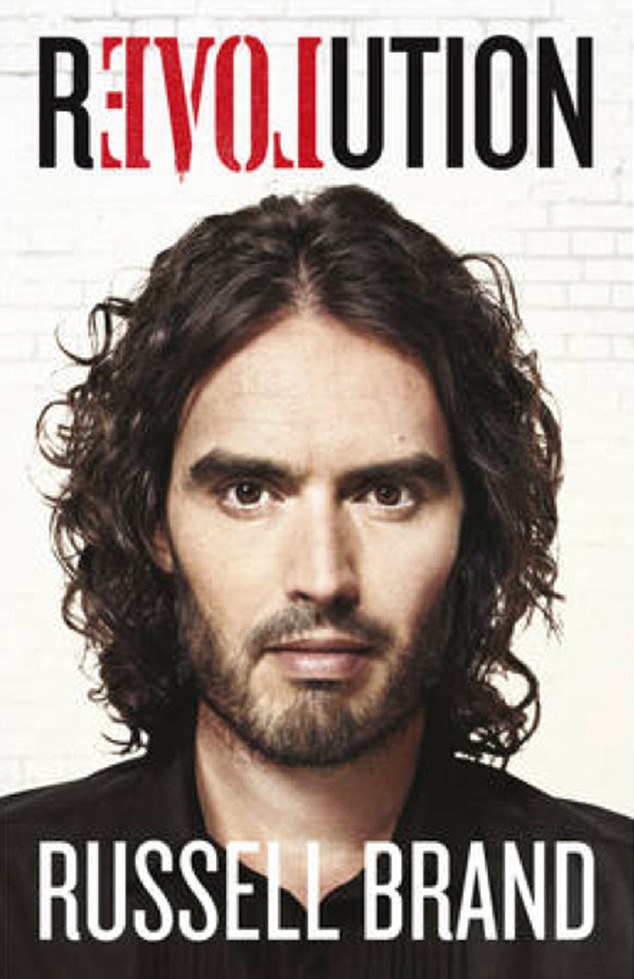
Screen shot 2014-10-23 at 14.12.48.jpgThere’s a general malaise about voting. As much as I adore the witty and eloquent Russell Brand, I find his disdain for voting appalling and unhelpful to his more impressionable followers. Even that old reprobate Johnny Lydon of the Sex Pistols, once famed as an anti-establishment rebel, has called Brand’s refusal to vote “the stupidest thing I’ve ever heard,” adding “You have to vote, you have to make a change. You’re given lousy options, yes, but that’s better than nothing at all.”

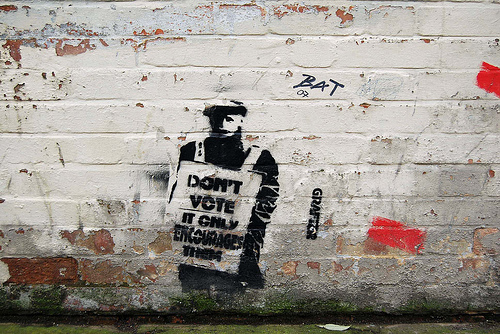
In 2013, Brand guest-edited Britain’s “New Statesman” and wrote at length about his views on politics, saying “I have never voted. Like most people I am utterly disenchanted by politics… I will never vote because, as Billy Connolly said, “It encourages them.””dont-vote

He has since moderated his words. “What I said was, ‘There’s nothing worth voting for.’ If there was someone worth voting for, I’d vote for it and I’d encourage other people if they think that there is a political party that represents their views; if they think there are politicians that are speaking on their behalf, by all means vote for them.”

We’re exhausted with the process. We’ve also lost interest in civic and social participation. Pre-1980’s, more of us were involved with our churches and schools, and we were more likely to be involved with professional or fraternal organizations. Before televisions and computers were available in every home, we met our friends and neighbours socially, to play bridge, or to pit our skills against each other physically in pickup sports and bowling leagues.

When pressed, those who can’t be bothered to vote will say that they’re just too busy. It may feel that way, but studies have consistently shown that we have the same amount of leisure time we have always had – we’re just using it differently.

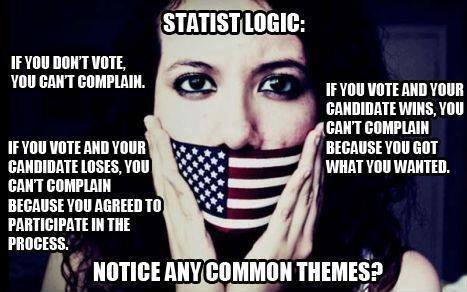
Statist-voting-logicOthers will say that voting makes no difference; we’re only exchanging one self-serving politician for another. Since the early sixties, we’ve had less trust in government and in politicians in general. The rise of ‘attack ads’ and smear campaigns has left voters with a foul taste in their mouth about politics in general.

There’s an actual formula for figuring out the likelihood of someone voting.

PB + D > C.

P is the probability that an individual’s vote will affect the outcome of an election; B is the perceived benefit that would be received if that person’s favoured political party or candidate were elected; D is for democracy or civic duty, or any social or personal gratification an individual gets from voting, and C is the time, effort, and financial cost involved in voting. (Wikipedia.org)

One of the issues affecting voters in Canada and the States has been a sneaky tinkering with that C; in the name of efficiency and a feigned attempt to curb ‘voter fraud,’ politicians have made it more difficult for some groups to be heard.

election-fraud-for-dummiesVoter suppression, the ‘dirty tricks’ dreamed up to intimidate, or to make it inconvenient or impossible for citizens to vote are illegal activities. After the Canadian Federal election of 2011, the Conservative Party was accused of having used live calls and robocalls to tell voters that their polling station had been changed. Voters were directed to false addresses, often several hours away from correct stations. These calls claimed, illegally, to be from Elections Canada.

A federal court was asked by The Council of Canadians to look into allegations of Conservative Party voter fraud. The court concluded that fraud had indeed occurred, probably by someone with access to the Conservatives databases, but said that there was no direct proof that the Party or any successful candidates were either directly involved or profited from the fraud. Although the Conservative were criticized for making “little effort to assist with the investigation,” the court did not annul the result in any of the six ridings where the fraud had occurred, concluding that the number of votes affected had been too small to affect the outcome. (Wikipedia)

In 2015, changes to Canada’s voter eligibility have a new requirement, that each voter prove his or her physical address on paper. The long accepted practice of having a second person vouch for a voter’s address will no longer suffice.

native voice“The Canadian Charter of Rights and Freedoms guarantees the right to vote to every citizen in Canada who is 18 years and older. While the Fair Elections Act doesn’t trump the Charter and render the right to vote for these groups null and void, the EFFECT of the Act could be just that. The Chief electoral officer Marc Mayrand reported in a CTV news article that removing vouch voting could affect over 100,000 people — particularly those who are Aboriginal and live on a reserve.

homeless votePeople who are homeless, whether on the streets, couch surfing or living somewhere temporarily, are also at risk of losing their ability to vote if voter vouching is dismantled. People who are homeless can experience theft, or sometimes misplace their personal identification because of housing instability. This shouldn’t hold them back from voting.

“Irregularities” have been noted with respect to voter vouching in the last election according to a report commissioned by Elections Canada. These irregularities are being touted by the current government as a reason to end voter vouching, however, the report actually states that these issues were ‘administrative’ and made by elections workers — not by voters themselves. In court cases that preceded the report, both the Ontario Superior Court and the Supreme Court of Canada agreed that, “there was no evidence of fraud or ineligible voters being provided ballots.” (Huffington Post Canada)

bc reserveThis change may also become a problem as physical mail delivery becomes a thing of the past. It will definitely be a problem for many First Nations people, who often do not have regular street addresses, and thus relied on vouching. Elections Canada now requires each person lacking identification that includes an address to have a different registered voter swear an oath as to the technical land description of their home or a letter from the First Nation confirming the location, along with a piece of identification with the voter’s name. Elections Canada will not accept Indian status cards alone.

voter-suppressionIn the United States, elections are locally administered, which has often been found to allow the manipulation of elections. Before the Voting Rights Act of 1965, poll taxes, literacy tests, and grandfather clauses were used to suppress poor and racial minorities from voting. Today, voter suppression is more subtle, but is an integral part of policy for the Republicans, who have championed voter ID laws, voter caging, and felony disenfranchisement. There is also a sad history of physical intimidation at polling stations, ranging from unauthorized security guards, to simply making voters wait for long hours in gruelling weather.

Some countries are working to improve voter turnout by increasing possible voting locations, requiring companies to give workers paid voting time off, or allowing voters to vote over several days, as they do in India. In France, voting is held on the weekend, so that most voters have no need for time off from work.

internet-voting1France, Switzerland, Estonia, Geneva and the United Kingdom also allow internet voting. The US Department of Defense has been looking into making internet voting secure, but no decisions have been made.

In Canada, federal elections still use paper ballots. There have been some efforts at the provincial level to allow internet voting, and some municipalities, including Peterborough, Markham and Halifax, provide internet voting as an option. We’re still a long way from being wired politically.

ask questionsNonetheless, and despite the best efforts of those who fear we’ll make the ‘wrong’ decision come Election Day, it’s still imperative that we use our votes to demand the changes we want to see in government. Voting is our power. By not voting, you cede that power to whomever’s voices are louder than the peoples, to further their own agendas and gain.

help wantedUnless we want a democracy in name only, we need to get involved, to seriously look at the candidates in our constituencies, and make an informed judgment on those who are seeking to work for us. Politicians are job seekers; they need to present a résumé and an outline of what they intend to do for us before being handed power. And they must be held accountable if they fail to perform up to their claims and our standards.

powerWhile they vie for their ‘job’ as your representative, you have the power. Once they’ve been elected, it’s out of your hands. So tell those who want your vote that they’ve got to work for it. Choosing not to vote, or to vote without understanding whom you’re hiring, only guarantees that Canada will find itself in the same place or worse by the next time the opportunity to make a difference comes along.

If you don’t vote, you just won’t matter. And all your complaints and demands will only be the wasted breath of the unheard and the unempowered.

So – Where Are You From?


everything-affects-everythingI live in Canada, and I am Canadian. However, I am also a citizen of the world. When it comes to activities all over the globe, there are no more borders – all countries are affected by the actions of those in all other countries. You’ve only to look at the recent terrorist attacks, the Ebola outbreak, or the long tail rising from weather or chemical spills at home or half-way around the world to see that we can no longer ignore or be silent about events in other countries.

global citizenshipThe world has become a global village. Understanding that we are world citizens should be creating a new level of understanding amongst countries. We have the ability to stop thinking that it’s “us against them,” to end foolish militaristic posturing, and to work together to solve problems as one, rather than reinventing the world with every new advancement.

Instead, some countries seem to be curling in on themselves, becoming xenophobic, fearful of anything even slightly foreign to their lives. We stereotype each other, with the more fervid extremists creating myths that certain people and races are not only different to us, but evil and subhuman. Some feel it’s not enough to enjoy their own religion; they insist that everyone must adhere to the same beliefs, at pain of death.

nigeria_boko_haramEvery human life is worthy and valuable. The lives of the thousands of Nigerians being slaughtered by Boko Haram are as worthy of being honoured as those of the Charlie Hebdo journalists in France. The world’s leaders marched in solidarity with France, but are strangely silent over everyday atrocities in Africa and the Middle East.

Racism, tribalism, regionalism, religious bias, segregation – these are the beliefs and banners of those who would divide to conquer. In that division, there is money to be made, regardless of how much blood must be spilled. Wars hell-bent on maintaining those divisions kill the young and naive, who sacrifice themselves on these altars of delusion.

bomberman Luis QuilesIn the free world, we raise barriers around ourselves, building ‘safe’ communities where those who are not like ourselves are not granted admission. We wrap our own children in protective cocoons, while children in war torn countries deal with the madness of adults who consider the maiming or death of innocent civilians nothing but collateral damage.

wealthy foodIndustrial complexes rape the land, destroying century old forest growth and rain forests, and pushing the creatures that once lived there further and further away from their natural habitats. Those too wealthy and jaded to have a sense of their place on the planet elect to spend their family vacation picking off animals near extinction for ‘sport,’ while illegal poachers slaughter the last remaining wild elephants for their tusks and temporary riches. Impoverished villagers rise early to secretly haul away the sand from their beaches, which they sell to industrialists for use in manufacturing computer chips – for computers they’ll never have access to in their lifetimes.

Poverty has an effect on us all. 70% of the world’s population live in countries where inequality has increased since the 1980s.

wealthy never have enoughThe middle class is disappearing, and a new stratum of untold wealth shelters the richest 85 people across the globe who share a combined wealth equal to that of the poorest 3.5 billion of the world’s population.

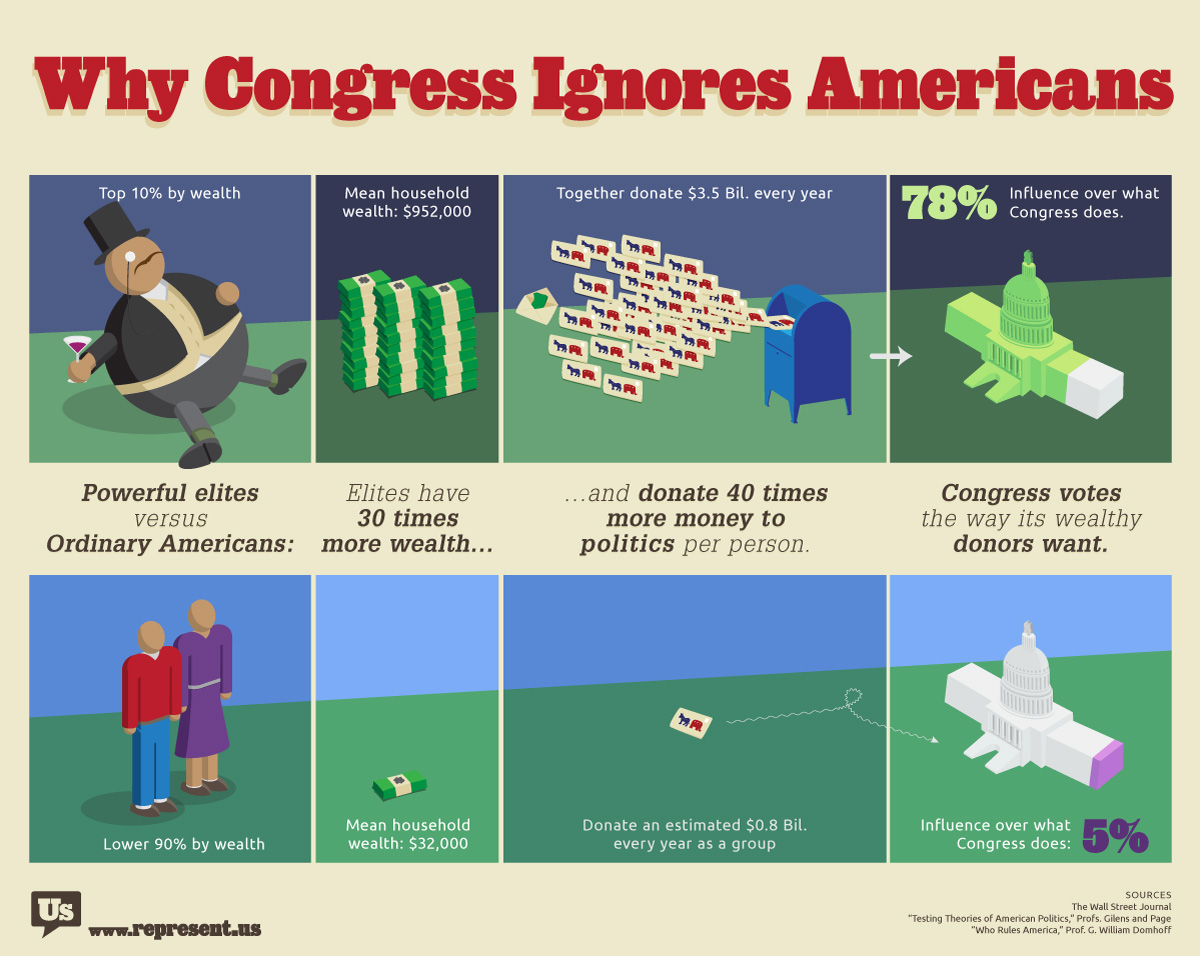
In a global economy, where we are all citizens of the world, wealth inequality is becoming the most important division of all, threatening political stability and driving up social tensions. The wealthy elites, not content with merely controlling vast fortunes, are now concentrating their efforts on controlling the political process of many free world countries, in an attempt to rig the rules in their own favour.

Oxfam executive director, Winnie Byanyima cautioned that people around the world believe that the rich have too much influence over the direction their country is heading.

WealthDisparity“In developed and developing countries alike we are increasingly living in a world where the lowest tax rates, the best health and education and the opportunity to influence are being given not just to the rich but also to their children.

“Without a concerted effort to tackle inequality, the cascade of privilege and of disadvantage will continue down the generations. We will soon live in a world where equality of opportunity is just a dream. In too many countries economic growth already amounts to little more than a ‘winner takes all’ windfall for the richest.”

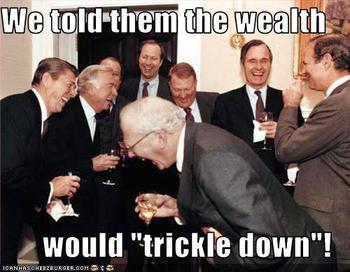
trickle_down_xlargeWe global citizens fear an oligarchy, and for good reason. The wealthy wield more and more political influence, allowing them to shape government policies in their favour. Faulty economic principles like the ‘trickle down theory’ have given the lowest tax rates to the rich in 29 out of 30 countries while personal taxes for the poor and middle classes have increased.

world citizenWe can no longer be silent when we see inequality or injustice, no matter where they are happening. “Where are you from?” is no longer applicable in a global village. The only question can be, “What are you doing to help change what is wrong with our society?”   

On a lighter note – here’s a link to my Sunday music column, at Bob Segarini’s “Don’t Believe A Word I Say” blog.

https://bobsegarini.wordpress.com/2015/01/25/roxanne-tellier-popping-the-top-off-covers/

Canada’s Heartaches by the Numbers


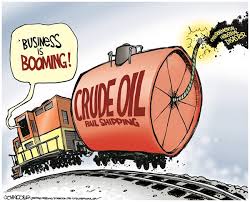
crude oil boomingOur dollar depreciated more than 2 cents on Wednesday, and is now worth .81 of the U.S. dollar, the lowest level since 2011. The Harper government put all Canada’s eggs in one basket by banking on North American crude oil, our top export, but the commodity has plunged from a high of $85 US a barrel in October of 2014, to a low of $46.US on Tuesday.

Finance Minister Joe Oliver announced this week that he would be delaying his budget from the usual February-March date until at least April, due to “market instability.”

Unable or unwilling to admit Canada’s damaged economy, Prime Minister Stephen Harper told reporters yesterday that “These things are creating some shocks that will impact us but they’re not going to throw us off our fundamental growth path or undermine the very strong fundamentals of the Canadian economy.” He added that “The government has complete confidence in the Bank of Canada in the actions that it has taken.”

The Bank of Canada cut the rate on overnight loans between commercial banks by a quarter point to 0.75% on Wednesday, in a response to the recent drop in oil prices. The previous rate had been at 1% since September 2010.  market failure

“The drop in oil prices is unambiguously negative for the Canadian economy. Canada’s income from oil exports will be reduced, and investment and employment in the energy sector are already being cut,” BoC’s Governor Stephen Poloz explained.

Many, including NDP finance critic Nathan Cullen, think Harper is in denial. The Conservatives had hoped to sail into 2015 on a high of oil fumes and the elimination of the$2.9-billion federal deficit , but it looks like their plans may be tanked as predicted federal tax revenues could be reduced by several billions of dollars thanks to global oil price shake-ups.

No worries, though, as Harper is relying on the annual $3 billion contingency fund built into the budget for “unforeseen circumstances.”

He also said that “The oil industry isn’t remotely the entire Canadian economy.” So … what is the Canadian economy?Canadian economy

Our population of 36 million boasts a 6.6% unemployment rate, with approximately 62% employed (16-64 years of age). (The United States, with 316.1 million, is at 5.6% unemployed, and 59.2% employed, while the United Kingdom, with 64.1 million people, has an unemployment rate of 6.0%, and 73% of people are employed.)

In Canada, wealth inequality, while an issue, is not quite as visible as in America; our Canadian 1% holds 12.5 per cent of Canada’s total income. 29 per cent earn $135,000 or more. But our incomes are generally lower – 95 per cent of working Canadians earn less than $100,000 a year. Our definition of ‘wealthy’ begins at $150,000.00 per year – chump change for wealthy Americans.

One of the reasons Canadians have not felt as impacted by wealth inequality is that, beginning in the late 1970’s, women surged into the workforce in record numbers. A household with two incomes could manage quite well. With the inclusion of children into the family, however, things got shakier financially. If one of the two wage earners has to stay home with the kids, they’ve effectively halved the family income, in order to raise children and run the home. As baby boomers aged, that child care burden lifted for a large portion of the middle class.

canadian workforceEducation, and it’s inevitable costs, are a factor. In order to succeed in a technological society, we need workers with complex skills and higher education. 64.1% of adults aged 25 to 64 had post-secondary qualifications in 2011, with women aged 25 to 34 holding a larger share of university degrees. 8 in 10 Registered Apprenticeship certificates were held by men.

In 2011, Almost two-thirds of adult Canadians had post-secondary qualifications, Stemwhile 2.1 million adults had a post-secondary certificate, diploma or degree in STEM (science and technology, engineering and engineering technology or mathematics and computer sciences) but half of STEM university degrees were held by immigrants who have lived in Canada for many years, and Canadian newcomers.

waiterUnfortunately, Canada has the third-highest proportion of low-paying jobs in the world, with only the U.S. and Ireland having a higher percentage of low-paying jobs. Canada is becoming a ‘nation of part-timers’; part-time employment may still outgrow full-time employment for some years as the baby boomers reduce their working hours or retire.

But the big, well-paying manufacturing companies have left Canada to take advantage of lower labour costs abroad. What’s left for those with or without special skills are low-wage service and retail jobs, which generally lack the benefits associated with higher paying positions, and are becomingly increasingly insecure.

StatsCan released this information in January 2015:statscan

In December (2014), Canada lost 4,300 jobs as full-time employment rose by 53,500 while there was a decline of 57,700 in part time jobs… Employment gains in 2014 amounted to 186,000 (+1.0 percent), with increases in the second half of the year accounting for most of the growth. Compared with 12 months earlier, the total number of hours worked increased by 0.7 percent.”

“There were 24,000 fewer women aged 25 to 54 employed in December. Their unemployment rate was unchanged at 5.2%, as fewer of them participated in the labour market. Employment among men aged 25 to 54 increased by 23,000 in December and their unemployment rate declined 0.2 percentage points to 5.5%, their lowest rate since 2008.”

This month, however, it was announced that five large retail companies will be closing Canadian operations. Lured to Canada by massive tax breaks, cuts and incentives, they’ll be leaving more than 21,000 unemployed by March or April.

Stephen-Harper-CowboyIn Alberta’s tar sands, Suncor cut 1000 jobs last week as oil prices crashed. They also announced that they’d decrease their capital spending program by a $1-billion, and reduce operating expense s by another $200 million.

Canada’s largest growth sector in jobs has been in service and retail industries. Only Alberta has seen respectable job growth. Mr. Harper’s blithe suggestion that the current oil crisis will fail to impact the economy as a whole, sounds very much like a man whistling past the graveyardcanada bleak future

Update Jan 24/15: Last week on Global TVs The West Block, Jason Kenny (MP, Canada’s Minister of Employment and Social Development and Minister for Multiculturalism) told host Tom Clark, “We won’t be using a contingency fund. A contingency fund is there for unforeseen circumstances like natural disasters.”

But during an interview for this week’s episode of The West Block, Canada’s Finance Minister, Joe Oliver told Tom Clark, “The contingency fund is there for unexpected and unavoidable shocks to the system and, you know, the oil price decline – which was a dramatic one – would fall in that category. I’m speaking as minister of finance so I’m sort of current on the thinking here.”

Use Your INSIDE Voice, Please!


debate shoutingI have a few well-meaning friends who think that I would be just great if I would only listen and agree with their viewpoints, and the people who share their beliefs. I’m always willing to listen to well-reasoned arguments – that’s how we learn and grow – but I have a real problem with some of the people who feel the way to reason is through shouting down other voices.

The loudest voice in the room is not necessarily the most right – but it is always the rudest.

oreilly shouting memeI can’t watch Fox TV’s Bill O’Reilly, for instance, ‘debate’ with any of his dissenters. Not only is his belligerence insulting to those he is supposedly giving a public forum, but it’s unseemly, as it is actually his show, run by him and those who are paid to make sure O’Reilly is heard. Perhaps the most telling thing about O’Reilly’s interviews – which he inevitably claims to have won – are the people he and his network will NOT allow on “The O’Reilly Factor,” for fear that, even with Bill’s louder voice, they will actually show O’Reilly’s opinions up for the smug, over-bearing and self-entitled views they actually are.

In this article, O’Reilly is once again shown as a master manipulator of his own image.

http://mediamatters.org/blog/2015/01/21/bill-oreilly-lies-about-his-role-pushing-debunk/202207

“O’REILLY: All right, we got a minute. The mayor of Paris, Anne Hidalgo, said she’s going to sue Fox News for reporting on so-called no-go zones in Paris. They’re dominated by Muslims and police hesitate to go in there — at least that has been the reportage in some places. I didn’t have anything to do with this. But I will point out that the mayor is a socialist.”

I’veno sense of humour increased self importance become rather inured to O’Reilly’s entitlement and self-satisfaction, but I have to admit, this next clip made me laugh.The man is so convinced of his own self-worth that he played this video on his show, and ‘joked’ that he should have taken top place. Maybe he and Nancy Grace can arm wrestle for the spot.

ush-limbaugh-handsRush Limbaugh has been an American commentator since 1984, mercilessly criticizing what he considers a liberal bias in politics and policies on main stream media. He’s also one of the highest paid talking heads in the U.S. media. A staunch, ultra-conservative Republican, he’s been praised by President Ronald Reagan (1992,) has won numerous awards, including the William F. Buckley Jr. Award for Media Excellence, and has even been named the 2014 Author of the Year for his book Rush Revere and the Brave Pilgrims: Time-Travel Adventures with Exceptional Americans by The Children’s Book Council.

rush limbaughHe also had this book written about him, which hit #1 on the New York Times Best Seller list in 1996. Franken has said that he chose to make the book’s title an ad hominen attack as “an ironic comment on the fact that Rush makes ad hominem attacks all the time.”” (Wikipedia.org)

And yet – The Rush Limbaugh Program is the highest-rated talk radio show in the United States. Only Howard Stern’s “Howard 100” show, netting a “cume” of 1.2 million listeners, comes close. On Limbaugh’s program, “For three hours every day, the program airs live and consists primarily of Limbaugh’s monologues, based on the news of the day, interspersed with parody ads, phone calls from listeners and a variety of running comedy bits (some live, some taped). Limbaugh also does live commercials during the show for sponsors. He sometimes promotes his own products, such as his political newsletter, The Limbaugh Letter. Occasionally, Limbaugh features guests, such as a politician or fellow commentator. A toll-free telephone number is announced for incoming calls from listeners. However, Limbaugh generally takes far fewer calls per show than most other national talk radio programs. (wiki.org)

His fans, known as “Ditto-heads,” are legion; his estimated listeners are believed to be more than 13 million per week. His opinions are deliberately controversial, and often racist or sexist. Callers who dissent receive the “Caller abortion” treatment. (Limbaugh’s term for disconnecting an unwanted caller, accompanied by the sound effects of screams, a vacuum cleaner and a toilet flushing) I guess that’s how you get the big money.

shouty manTalk Radio is big in Canada as well. But our talk radio tends to be confined to local areas, and be more locally focused. The two largest talk radio networks in Canada are CBC’s Radio One and the French language Premiere Chaine. However, we, too have our share of shouty men with fixed opinions.

On some of the call in shows, the host first reads a bit of current news, gives his opinion on the subject, and then opens the phone lines. Callers are screened, and, while our dissenters may be treated a little less rudely, other sides of an issue are rarely given much time. Over the course of the next several hours, callers who agree with the host grind down on the day’s subject, adding their own experiences, which are usually negative.

The problem with this is that, with no dissenting voices, it becomes a morass of “that’s terrible!” “I know, right? And it happened to me too … and even worse!” and several hours later you have a great number of people who have been stirred up about some tiny issue, and have nowhere to relieve their mental tension. It’s an exercise in negativity and a futile windup of people who were likely just having a normal day, until they were dragged into a group of people who had an axe to grind and bad experiences to share.

The listener has become part of the show; unhappy, angry, tense, their stomachs knotted … this can’t end well.

In a true dialogue, people talk rationally, and explain why they feel the way they do. Their passion does not have to be exemplified by a louder, dominating voice, because truth will eventually out, and ring truer than lies. The other person may not hear or accept your truth, but screaming your truth won’t affect how the other person believes. It just adds to a morass of anger, and a division of people.

debateWe have freedom of speech in Canada, and that, we rightfully defend. Our talk show hosts, just like the ones in the United States, have the right to say what they believe, and the technology to let listeners agree with their perspective.

I’m just asking that they try and keep their voices down so that I can hear what everyone is saying .. . not just the one’s with an agenda already in place, in a forum where those who disagree are summarily dismissed before their own freedom of speech can be exercised.

The Last Days of Ivory


elephant-with-babyImagine a world without elephants. There’d still be some in zoos,  but if illegal poaching is not stopped, all elephants in the wild could be extinct in just 11 years.

last days of ivoryOne elephant is killed – illegally by poachers – every 15 minutes; 96 a day; 33,792 a year. All for their tusks, which are then smuggled around the world, and sold at a profit. Those profits are then channelled to terrorist groups, who buy weaponry to kill and control others.

Renowned film director Kathryn Bigelow directed this very short film which outlines the connection between elephant poaching and terrorism. A PETA member, Ms Bigelow opted to use animation for the story, as she could not bear to see footage of live animals being tortured and killed.

But you don’t have to be a PETA member to know that the slaughter of animals is wrong.

https://www.youtube.com/watch?v=OHAGlPA8c38

The team of “Last Days of Ivory“ has a web page with more information and a call to action.

“Last year we were made aware of the very real connection between elephant poaching and terrorism. For us, it represented the diabolical intersection of two problems that are of great concern – species extinction and global terrorism. Both involve the loss of innocent life and both require urgent action.”

http://www.lastdaysofivory.com/

I know that it feels like every day is another day filled with bad news and hyperbole. We’re told that the world will end if the bees become extinct; that ocean life faces mass extinction before the end of the century; 2014 was the hottest year overall in the world in recorded weather history; earthquakes, tsunamis … it never ends.

Our minds are overwhelmed and fatigued by all that is in danger of being lost, and we feel unable to do anything to change the situation. So we ‘tsk tsk’ and carry on with our day.

But there are some things that are in YOUR hands. You can be a part of the solution.

end-ivory-funded-terrorism@2x“There are real things we can all do to stop wild elephants from disappearing from our world while cutting off funding for some of the world’s most notorious terrorist networks. This site is here to help you convert your anger, your sadness and your compassion into action. Use it!”

Elephants2“Elephants are among the world’s most intelligent species. The elephant’s brain is similar to that of humans in terms of structure and complexity—such as the elephant’s cortex having as many neurons as a human brain, suggesting convergent evolution. … Elephants exhibit a wide variety of behaviours, including those associated with grief, learning, allomothering, mimicry, play, altruism, use of tools, compassion, cooperation, self-awareness, memory, and language. Further, evidence suggests elephants may understand pointing: the ability to nonverbally communicate an object by extending a finger, or equivalent. All indicate that elephants are highly intelligent; it is thought they are equal with cetaceans and primates in this regard. Due to the high intelligence and strong family ties of elephants, some researchers argue it is morally wrong for humans to cull them. The Ancient Greek philosopher, Aristotle, once said that elephants were “the animal which surpasses all others in wit and mind.” (Wikipedia.com)

happy-elephantThere are so many good reasons to care about these big gentle beasts. Spare a moment and share this information with anyone who has a heart.

Martin Luther King Day


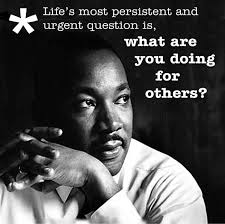
what are you doing for othersInjustice anywhere is a threat to justice everywhere. We are caught in an inescapable network of mutuality, tied in a single garment of destiny. Whatever affects one directly, affects all indirectly. Never again can we afford to live with the narrow, provincial “outside agitator” idea.”   (Martin Luther King Jr. ) 

Today, Americans observe Martin Luther King Jr. Day. It’s a federal holiday, so many people will enjoy a long weekend, with schools, banks, courts and all federal offices closed.

King was the inspiration of millions, being integral to the Civil Rights Movement of the 1950s and ‘60s. During the 1963 March on Washington, he gave hope to all who felt less than free in America with his uplifting “I Have a Dream,” speech which earned him a reputation as one of the greatest orators in American history.

https://www.youtube.com/watch?v=smEqnnklfYs

rosa parks quoteIn 1964, then President Lyndon B. Johnson signed the landmark Civil Rights Act that outlawed discrimination based on race, color, religion, sex, or national origin. That same year, King received the Nobel Peace Prize for combating racial inequality through nonviolence.

King was planning a national occupation of Washington, D.C., to be called the Poor People’s Campaign, when he was assassinated by James Earl Ray, in Memphis, Tennessee, on April 4, 1968.

“We know through painful experience that freedom is never voluntarily given by the oppressor; it must be demanded by the oppressed.” (MLKjr)

After his death, he was awarded the Presidential Medal of Freedom and the Congressional Gold Medal. Soon after, labour unions in contract negotiations began to campaign for a holiday, Martin Luther King Jr. Day , in his honour. In 1971, the day was established as a holiday in numerous cities and states

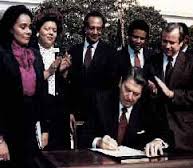
reagan signs MLK dayPresident Ronald Reagan signed a bill designating the third Monday in January to honour King in 1983, but it was not observed until three years later. It is a floating holiday, in that it is celebrated around the time of King’s birthday, January 15. In 1986, the day became a U.S. federal holiday.

Interestingly, Reagan originally opposed the holiday, citing cost concerns.

jesse_helmsSenators Jesse Helms and John Porter East (both North Carolina Republicans) led opposition to the bill and questioned whether King was important enough to receive such an honor. Helms criticized King’s opposition to the Vietnam War and accused him of espousing “action-oriented Marxism” Helms led a filibuster against the bill and on October 3, 1983, submitted a 300-page document to the Senate alleging that King had associations with communists. New York Senator Daniel Patrick Moynihan declared the document a “packet of filth”, threw it on the Senate floor and stomped on it “ Wikipedia.com)

In 1994, Congress designated the King Holiday as a national day of service. But some states resisted observing the holiday, an action that would seem directly opposed to King’s ‘dream.” It was not until 2000 that the day was officially observed in all 50 states.

Many politicians still active in government today voted against the holiday. In October 1983, Senate Judiciary Committee Chairman Chuck Grassley of Iowa and Senate Finance Committee Chairman Orrin Hatch of Utah, former GOP presidential nominee John McCain of Arizona, and Richard Shelby of Alabama, were amongst the 22 opposing votes against 78 Senators in favour, along with the current House Appropriations Committee Chairman Hal Rogers of Kentucky, and current top Republican advocate in defense of the Voting Rights Act, Rep. Jim Sensenbrenner of Wisconsin.

steve scaliseMajority Whip Steve Scalise, a Republican from Louisiana, voted twice against a state version of the holiday. Which is not surprising, considering that it has recently become known that Scalise delivered a previously unreported speech at a 2002 conference sponsored by a white-supremacist group. He was one of three Louisiana statehouse members who voted against the proposal in 1999, and then one of three nay-sayers in 2004.

supreme court“The U.S. Supreme Court ruled 5-4 in June 2013 that a key provision of the 1965 Voting Rights Act designed to prevent racial discrimination in certain voting laws was no longer necessary. The majority opinion, authored by Chief Justice John Roberts and joined by Justices Antonin Scalia, Anthony Kennedy, Clarence Thomas and Samuel Alito, stated that “things have changed dramatically” in the South and that the “country has changed” since the Voting Rights Act was passed. The court argued the law had successfully defended against discrimination, but was no longer needed. Racism, the court majority appeared to suggest, was over, and laws created during a time when such hatred was in its heyday served now to place unjust “burdens” on certain states and jurisdictions that wished to pass new voting laws — laws, of course, that had nothing to do with trying to suppress minority votes. “ (Huffington Post)

“An unjust law is a code that a numerical or power majority group compels a minority group to obey but does not make binding on itself. This is difference made legal. By the same token, a just law is a code that a majority compels a minority to follow and that it is willing to follow itself. This is sameness made legal. Let me give another explanation. A law is unjust if it is inflicted on a minority that, as a result of being denied the right to vote, had no part in enacting or devising the law.” (MLKjr)

And so today, Americans celebrate a holiday honouring a man instrumental in the creation of the Civil Rights Act that outlawed discrimination based on race, color, religion, sex, or national origin, while SCOTUS – which consists of a non-elected Chief Justice of the United States and eight associate justices who are nominated by the President and confirmed by the Senate for life tenure “unless they resign, retire, take senior status, or are removed after impeachment (though no justice has ever been removed)” (Wikipedia.org) – dismantle that act to protect the very states that impelled it’s necessity.

“How does one determine whether a law is just or unjust? A just law is a man-made code that squares with the moral law or the law of God. An unjust law is a code that is out of harmony with the moral law. To put it in the terms of St. Thomas Aquinas: An unjust law is a human law that is not rooted in eternal law and natural law. Any law that uplifts human personality is just. Any law that degrades human personality is unjust.” (MLKjr)

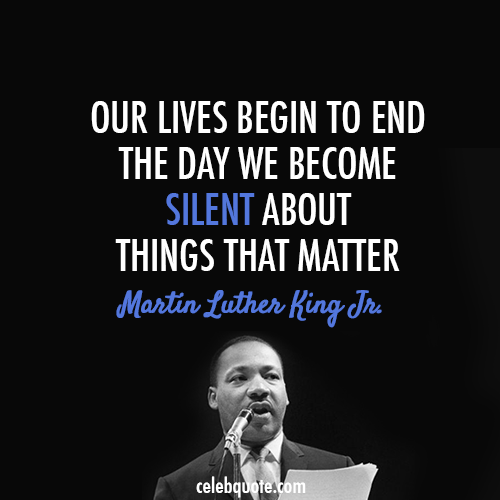
martin-luther-king-jr-quotes-silenceKing’s words ring as true today as they did in this 1967 speech he gave at Stanford University. The “Other America” still exists, and will continue to do so until more people, universally, demand social equality and human rights for all.