To Boldly Go …


Thintelligence: “The state of mind where a person does something without considering the consequences. The idea may seem brilliant at first, but the after-affects usually prove to be deadly. This phrase was invented by Michael Crichton in his 1990 book Jurassic Park.

JurassicPark glasses

“They don’t have intelligence. They have what I call ‘thintelligence.’ They see the immediate situation. They think narrowly and call it ‘being focused.’ They don’t see the surround. They don’t see the consequences.”

While it might be possible to reanimate a dinosaur from it’s DNA, what real purpose would that serve in a world where a dinosaur would be just another endangered species?

Most of us are eager to jump on hot new technologies that promise to improve how we experience our lives, while rarely considering what the lasting effect might be on current technologies. The invention of the car put an end to all of the industries previously surrounding the care and comfort of horse drawn carriages. obsolete techDigital photography killed most of the industries that provided material to those who preferred film. Cassettes replaced vinyl, and then were themselves replaced by CDs.

If it’s new, it’s cool, and we can afford it … we want it. Now.

This is the world we have created, bit by bit, as we embrace what science and technology have helped to provide for our entertainment.

Without realizing it, and without ever technically agreeing to these changes, we have slowly awoken to a world that greatly differs from the world in which we once lived. Most of us just buy into whatever becomes the new standard. How we live within our world subtly alters, and we barely notice.

When I was a young woman, social contact with other people was my primary focus. When I couldn’t be with friends, I had a slew of hobbies to keep me busy. Now, I can’t remember when I last pursued any of those crafty pastimes.

And I honestly can’t remember ever being ‘bored.’ Oh, I’m sure there might have been an instance or two before I discovered boys and booze, but overall .. nope.

I don’t see friends nearly as often as I used to, these days, even though I probably have more free time now than I ever did then. It’s just so much easier and more convenient to keep in touch through social media.

That loss of face to face, hand to hand, contact has had an affect on how we see and treat others. We are quicker to make judgements about other people, for good or ill, and less empathetic to those outside of our social bubbles.

Those tiny steps from there to here were imperceptible. Those of us who now rely on a tablet sized phone to corral all of our communication and computing needs hardly remember the consumer uncertainty and fear that surrounded the advent of the first personal computers.

first pcEarly adapters eagerly coughed up the cost of a new car to have one of the ungainly machines in their home. But for the average consumer, it would be a good twenty years before a home computer became commonplace.

Today’s teens can’t remember a time when they weren’t tethered to their phones. They barely spare a thought for their ability to be in constant contact with anyone, anywhere in the world, and to the informational capability of their device.

UN human rightsIn fact, this access to knowledge has become so universally accepted that the United Nations have now decreed internet access human right, up there beside food, water, and freedom of speech.

Knowledge is Power.” At one time, only the educated and the rich had access to the amount of knowledge now available to every one of us with the desire to be taught, and an internet connection. From the most obscure bit of trivia to schematics for the creation of nearly every machine known to man, any one of us can be experts in as many fields as we wish to conquer.

Or we can watch funny videos of pets being shamed; it’s our choice.

The flip side of the process that lets us do price comparisons online is that it is the same means that allows terrorists, criminals, or sexual deviants, to find online communities filled with like minded, twisted, individuals, and gives them the freedom to access instructions for how to make bombs and other destructive weapons.

pros and consAnd the computer language that allows us to do our banking online is always under attack by those who would use computer made trojans and viruses as a way to steal our money and personal information.

This is the place where the future can be held hostage, in a struggle between the thintelligent and those who rightly wonder what horrors could potentially be unleashed by new technology.

Even the smallest of changes can impact directly on what our future will look like. You do, however, have to have an understanding of how fragile civilization can be, to see what devastation can occur when we fail to take into consideration the impermanence of our past achievements.

Those who would rather argue over who is responsible for climate change, rather than deal with the effects of that change, will suffer the consequences as horribly as those who can see that we have to alter how we treat the planet, or risk not surviving. Those who believe it’s better to put government and corporate resources into sucking out the last of the oil, wherever it can be found, and at a frightening cost to the planet’s ecology, are arch princes of thintelligence, unable to see the consequences of NOT buying into less aggressive and sustainable energy sources.

We are in a time of flux, just as we were when the first cars began to appear on the dirt roads, that would, in good time, become the highways we drive upon today. The biggest difference between the past and present is that we now communicate our words and thoughts much more rapidly. For some, this onslaught of possibilities is exciting; for others, a nightmare.

But we cannot halt the future. Those who vilify a good old daysworld that doesn’t resemble what they believe to have been better times, and who would tear down all that has gone before that doesn’t fit into their memories, be it governance or infrastructure, are naive, and dangerous.
Demolition may be exciting to watch, but the slow and back breaking labour necessary to rebuild can throw up roadblocks that may stymie future generations for decades.

And it takes a great deal more than bravado to create the future. Most of us simply don’t have the intelligence or ability to transform thoughts and words into architecture or proven science.

There’s a middle ground to be found and walked, one in which we honour what we have created, and look to the possibilities some visionaries have proposed. But always with a nod to the unforeseen consequences all change brings to the planet and it’s inhabitants.
Temptation Redux


Much as I have tried to pull together at least a preview of a project that I’m working on to share with you, it is not to be; there is much back burner simmering to be done before that column is ready to be savoured.

Hmmm… back burner simmering … sounds like something good to eat! Speaking of eating … here’s something I wrote in the Spring of 2013, and have revised and updated for your dining and dancing entertainment. Bon Appetit!

The Last Temptation

Mmm … food. Can’t live with it, can’t live without it. For some, food is a sensual pleasure, as delicious and desirable as sex. To others, feeding themselves is a chore; if they could, they would be content to fill their nutritional needs by swallowing a tablet.

Gourmet or gourmand? That is the question. I believe the essence of human sensuality is embodied in one who not only enjoys good food, but revels in all its glories; heaven on the palate, a visual treat, and a tactile experience. To me, there is little as delightful as a feast for both the eyes and the stomach. Good food, in all of its 3D wonderment, warms the cockles of my heart, quickens my breath, and eases the tensions of life.

Oh yes, I know. Everything in moderation, and if I ever figure out how to do that, I’ll get right on it! But the warring culinary DNA factors in my blood and heart crave lashings of French cooking, with a shanty Irish reliance on carbohydrates swimming in butter, and a British sensibility that encourages such brutal delicacies as steak and kidney pudding. I love food. pomegranateNo – I am in lust with good, honest, fresh, beautifully prepared, delicately seasoned, lovingly plated and brilliantly presented food.

I grew up when food was only available in season, and then just in the grocers for a very small window of time. Pomegranates, black cherries, tangerines … gifts from the gods! We snapped up these delicacies, pressed them to our breasts, and rushed them home to be enjoyed in the loving spirit in which they had been grown.

dragonfruitTimes have changed, and for the most part, I applaud the growers of the world, who now bring old favourites and new sensations to our tables and taste buds all year ’round. I approached my first Dragon Fruit with apprehension, but fell to its creamy goodness. I still have yet to cook an artichoke, so fearful am I of bruising its delicate heart. I weep for the people of South America, whose primary staple grain and protein, quinoa, has fallen afoul of North American foodies and vegans – their lust for this important protein supplement is now one of the two main causes of deforestation in Brazil.
Oh brave new world that has such wonders in it!

The flip side of this global food consciousness is, of course, the prolific rise of fast food – an abomination in my eyes – and the voraciousness of the gaping maws of people who apparently no longer have an OFF switch on their hunger. shopping nightmareA visit to the grocer the day before a holiday will have you convinced that we’ve just been alerted to an impending weather disaster, zombie apocalypse or nuclear holocaust. Carts crashing into each other, shoppers strip the aisles clean of all available food stuff like piranha. It is to weep.

Food has always been woven into our culture, enshrined in art, music and literature.

Today, trained and novice chefs compete for our attention in an orgy of food porn on their own television channels. From the likeable Jamie Oliver, intense and so well meaning, to the scatological ravings of kitchen madman Gordon Ramsey, to the ‘en garde!’ insanity of Iron Chef, or the folksy drawlings of now diabetic Paula Deen, you can scarcely spend an hour in the 500 channel universe without being reminded that you’ve not eaten in at least fifteen minutes.

nigella lawsonNigella Lawson is embraced and acknowledged as the courtesan of TV food; although neither a trained chef nor cook, her softly curving figure and clearly erotic attention to the food she prepares seduces the viewer into a relaxed and loving appreciation of goose fat and Riesling.

But it is in classic film that the connection between food and sensuality is best exhibited, in a veritable moveable feast.

In 1963, a lascivious dining scene in Tom Jones, of Albert Finney and Joyce Redman devouring a chicken, left movie goers gasping.

Or consider … Alan Bates describing the best way to eat a ripe fig in Women in Love (1969). Phew! “Like a prostitute, the bursting fig makes a show of her secret.”

In 9 ½ Weeks, Kim Basinger and Mickey Rourke played sensually with jello, pasta, grapes, cherries and strawberries and the surprise of an jalapeno until her face was sticky with juices and she begs, with mouth agape, for more. Not very subtle, but very effective.

Babette’s Feast, (1987,) a film based on a story written by Isaak Dinesen, showed the healing properties of glorious, delicious food on a religious community divided by fear of strangers. Big Night, (1996,) Stanley Tucci’s film about a New Jersey restaurant, exalted in the remarkable healing powers of a shared meal.

Is there a right way to eat ramen, that glorious noodle soup? Why yes – and Tampopo (1985) showed us how to give respect to the ingredients. “Appreciate its gestalt. Savor the aromas. Jewels of fat glimmering on the surface. Schinachiku roots shining. Seaweed slowly sinking. …” More than a haiku to the food, it is total appreciation. There’s also a nod to drink, with the sipping of sake from a woman’s navel.

“Leave the gun. Take the cannoli.” Goodfellas –  a celebration of food! “Pauly … had this wonderful system for doing the garlic. He used a razor, and he used to slice it so thin that it used to liquefy in the pan.”

La Grande Bouffe is nothing more than a story of four friends who set out to eat and screw themselves to death in the French countryside. I’ll spare you the visuals on that one. Nor will I include scenes from the shocking waste of butter in Marlon Brando and Maria Schneider’s romp in Last Tango in Paris. Butter aficionados will find it on their own.

No Reservations (2007), starred Catherine Zeta-Jones as a sexy chef who made her puppy dog underling sit up and beg for treats.

You’ll never feel the same about quail after watching this scene from Like Water for Chocolate (1993) Tita uses her suitor’s gift, seasoned with her blood and longing, to make quail in rose petal sauce. Her passion is communicated through the delicious food to Pedro, her potential lover, while her haughty mother dines in salty disapproval. Eventually, her heat causes an outhouse to erupt into flames.

In the similarly themed Chocolat (2000), Johnny Depp and Juliette Binoche enjoyed the magic of lovingly handmade chocolate candies. In Woman on Top (2000) Penelope Cruz, playing a chef, has phallic-looking chilli peppers rubbed on her lips.

You remember the shimmering, shadowed, shower, but do you remember Jennifer Beals devouring a lobster tail in the seduction scene in Flashdance (1983) ?

A full menu of films that piqued our appetites would leave us overstuffed, so I’ll stop there.

We all hope to age gracefully and beautifully, like a fine wine. But many of us will eventually come to the point where, for health or dietary reasons, we can only look longingly at a delicious spread, and whimper into our hands.

harvest.jpgAs harvest time nears, and before political correctness, weight gain, national health, and propriety wipe these elemental pleasures from our memories, bite into a ripe strawberry, bury your nose into a bushel of fresh tomatoes, nibble at the edges of a freshly cut pastrami or hold a mouthful of champagne against your taste buds, reveling in it’s effervescence.

And raise a glass and a fork to one of the most basic and natural joys of living … the enjoyment of food!


Mid August


Mid August, and most days I feel like, this year, summer never really got started. Maybe it’s the weather, or the political climate, but something feels off-kilter. My potted veg and herbs are in shock; it’s been either torrential rain or temps in the 90s – sometimes in the same 24 hours – every day since they were planted. Sodden pots sit cheek by jowl with containers so arid they threaten to burst into flame. There won’t be much of a harvest this year.

Mid August, and the back to school sales have started. Being an eternal student at heart, I always get really excited about 3 ring binders, coloured pencils, pencil cases, and the like. Which is probably why I have about ten boxes in storage of said items. I’m a victim of stationery covetousness.

The kids playing on the block look like they’re done with summer. Perhaps they are apprehensive about returning to the restrictions of another year of school, of seeing if their old friends have changed, and of having to meet new people who may be friend or foe. Or maybe they’re just caught their parents’ malaise. Either way, the little girl that pushes the doll stroller up and down the street while wearing her mother’s high heels just doesn’t seem to have as much enthusiasm for the task these days.

Mid August, when we postpone the reality of the coming chill with a two week, overheated, ExTravaganza! Yes, the CNE began on Friday, with Burton Cummings and the boys kicking it off with their usual flair.

CNE midwayThe Ex holds less appeal for me every year. I’m still mourning the loss of the Alpine Way, and my ears still keen to hear the dulcet tones of the barker demanding that we come to see the “Gorilla Gorilla Gorilla GURL!”

It’s all downhill after the Gorilla Girl leaves. I can’t even be motivated by fried chicken feet.

Mid August, and news that the legendary recording studio, Le Studio, in Morin Heights (about 90 kilometres north-west of Montreal,) has been destroyed by fire, possibly arson. This, coming just a week or two after news that a successful GoFundMe project had enabled musician Richard Baxter to begin renovating the old girl with a team of volunteers.

Founded in 1974 by Quebec record producer Andre Perry, the studio and residence was once the ‘go to’ spot for Canadian and international artists, including Rush, the Police, the Bee Gees, Sting, Roberta Flack, Cat Stevens, David Bowie, April Wine, Keith Richards and the Ramones.

But not me. I never even had the pleasure of visiting the place, which was a pity, because I spent some pretty formative years in the area as a teen. I’ve always liked to tell myself that Le Studio was built on the site of the old Alpino Lodge. I neither know nor care if that is true.

In the 60’s, my friend Marianne and I would camp by the little lake that wound it’s path around and about the Alpino, babysitting her younger brother, fishing for our food, and generally waiting for the weekend to arrive and the party to start. Those were the days when it was not only possible for a couple of 14 year old girls to be abandoned in the woods for a week at a time, near a lodge that catered to the wealthy and the jaded, with only an eight year old boy as companion and protector, but for said kiddies to not only survive, but thrive, and indeed have a very merry time.

true romance magWhat did we do all day, I asked myself recently. How did we fill all of the hours when we weren’t minding the brat, fishing, picking berries, tending the smoky fire, or reading soggy comic books and True Romance magazines? Mostly we talked, for hours at a time, about our dreams, hopes, and fears. Some days, I’d make Marianne laugh so hard that she’d pee her pants. If I was in a mood, I’d keep it up until her week’s worth of undies were all strung up on nearby branches.
And we’d wait for Friday night. On Friday night, Marianne’s mother and boyfriend would arrive from Montreal, bringing supplies, and freeing us from babysitting duties. On Friday night, we’d clean ourselves up as best we could, and present our under aged selves to the Lodge, where the full spectrum of Morin Heightians, converged for an evening of dancing and drinking. No one frowned on a young woman or man dancing with an older woman or man, or even a man dancing with another man. The point was the dance, the movement sparked by the music of a local combo giving it all they’d got. And no one asked for i.d.

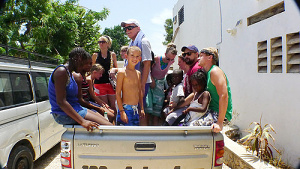
When the night’s entertainment packed up, the teens that had been slouching on the lodge’s porch, smoking home rolleds and doobies that they would light with a wooden match struck on a boot sole or a pant zipper, would all pile into the back of some sixteen year old guy’s pickup truck. We didn’t need no steenback of pickupking seat belts! And off we’d go, the gang of us, with maybe a dog, and a musical instrument or two for company, headlong down the steep road, high as kites, heading for the dam so that we could continue the revelry, at least until the purple micro dots wore off and/or the sun came up.
(My daughter told me recently that she’ll not allow her eight year old daughter to walk the two blocks to school by herself until Kay’s about twelve. Or maybe thirteen. And then, only if there’s a friend nearby who’ll walk with her. In the daytime. Two blocks away. Different times.)

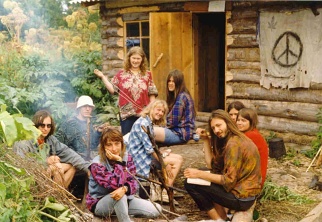
Mid August, and many of my friends are celebrating the fiftieth anniversary of the Summer of Love. I remember schoolmates who got caught up in the hoopla and abandoned the city for hippie dreams, disappearing in a puff of smoke and patchouli, heading for communal farms that put the lie to the middle class dream of suburbia and two car garages. hippies 60s communeI wonder what ever happened to Donna, the dreamy blue eyed beauty that loved the Monkees as much as I did, but chose a hardscrabble life mucking out barns instead, determined to stand by her longhaired, drug dealing, man. Is she still living in rural Canada or America, amidst macrame pot holders and peace symbols? Or did she wake up one morning and realize in a horror stricken panic that she could have been and done anything she wanted to, had she chosen differently?
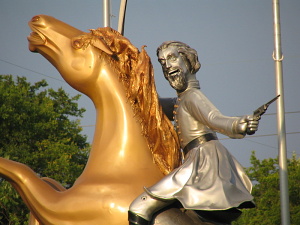
Mid August, and my flabber is still ghasted when I contemplate the summer madness that allows some, in the U.S., and sadly, even in Canada, to agree with Trump that the removal of these ‘beautiful’ statues erected to honour Confederate generals would be a hardship upon those who might not otherwise have the opportunity to see such ‘works of art.’

Can you hear the dog whistle in that observation?

ugly confed statueBecause, it is implied, even if the art is not Louvre-worthy, that people of colour, and the inner city poor, should at least have the opportunity to feast their eyes upon such statuary. That the monument honours a man in support of slavery and a slave trade that treated the park’s attendees ancestors as human cattle, is a mere peccadillo in their eyes.

A year ago, Zyahna, a young, African-American resident of the city of Charlottesville, petitioned for the removal of one such statue, and to have the park she and her friends frequented re-named from Robert E. Lee Park to Lee Park, saying, “I am often exposed to different forms of racism that are embedded in the history of the south and particularly this city. It makes us feel uncomfortable and it is very offensive.

When I think of Robert E. Lee I instantly think of someone fighting in favor of slavery. Thoughts of physical harm, cruelty, and disenfranchisement flood my mind. … I am offended every time I pass it. I am reminded over and over again of the pain of my ancestors and all of the fighting that they had to go through for us to be where we are now. Quite frankly I am disgusted with the selective display of history in this city. There is more to Charlottesville than just the memories of Confederate fighters. There is more to this city that makes it great.

Let’s not forget that Robert E. Lee fought for perpetual bondage of slaves and the bigotry of the South that kept most black citizens as slaves and servants for the entirety of their lives. As a result, legislatures of the south chose to ignore and turn a blind eye to the injustices of African Americans from Jim Crow and anti-black terrorism to integrated education. These are all some things that this statue stands for. It is about more than just an individual, but rather what that individual believes in and the things that he stands for.”

In 2016, the petition fell just 270 supporters short of it’s goal of 1000 in concurrence with her appeal. A year later, the city council did indeed agree with young Zyahna, putting into motion a series of events that would ultimately lead to the death of one young woman, and two police officers.

bread and circusesMake no mistake; the decision to remove the statue was a democratic decision. The reasoning behind the removal was sound, fiscally conservative, and sensitive to ALL of the residents of the city, not just those who wanted it to remain.

The only ones incensed by the decision were those who continue to believe that the emotions and history of white Americans are innately superior to those of other colours. Even the sidestep, that defends the artistry of the statues while denying the inherent racism implied, revolves around the right of white Americans to continue fawning over defeated, racist and bigoted leaders over the sensibility of those who were physically, emotionally, and financially damaged by those same leaders.

“Two things only the people anxiously desire — bread and circuses.”

Will this cataclysmic rift in ideology tear the country in half, ending in a Civil War Part Deux? And, more importantly for we in the North, as we read the words of many Canadians on social media agreeing with this cockeyed rationale for racist ‘art’, is Canada moving relentlessly towards a similar, more openly racist and bigoted point of view?

Mid August, and it’s never felt so much like that black day in July, 50 years ago …


Blackberries and Entitlement


There is a very nice house on the corner of my street. The back yard is surrounded by a tall fence, but as you walk by, you can peep through, and see that there is a lovely garden inside, with a deck, and a nice patio seating area. It’s all very well kept and tidy.

Plants peek out through the fence, as plants will. There are some flowers, and a few weeds, and some of those long, brambly, blackberry stalks, the sort that seem to go from manageable to ‘ow! that long branch just scratched my arm!” in a matter of seconds.

blackberry bushA few months ago, the blackberries appeared. Blackberries start out red and inedible. It’s not until they turn black that they become tasty. There is usually about one week in the summer when the berries all hit peak perfection simultaneously. At my old house, I had a wall of blackberry bushes. When they were ready to pick, I would go into hyper drive, trying to get as many of the berries harvested as I possibly could, so that I could make a summer jam. I’d also offer my neighbours some of the bounty. And, inevitably, the birds, squirrels and raccoons would have a messy feast as well.
The first sighting of the blackberry plants escaping the fence on the corner house gave me a little frisson of emotion, a combination of happiness at seeing the familiar fruit, and a twinge of sadness at no longer having my little Scarborough fruit and veg garden. Planting in containers just isn’t the same.

Halfway through July, the magic moment arrived, and suddenly the branches bent low with beautiful, glossy black berries.  I’m sure I wasn’t the only passer-by that helped herself to a berry or two when I walked by the house. The branches were, after all, bordering the sidewalk, and just a tiny portion of the plants that lined the inside of the fence.

The day after the appearance of the berries, a small sign, written in crayon, and in a child’s handwriting, appeared on the fence. It said, “Please don’t pick the berries. Thank you.”

depressed personNow, perhaps my chagrin at seeing that sign stemmed from a desire to be inside the fence, gobbling down handfuls of the berries before harvesting a bushel or so for jam making.

But the first thought that crossed my mind was that someone had missed a wonderful opportunity to teach a child about sharing and responsibility. Since the home owner had allowed their plants to cross over into common ground, the berries were, ostensibly, now to be had by anyone who passed by the branches on their way down the street.

And if someone picked a berry and enjoyed it, that was a way of spreading the wealth, so to speak, without having to make any real effort. A way to allow others to enjoy a little treat, without that gift costing our benefactors any loss or stress. You  might not know who enjoyed that pleasure, and they might never know that it was you that let them have it, but there can be a strange, inner joy that comes from simply giving away some of the surplus of what you have.

Instead, the parents of that child taught her that she needed to keep a firm grip on what she ‘owned,’ even if that ‘property’ wasn’t actually contained within its bounds.  Best to assume that others will take things away from you, if you’re not stern and disciplined, and keep a firm grasp on your ‘stuff.’ And if you don’t tell them to back off, they’ll take and take and …oh!

i've got mineThat’s a weird and ugly paradigm that many live by now; the world of “I’ve got mine, and I’ll fight anyone that tries to get some for themselves!”
That’s the mindset of those who are threatened by anyone else enjoying even a sip of life’s cup, since it is a sip they feel to be taken from their own mouths. It’s what people earning a comfortable living feel like when they hear the minimum wage might be raised so that others with more menial jobs can actually afford to live. And it’s the way that many Canadians feel when they hear that there is a cost to ignoring the civil rights of other Canadians, and in the resentment they feel when the courts actually have to shell out millions to pay those costs to the victim.

It’s in the self-righteousness of the outwardly religious who piously mouth the Lord’s Prayer, but deny Christ’s preaching to love everyone as he loved them, and to treat others as they wish to be treated.  It’s in those who would put the possible cost of healthcare for transgendered people in the military over a respect for those peoples’ basic rights, as they spend their lives in the defence of their country.  It’s even in the behaviour of the driver who feels the need to be in constant touch by telephone entitles him or her to break the law and answer their cell phone while zipping down the highway at 140km an hour.

It’s a selfishness and entitlement that can be seen daily, on the streets, and in the houses of corporate and political power. The real trickle down that we’ve seen over the last few decades hasn’t been the money that the rich and powerful never did let fall on the lowly, but the examples that they’ve shown us, of how disrespect, lying, and a lack of accountability can enrich those who simply don’t care about anyone other than themselves.

We want to celebrate those who have stood on the shoulders of giants, but instead we are too often and too loudly confronted by those with feet of clay, who prefer to stand on the throats of the weak.

“If I have seen further it is by standing on the shoulders of giants.” Isaac Newton.

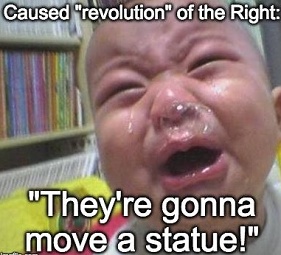
baby crying over statue removalNowhere was the inevitable down slide of perverted entitlement seen more clearly than in this weekend’s parades, protests, and riots in Charlottesville, Virginia. Far-right activists descended upon the city for a Unite the Right rally against the removal of a statue of Confederate leader, Robert E. Lee.

In April, the Charlottesville City Council voted to sell the bronze statue that stands in downtown Charlottesville. The city council also unanimously voted to rename Lee Park. However, two members of the five-member city council still voted against removing the statue. In May, a judge halted that removal for six months.

For those playing along at home, Lee was the general who lead the charge of the Confederate Army, in defence of slavery, against the prevailing American forces of the time. The Confederacy lost. The statue was commissioned in 1917, 52 years after the war ended, and was finally erected in 1924, 59 years after the war ended.

The march of the alt-right was composed primarily of young, white, decently dressed young men, who seemed to feel that their lack of melanin outweighed their concurrent lack of anything remotely special about themselves. Just having been born white and American has lead them to believe that they should have everything they feel they deserve in life – even if it means taking from others less fortunate.

Some are equating this all-white/alt-right protest to the Black Lives Matter protests. I would unequivocally disagree. One is a group seeking to elevate themselves socially by denying the rights of others, while the other is a traditionally oppressed group seeking their civil rights. Violent protests are wrong no matter who participates, but the messages are in no way equivalent.

“[…] I agree with Dante, that the hottest places in hell are reserved for those who in a period of moral crisis maintain their neutrality.” Martin Luther King, Jr.

A state’s leader that would qualify his objection to ‘hatred, bigotry and violence‘ by adding “on many sides” is no leader at all, but rather a fool who dog whistles to his bigoted and racist followers, egging them on to further violence, in a game of false equivalency.

“… there was strong reaction to Trump’s refusal to denounce far-right extremists who had marched through the streets carrying flaming torches, screaming racial epithets and setting upon their opponents.

The clashes started after white nationalists planned a rally around a statue of the Confederate general Robert E Lee that is slated to be removed, and culminated in a car being deliberately driven into a group of people peacefully protesting the far right rally, killing one person and injuring at least 19.”

Even those within his own party disapproved of Trump’s lukewarm response.

The Republican senator Cory Gardner of Colorado tweeted: “Mr President – we must call evil by its name. These were white supremacists and this was domestic terrorism.” This was echoed by Senator Orrin Hatch of Utah who lost a brother in the second world war. “We should call evil by its name. My brother didn’t give his life fighting Hitler for Nazi ideas to go unchallenged here at home.” ”  (The Guardian)

Despite the public disavowal of those who committed these offences, there were still many on social media who defended their racism by claiming that their protests are a reaction to what they see (the removal of a statue of a Confederate general) as a ‘direct assault against white people.”

Essentially, they are saying they’ll go to civil war to protect the past in an effort to avoid moving forward. The lives of those they harm are of no consequence; their actions say that their traditions and history are more important than the lives of other human beings.

charlottesville carThe Rebel staffer, Faith Goldy, was complaining about left-wing protesters not being inclusive, when she was interrupted by the killing of one of them, preserved on video as it happened.

The truth that must be said, that must be shouted and proclaimed, by not only the President of the United States but by all of his followers and sycophants, is that there is no equivalency between those who marched for their white rights, and those who had finally had enough of those who believe they can only be ‘equal’ if they are allowed to be superior to others through oppression. This was domestic terrorism, as deadly and frightening as any other sort of terrorism. The difference here is that this terrorism is being nurtured by other Americans.

White Americans, and especially young, white, male Americans, aren’t oppressed in the least. No one is trying to take their guns or Christmas away from them. Their churches are not being burned, and there are no burning crosses on the lawns of ‘whitey.’ No one is trying to take away their right to marry the person of their choice. They are under no worse of a travel ban than the need to remove their shoes before being allowed entry onto an airplane. No one feels so threatened by their very presence and colour that even the murder of a child walking home from school can be justified because someone ‘feared for their life.’ And there are no political groups so threatened by ‘the white demographic’ that they have to jury rig districts to ensure the right/white candidate is elected.

They don’t have grandparents and great-grandparents who lived through slavery and systemic racism that took from them even the hope of the prosperity of the average white American. Their parents weren’t imprisoned for marrying someone of a different colour, or for merely being mistaken for an actual criminal because ‘they all look alike to me.’

Racism and bigotry – that’s America’s real history and legacy. Great strides toward a more equal and civilized society have been made in the last several decades, but the actions of those who would ‘make America great again’ by ‘making America white again’ threaten to halt that progress, and tear the nation apart. It is only by accepting the ugly past, and learning from it, that a better future can be attained.

The willfully ignorant, those who are armed and dangerous to anyone who disagrees with their bigoted beliefs, who create their own echo chamber filled with half-truths and lies, are the cancer that will bring America to it’s knees.

America’s president has been very bold in denouncing global terrorism. It is apparently only domestic terrorism that keeps him silent.

What’s That In Your Pants?


If anyone had said to me, even a couple of months ago, that in July of 2017 the President of the United States would suddenly decree, apropos of nothing, and via Twitter no less! to “please be advised that the United States Government will not accept or allow Transgender individuals to serve in any capacity in the U.S. Military”  … I’d have snorted like an outraged donkey.trump trans tweet

What the lemon scented fart? If any further proof was needed that the POTUS is not only ignorant of the Constitution, civil rights and the year, his homophobic proclamation sealed the deal.

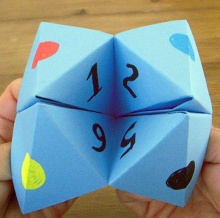
I get it. He’s 71, and possibly – no, make that probably – suffering from senile dementia and/or Alzheimer’s, and was never the hippest dude on the block even during his heyday, but this ridiculous knee-jerk revealed the ignorant, paranoid and prejudiced clod that somehow managed to fool enough of America to hit his Peter Principle pinnacle; the American paper fortune tellierPresident has reached the extreme tippity top limit of his competence, and is sliding into total incompetence and irrelevance, while clutching America’s nuclear codes like a paper fortune teller.

The news cycle went into overdrive after his tweet. Possible reasons for this cruel verdict included the reveal that a congressional fight over gender reassignment surgery, which threatened funding for his controversial wall with Mexico, was at least partly to blame. This despite studies that clearly showed that the highest possible cost estimates of hormone therapy or gender reassignment surgery would range from $2.4 million to $8.4 million, (equivalent to two or three Trump weekend getaways to Mar A Lago.) Costs overall would represent an “exceedingly small proportion” of total health care.

The militarsarah huckabee sandersy spends much more on Viagra. The Department of Defence spends $49.3 billion each year on health care.


White House spokeswoman Sarah Huckabee Sanders said the President was concerned about the policy. “This is a very expensive and disruptive policy and, based on consultation that he’s had with his national security team, he came to the conclusion that is erodes military readiness and unit cohesion and made the decision based on that,” she said.

I’m gonna guess that consultation involved less of the security team and more of his little, green, G.I. Joe figurines.toys for boys and girls

Tarah Demant, Amnesty International USA’s director of Gender, Sexuality, and Identity program said Mr Trump’s decision violated the human rights of all transgender Americans, adding: “It lays bare the president’s prejudice and underlines the fact that creating policy based on bigotry is becoming a dangerous and cruel pattern for President Trump.”

In other words, his own prejudice about how he personally would feel about serving alongside transgender military personnel was to supersede the many surveys and studies done within the actual military community that concluded that letting transgender people serve openly would have a “minimal impact” on readiness and health care costs, largely because there are so few (between 1,320 and 6,630) in the military’s 1.3 million-member force. Awful big talk from the Bone Spur Kingtrump bone spurs

Beyond any real or imaginary financial or morale implications, Trump’s words were a dog whistle to his base, those who agree with his fearful and intolerant ravings. Thankfully, there are less and less of them.

Without getting into all of the macho silliness and obvious fear of sexual inadequacy 45 has displayed throughout his life, you’d still think that he’d, by the age of seventy-one, at least be over his fear that the gay might get on him.

Because at the heart of it, an awful lot of people, especially older men like Trump, fear that their sexuality is a delicate thing. Masculinity, defined by male genitalia, is apparently so fragile that even a chance encounter with another male’s naughty bits will break it. Those kids in school who feared getting the gay cooties, who thought the queer might rub off on them if they even spoke to a transgendered kid, or who yelled out “fag” at anyone who broke fashion ranks with the ‘boys’ are more scared of their fragile grasp on their own sexuality than their victims are of their tormentors.

Even the word “homophobia” is a misnomer. A phobia is defined as an “irrational fear or hate,” something you might feel about heights, or spiders. If anything, the term would more appropriately be “homoism” since the range of negative attitudes and feelings towards those whose sexual taste differs from one’s own is more akin to words like racism, sexism, or ageism.

(Homophobia) has been defined as contempt, prejudice, aversion, hatred or antipathy, may be based on irrational fear, and is often related to religious beliefs.” (wikipedia)

Those emotions are a lot more definitive and deep seated than any you’d bring to bear on that poor spider who just happened to wander into your shower.

No, this whole ridiculous and overt terror that some ostensibly macho men exhibit is their fear that contact of any kind with homosexuals or the transgendered might change their “All Boy” identity into one that is “not-normal“.

It’s also that they’re afraid that a man will hit on them the way they hit on women.

It’s so irrational that it even out-irrationalizes racism; a bigot may hate people of a different colour, but he’s really not too worried that he might wake up one morning and find his skin tone has changed to black. No, that would be silly!

i woke up like this. jpgBut a homophobe does have a secret fear that they could wake up one fine morning and find that they suddenly crave the touch and scent and feel of someone who’s got all the same plumbing as they themselves are concealing in their boxers.

Several studies have linked homophobia to latent homosexual arousal. Maybe. After all, it’s not uncommon for those entering puberty to wonder about their own sex’s sexy bits, as well as the opposite’s. Most young people are worried that the acting out of their desires will disqualify them from fitting in with their peers. Closet homosexuals, therefore, have the most to fear; namely, that they’ll be found out, and socially ostracized.

henry rollins gay marriageIt’s crazy and irrational, and that’s why civilized society had to take a stand, and let the grownups decide that the establishment of civil rights made it a federal crime to “by force or by threat of force, injure, intimidate, or interfere with anyone. ” And that means ALL people, regardless of race, color, religion, or national origin, and, since 1974, gender.

Which didn’t stop a small group of people, all puffed up with religious arrogance, from deciding that their own Holy Book‘s preachings gave them the right to ignore that legislation, and discriminate against legal same sex marriage.

By late 2014, same-sex marriage had become legal in states that contained more than 70% of the United States population. More than 70% of Americans lived in a jurisdiction where same-sex couples could legally marry. .. On June 26, 2015, the U.S. Supreme Court struck down all state bans on same-sex marriage, legalized it in all fifty states, and required states to honor out-of-state same-sex marriage licenses” (wiki)

Those who morally disagreed with this decision pushed back. Some, putting the lie to that old saying, “If I knew you were coming, I’d have baked a cake,” refused to bake wedding cakes for gay marriages. So sue me, they said. And the newlyweds did …

What makes people fear the gay and gay marriage? It’s because you’re giving these people equality. And that’s the biggest fear that people with power have: that you’ll get some too.

“I don’t want to be married. But if two people are crazy enough to be that in love with each other, damn, that’s a great thing. Give them a break. Life’s really short.

If you don’t want a gay marriage, then don’t have one.”

Henry Rollins on Big Think

Trump’s declaration of war upon those who protect their fellow citizens during times of both war and peace is unsavory, ill-advised, homophobic, and unconstitutional. It’s also very ill timed, since it was just last June 30, 2016, that then-Secretary of Defense Ash Carter announced that transgender people would be able to serve openly in the military in a memorandum directing the completion of such inclusion by June 30, 2017.

With the deadline approaching, current Defense Secretary James ‘Mad Dog” Mattis announced that he would be delaying the policy, writing: “After consulting with the service chiefs and secretaries, I have determined that it is necessary to defer the start of accessions for six months. … We will use this additional time to evaluate more carefully the impact of such accessions on readiness and lethality.” mattis isis waswas

Mattis and Trump seem unaware of the legally sticky wicket they’re facing with this strategy. An attempt to enforce a reinstated ban against transgender persons currently serving in the military would face steep legal challenges and precedent. Under well-settled law, the courts would almost certainly hold that soldiers who came out as openly transgender in reliance on the military’s own policy could not be subsequently penalized for doing so. Current transgender soldiers, who are relying not just on a policy of de facto tolerance, but on an official policy expressly permitting open service, could and would take legal action.

More importantly, and on a human level, the conversation about transgender military service should not revolve around numbers, or deeply held, albeit illegal, prejudices. Either America respects it’s values and citizens, or it does not. The current President of all Americans has drawn a hard line demonstrating that he stands with those who lack respect for the value and rights of LGBTQ American citizens.
……………………….

And now, a musical interlude to clear your palate …

In the bad old days, the majority of LGBTQ people in the entertainment business strove to cover their sexual proclivities. But there were a few brave souls who dared to flaunt their fabulousness.

Jackie Shane YongeSt_onstageOne bright light that graced Toronto‘s stages was Jackie Shane. Born in Nashville in 1940, he cut his teeth touring with musical house mother, ‘Queen of the Blues’, Marion James, eventually becoming part of the band, The Motley Crew, which was based in Toronto.

Jackie was a soul/R&B singer who frequently performed at the Sapphire Tavern. His appearance was androgynous; he often wore makeup, and sometimes an evening gown.

His flamboyant stage act, makeup and attire so threatened the media gatekeepers that even the  CHUM radio station refused to interview him on-air, and only began playing his hit single, “Any Other Way,” after it had begun climbing the charts, finally peaking at the number two spot in Canada in 1962.

“Jackie Shane wasn’t bringing his act to Toronto so it could be better understood. Instead he was taking it out of context, to someplace where it seemed more alien and strange. Maybe he liked it better that way. By coming to Toronto he was escaping segregation and getting to perform to white people with presumably deeper pockets, who had never seen anything like him before. You could cross over in the States, but then you’d have to pull a Little Richard and turn your ‘freak’ show into a clown act, taking out the gay innuendo.” (Carl Wilson, music journalist)

Shane was the stuff of mystery and legend. Rumours swirled around him, including one that claimed Shane was cousin to Little Richard. Shane left Toronto in 1971, moving to Los Angeles, where Jackie turned down an offer to be part of the band Funkadelic.

After returning to Nashville after her mother’s death, Jackie lived as a woman. Shane had become a legend, and, like most legends, there were rumours of her death, including one claiming that she had been murdered in 1998.

She was gone – but not forgotten.

From Now Toronto‘s Michael Rancic, ” In 2010 the CBC produced a radio documentary about her life, and rare live footage of Shane was featured in Bruce McDonald’s three-part TV documentary, Yonge Street: Toronto Rock & Roll Stories, in 2011.

Noted music journalist Carl Wilson wrote his own extensive take on Shane’s enduring relevance for Hazlitt in 2013, placing Shane within a larger context of the history of queer and Black performers. The following year, Videofag hosted an exhibition for an animation by Sonya Reynolds and Lauren Hortie called Whatever Happened To Jackie Shane?

Her live album was nominated for the Polaris Heritage Prize in both 2015 and 2016, and earlier this year, The Globe And Mail published an article calling Shane a “lost transgender superstar,” and a volume of Toronto queer history, Any Other Way: How Toronto Got Queer, was published by Coach House and featured an essay by Steven Maynard.

Archival record label Numero Group is releasing the first-ever artist-approved collection of soul singer Jackie Shane’s work.

Named after her most well-known single, Any Other Way is an extensive collection of all six of Shane’s 45s, highlights from the often bootlegged 1967 live set recorded at Toronto’s famed Sapphire Tavern, as well as three never-before-heard tracks.”

Any Other Way is out October 20.

Diva, Drama Queen, Dictator – It’s always about Power


Isadora DuncanAs a young woman, growing up in Alberta and Quebec, I loved drama. I yearned to be on stage, wowing the audience, making sweeping gestures that would evoke memories of Judy Garland or Isadora Duncan. I wanted to wear fabulous clothing, clothing so stunning that people would stop dead in the streets to watch me as I sashayed along the pavement with my scarves twirling in the breeze,  and my skirts trailing behind me like a bridal train.

The fact that, at this stage, I was only raw material waiting to be shaped into something better, totally escaped me. Children have no power beyond that which their parents allow them. My desire for fame was a comforting consolation to circumstances yet to be under my control.

Even as a fledgling muso in the eighties … and what a time that was to be dramatic! … I was wholeheartedly in sync with the stage mindset, and the need to be in the spotlight. I shunned the whole blue jeans and flannel shirt ethos of most Canajuns, preferring to be seen in spandex and Danskin bodysuits. All of which was totally acceptable, even reasonable, given the times and my career in the entertainment world.               

irreplaceable CocoMy goal was to be a Diva, a Drama Queen whose whims and pronouncements were acknowledged, and even accepted as truth. Who wouldn’t want to be the one whose outrageous outfits and still more shocking antics kept others talking about her in hushed, and often respectful, tones? I wanted the power that comes from being predictably unpredictable.

Alas, my dream was hampered by a stark reality;  I’m a fairly level headed person. Years of practicality and living in a sometimes stark environment had made me a rather sensible, responsible, and empathetic human. In order to think myself superior to others, I would first have to believe that others were inferior to me.

 Divadom was just not in my skillset.

unlimited powerTo be the Diva, the Queen, the one that must have all of the attention all of the time, requires an exhausting amount of maintenance to ensure that the public remains engaged in following even the most mundane of acts.  It’s a hard position to maintain, requiring a persistent  but oblique scrutiny of those expected to slavishly serve, and a constant pulse-taking to ensure the attention never flags. And of course, to keep the interest fresh, it requires that new and ever more shocking behaviour be always on display.

It is draining to those who orbit this satellite, who must shove aside their own needs to serve the one who has demanded their attention. Those who follow those who must be served and obeyed, abdicate a full responsibility for their own lives, in the pursuit of abject servitude to another’s.

drama queenThe Diva is having all the fun. Oh, they may occasionally frame a petty or inconvenient moment of discomfort as being equivalent to a circle of Dante’s hell, but it will be made clear that they alone are emotionally capable of suffering the tortures of the damned. Your job loss or cancer diagnosis pales at the spectre of their badly timed broken fingernail. Your real job is the alleviation of the Diva’s melodramatic – and often imaginary – pain.

The Drama Queen excels at public adulation; it is the symbol of their public finally affording them the attention and adoration they honestly feel they deserve. Crumbs from the public display may be magnanimously bestowed upon the most fortunate of their sycophants and supplicants. But always with the corollary that the best and most precious of what is available is only for themselves.

It is the essence of power, writ small or large.  Drama, excitement, egotism, the shock and awe of unbridled narcissism … chaos.

Now the thing is … we humans do like a bit of drama in our lives. It’s why we gossip, and stir our own pots of personal theatre. And we all would like a little power, please and thank you. From the lowliest beggar in the lowliest gutter to  dictators and heads of countries, most of us are all looking for a little more control and power, some magic wand allowing us to claim that we are better and more valuable than someone else, and therefore deserving of more of whatever it is that we prize. Human nature. A base desire to be found worthier than another, and an insistence of  public acknowledgement of that importance, by words, deeds, or offerings.

power corrupsThat need lies at the heart of every power struggle in human interaction in history; the only difference being in how far that desire for control is taken.

From the labourer who is afraid to talk back to his boss and so comes home to yell at his wife, to the megalomaniac who commands despotic power over a company or a country, the thirst for power and control is only limited by the one who craves it.

inertiaBut we humans also need stability, security, and the comfort of habit. Most of us embody Newton’s first law of motion – sometimes referred to as the law of inertia. “An object at rest stays at rest and an object in motion stays in motion with the same speed and in the same direction unless acted upon by an unbalanced force.

People in the civilized world tread a familiar path, day in and day out. They wake up, go to school or work, spend the majority of their time doing a job they’ve done the day before and will do the next day, and then go home, have a meal, watch a little TV, and finally, go to bed. The next day, they do it all again.

Within that majority are some who want and need to break out of that routine. But for most of us, it may be a rut, but it’s our rut, and we’re inured to it. To abruptly have to grapple with chaos and change on a regular basis asks us to suddenly develop the ability to be mentally prepared, at all times, on a moment’s notice.

That’s just not how the average person rolls. Most of the time, it’s enough for us to look forward to a long weekend or a raise in salary. There is comfort in habit, stability in routine.

Divas, drama Queens, and dictators are the unbalanced forces that unleash chaos on inertia, alter the course of lives, destabilize the comfortable, and consume all in their paths.

pod save americaIn some situations, chaos is welcomed, at least for a short period of time. Long term frustration and anxiety over things we believe cannot be changed can lead to a need for a saviour, for a liberator who will kick over the traces of what has been, the disruptor who will fly in the face of what we’ve been told is ‘just the way it is.”
But unbalanced forces have a limited life span. We may cheer the tearing down of a wall, but a small part of us knows that it is the rebuilding that will consume our reality for years to come. Although the unbalanced force can do great damage during its arc of influence, the simple truth is that modern civilization and our social institutions are based upon a massive inertia that tends to keep the quo in status, and seeks to balance the unbalanced.

Eventually, even the most easily amused of the masses begin to look for a justification of continued devotion. Power, whether it is wielded in a high school clique or at the highest levels of society, has to be shown to be warranted, and eventually validated by actions beneficial to the majority, not just those  temporarily blinded by the harbingers of fireworks, sound, and fury proclaiming the power seeker’s arrival.


What’s That Sound?


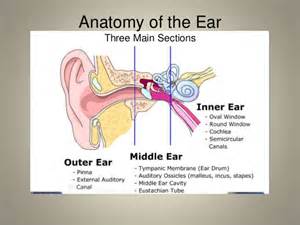
ear anatomyWe all have ears. Why do we not all hear the same way? Barring physical anomalies, all the parts of the ear are standard in pretty much every human. Male or female, an ear’s an ear, right. Or is it?

According to a brain imaging study done by the Indiana University School of Medicine, men listen with only one side of their brains, while women use both.

I said, MEN LISTEN WITH ONLY ONE SIDE OF THEIR BRAIN.

men don't listenSorry … that was to engage the other side, guys.
You can’t actually hear how your own voice really sounds without recording it. When we speak or sing, the sound is transmitted through the bone of the skull and jaw, combined with the sound coming through the air. What you are really hearing are the vibrations of your vocal chords, mixed with the air passing through your mouth, and bouncing off all that bone.

Which might be why we just love singing in the shower – it acts like our own personal sound booth, amplifying and perfecting what we think we hear. Most showers are small, and made with ceramic tile, which absorbs very little sound. All of that proximity bounces sound around, adding volume, power, and resonance to what you’re hearing. The reverb even helps to correct your pitch, and enhance the bass, making it sound deeper. Thanks, science!

But in a nutshell, that’s why you sound better in the shower than you do at your local karaoke bar. I have a dream … karaoke shower

We know that sounds hit your ear differently at different times of the day, and in different places and circumstances.

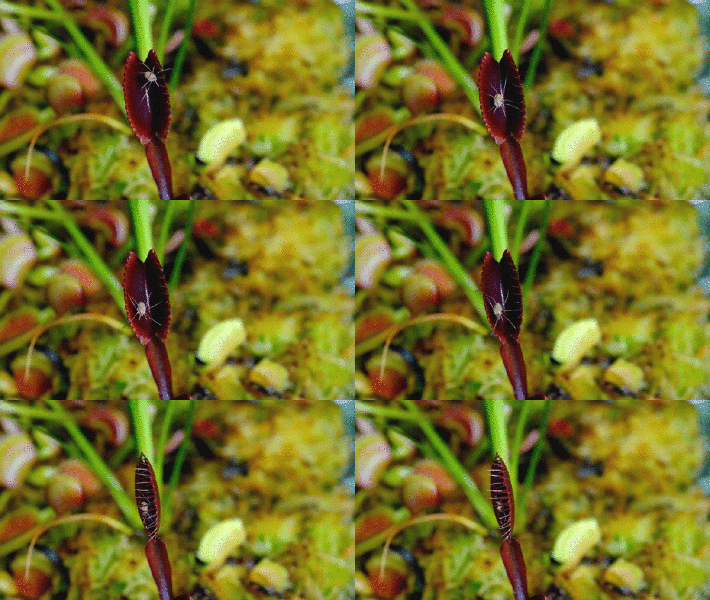
My hearing is a lot more acute in the morning. Hearing is the first sense I experience when I wake, likely a throwback to our cavemen days, when it was an important defence mechanism. I sleep like the dead, and rarely hear any noises during the night, but come morning, I’m as sensitive to vibrvenus fly trapations as a Venus fly trap.

I wake very early, and for a while, I keep my environment nearly soundless, save the odd meow from my furry overlords. I tend to turn off the beeps, boops and bings from my computerized devices, and use the time for contemplation and writing. Once I decide to enter the world of sound, my ears are primed and capable of hearing and understanding recorded words, even in foreign accents, at the lowest possible volume setting.

Sound sounds differently at different temperatures. The colder the temperature, the further sound can travel. Since most of us live in countries where it’s colder at night than in the day, we tend to hear noises in the night more clearly than we do in the daytime hours.

When music is involved, however, things get very complicated. That difference in how we hear at different hours applies across the ‘board,’ as many sound engineers have found to their shame. Bass notes ‘soften’ as the night wears on. What can sound amazing during a late night session is very likely to sound muddy and overly bassy the next morning. For the clearest mixes, daytime sessions are generally the smartest way to go.

For musicians in general, and vocalists in particular, pitch and tone are our tools of the trade. Some people are born with perfect pitch – not I, though I do have very good relative pitch, making it easier for me to hear and create vocal harmonies.

perfect_pitch“Perfect pitch (also referred to as absolute pitch) is the incredibly rare ability of a person to instantaneously identify or sing any given musical note without a reference pitch. It is estimated that 1/10,000 people in the USA are born with this cognitive trait.
There are two types of perfect pitch: active and passive. A person with active perfect pitch is able to sing or hum any given pitch; that is, if they are asked to sing a B flat without hearing the said note or any reference note, they can sing it without any problem.

If a person with passive perfect pitch is asked to sing the same B flat note, they cannot. However, if a random note is played for them, a person with passive perfect patch will be able to name it without any problem.

For many, perfect pitch can be a blessing and a curse at the same time. On the plus side, the possessor of perfect pitch can tune a musical instrument without aid, correctly judge whether or not a piece of music is being played in the correct key, and identify specific instruments as playing in or out of tune.

This skill would certainly come in handy for a piano tuner, instrument maker, or conductor. On the negative side, those with perfect pitch are likely to find it harder to enjoy music. They can hear all of a performance’s flaws in intonation. What’s more, if the performance is played in a key other than the original, those with perfect pitch will likely find it to be cringe inducing.

In their mind, they already know what the performance should sound like as far as pitch is concerned, so anything they hear is going to be compared to their internal tuning fork. Basically, anything that doesn’t align to their mind’s perfect pitch will sound out of tune. For some, that’s as bad as nails on a chalk board. “  (https://www.thoughtco.com/what-is-perfect-pitch-723911)

You cannot learn perfect pitch; it is a gift/curse you have to be born with. Most musicians have a good relative pitch sense, which allows them to play songs by ear and improvise. Relative pitch, however, is a skill that can be learned with enough training and practice.

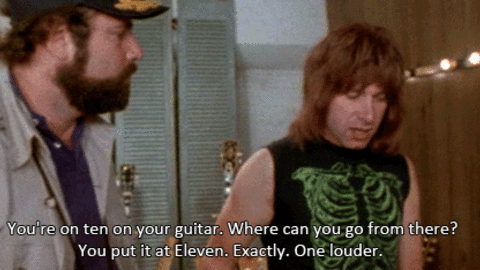
If you are lucky enough to have become an old musician,this one goes to 11 you may have discovered the downside of ‘”if it’s too loud, you’re too old.” Professional musicians are about 57% more likely than non-musicians to suffer from tinnitus (constant ringing in the ears,) and suffer noise induced hearing loss four times more often than other people. Neither of these afflictions are fun, just to be clear.
That drinking habit might also be a culprit; high alcohol consumption over a long period of time may lead to brain shrinkage, which can damage the auditory nerves. Researchers also believe that a regular ingestion of alcohol may lead to permanent hearing loss in the long term, and some loss of low frequency sounds, at least temporarily. All that yelling to hear each other in the club? Yeah, that’s not good for your ears.

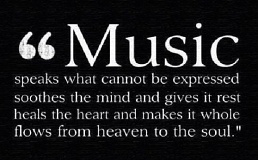
And you need to be good TO your ears. Humans love sound, we love to communicate. Music has been found in every culture, past and present, across the planet. Music is woven from every influence in our society – social, economic, climate, technology and politics – to create the image that we choose to present to our pmusic-quoteseers. It’s integral to creating societies that can come together as one, to move civilization forward.

When we lose the ability to hear each other, whether through physical hearing loss, or a decision to stop listening to those who think and act differently, we impede society’s progress to the next level of humanity.

music unites.jpgMusic is a universal language, but in order for all to hear what is said, there must be a generosity of listening, and that can only happen in a calm, open, giving environment. When everyone is being compelled to think and feel the same, you get a lot less ‘moon in June‘ love songs, and a lot more marches and songs glorifying dying for the Fatherland, eventually leading to the sounds of silence.

But when our world is in ‘receiving’ mode, we can easily accept and even appreciate the differences of others.

Boom Times in the Big Smoke


It’s Boom Town for realtors in Toronto these days. 243,400 houses were sold last year, and as of April of this year, the average residence in the city had a starting price tag of a cool $921,000.

378 East Sept 2016My old house in Scarborough, which we sold last July, was re-sold twice more by speculators before the year ended, each time jumping another $100K or so in price. It’s now been demolished and rebuilt as a monster home. I wouldn’t recognize the place, they tell me.

Fine by me. We sold, we moved, and I can barely remember the person I was when I lived in my big, old bungalow. Turns out it’s great not to have the onus of house maintenance, and the constant waiting for the next expense to drop. Renting, after 30 years of owning, may not lend the same sense of autonomy, but it also comes with a lot less responsibility and chores.

Taxes can be a burden on the home owner as well, since your residential tax is based on current value, not what you paid for the place at the time of purchase. If you lucked out in the eighties and bought your dream home for around $100,000, you might be considering a second job just to keep the taxes paid and the utilities flowing.

hawkstone-manorGood ol’ Rompin’ Ronnie Hawkins has his big estate, Hawkstone Manor, up for sale. Again. He tried to sell it for $14.9 million back in 2013, and failed. But it’s up again, this time listed at $4.3 million. If it goes to a bidding war, which is not out of the question, he could still get closer to the $10 million mark.

From the Toronto Star, April 2013:
“It’s a $100 house on a million-dollar property.”

The nine-bedroom, five-bathroom home is really only notable for the lifetime of memories that line its orange living room walls. A buyer would likely bring in a bulldozer.

But the house sits atop a rare piece of prime Kawarthas real estate — 165 acres gently sloping down to almost 4,000 feet of waterfront that, on these sought-after shores of the Trent-Severn Waterway, can go for $5,000 a foot.”

The Order of Canada recipient is 82, and not in the best of health. Whatever the final price, he and his wife will be able to cash out big and find somewhere a lot cosier to shelter them in their golden years.

sold over asking. jpgAnd that’s the ideal situation to be in, in the market right now. If you’re selling and have to purchase another place in the city – good luck to you. They want ridiculous money for so much as a garage, without a house attached. It’s madness. Tiny bungalows, like the one I’m renting, list for $800K and sell for over a million.
And when the interest rates rise in a bit, it’s gonna be even crazier. How can the average person buy so much as an entry home in the city, without a family income somewhere in the $300K a year range? It’s nuts. Rock, meet hard place. Rock musicians … move to Hamilton.

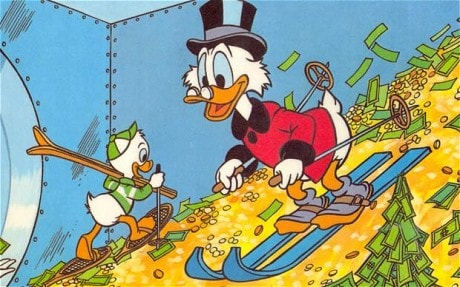
Funny thing, though, about this real estate madness – with hundreds of thousands of properties changing hands in the last two years, there have never been more paper millionaires minted in the city than it’s likely seen in it’s history. scrooge_mcduck

Not just millionaires – multi-millionaires. If you’re one of those lucky enough to have pretty much retired the mortgage, and are ready for retirement yourself, you could be walking away with more money than you ever dreamed you’d have. (Not me, I hasten to add – we did alright but didn’t hit Scrooge McDuck status. We’re barely McDucklings. We’re Ova McDuck, if anything.)

Barring a lotto win, which is unlikely, since I keep forgetting to buy a ticket, I’ll probably spend the rest of my days in rental properties, of decreasing proportions. Part of me would love to be a home owner again, but the rational, sensible part of my brain is quite comfortable with letting someone else worry about the roof, the septic tank, and the tyranny of ‘keeping up with the Jones.

I’m liking this downsizing, says the unrepentant hoarder. I’m liking trying to fit everything that once overflowed a 4000 square foot sprawler into this teensy tiny, less than 1000 square foot bungalow. It’s given me the chance to actually sift through all of these souvenirs and memories, and sort the metaphorical wheat from the chaff. I’m culling the hoard. It’s great to tear willy nilly through the detritus, and toss out the junk. It’s fun to put boxes of odds and ends on the lawn, under a big sign that says ‘Free!’ and watch cars screech to a halt, their drivers eager to find some little treasure to haul home.

1 800 got junkIt’s really heartening to go through all of the boxes of clothing, shoes, books, craft items, and linens, choose what can be redistributed within our family and friends, and then pass on the overflow to people who will appreciate what we’ve donated. There are so many who have so little, while others have three of everything. Distributing some of my bounty to those who can use it liberates my home AND my heart.
I didn’t need three apple corers. In fact, I have never even used one of them, not even once. Ditto the cherry pitter.

For the first time in my life, I’m no longer buying stuff ‘just in case,’ or with a view to some future purpose, because my future is now, and I want to be present.

I’m happy for those who are selling their properties for a tidy profit. I’m happy for those who are finding their dream homes. I worry about Torontonians who missed the real estate roundabout, and are now trying to find something affordable to rent. But this is all going on around me, and like you, I have very little say in what the Toronto of tomorrow will resemble.

Owning a home is not for everyone. It’s a very nice thing, and can certainly be wise and profitable in midlife. But when it comes time for retirement, home ownership is more like an anchor around your neck, keeping your proverbial boat stuck in one place. To enter new waters, you’ve got to haul up that anchor, and unfurl the sails, letting the fresh breeze take you somewhere new and exciting.

Avast, me hearties … I’m bound for uncharted shores!


Our Flag is Red and White


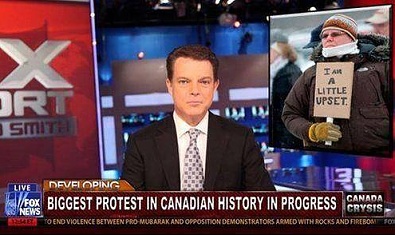
biggest protest in canadaCanadians … we love our country, but that’s never stopped us from having our beefs with how it’s run. Unlike many other countries, we feel free to speak up about what angers us. For all our reputation of being a polite and respectful people, we reserve the right to disagree with those who would impose their will upon the nation.

We love our healthcare, but are aware it needs tweaking to be all that it should be. We know that it is not ‘greedy’ or ‘entitled’ to demand that the healthcare that we pay for with our taxes, works for every Canadian.

We love our democracy, but want to ensure that we remain democratic, which calls for electoral reform. We don`t want to run the risk of any party taking control of the system and bending it to it`s favour – we won’t accept trickery or gerrymandering in our elections.

don't do it againMany were angry at the direction we took in the last decade, under the Conservative prime minister . We now have a Liberal prime minister, and likely just as many have issues with his party. In our Canadian way, we will protest against what we dislike, and in due course, vote for the direction we would like to have in the future.

Because this is not a “my country – love it or leave it‘ place, we can and will criticize those in power, and insist upon our right to do so.

On July 1, we honoured the establishment of Confederation in 1867. But the interesting thing about the adoption of the July 1867 date is that, at that time, Canada consisted of only four provinces; Ontario, Quebec, Nova Scotia and New Brunswick. While Canada Day acknowledges an important national milestone, it’s not really celebrating all of the country we now call Canada.

Nor does the concept of Canada Day include the indigenous peoples who were here before the settlers came from Europe. Even our national anthem ignores the fact that this is not our native land. Instead, we live ON native land, 89% of which is Crown Land administered by Indigenous and Northern Affairs Canada, and still in dispute, hundreds of years after the first treaties were written.

resistance150The First Nations people have been here for over 13,000 years, and for many, the celebration of Canada Day amounts to ” celebrating resource extraction of our territories. The Indian Act is still in place. The government is not allowing First Nations to have a voice. So why would I ever celebrate?”” (Anishinaabe traditional storyteller and teacher Isaac Murdoch.)
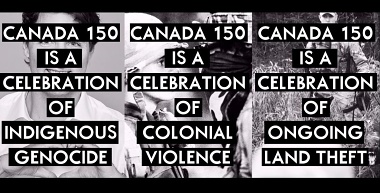
The #Resistance150 movement was created nearly eight months ago by Murdoch, Michif visual artist Christi Belcourt, Cree activist Tanya Kappo and Métis author Maria Campbell, as the group discussed the festivities planned by the Liberal government for Canada 150. They found it increasingly difficult to accept that the government, while giving lip service to plans of reconciliation, continued to ignore the ongoing fraught relationships between native Canadians and the rest of Canada.

Canada150 protestTheir resistance movement was developed to inspire other indigenous people to reclaim what they lost during colonization; their land, language and traditional ways.
The group created a camp for indigenous children and youth to attend called Nimkii Aazhibikong on Ompa Lake, located about 20 kilometres north of Elliott Lake, Ont. this year. Here the children can immerse themselves in traditional languages, explore their culture, and discover their environment under the tutelage of visiting local elders.

“Beyond attention to culture, Murdoch`s group also wishes to send a strong message on the negative effects of climate change and the First Nations longstanding dispute with the government over land ownership.

All over the country there’s this free-for-all in resource extraction that’s happening,” he said. “First Nations people are screaming and saying, ‘No’ and Canada just keeps saying, ‘Yes.’”

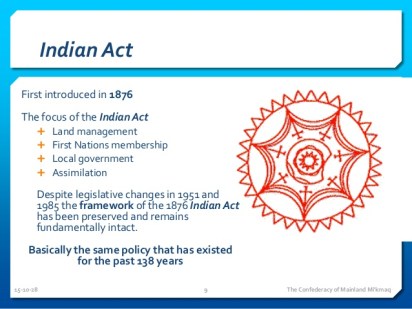
first-nations-elections-law-oct15-9-638On top of sounding the alarm over how resource extraction and pollution is hurting the environment, Murdoch said the #Resistance150 movement is also calling for the abolition of the Indian Act, which was first introduced in 1857 by the British colonial government, and reads very much like a treatise from the Southern Baptist religionists banning dancing in the 1984 film Footloose. Cruel, vindictive and petty, the Act aimed to crush the people and their culture, by any means available.

” Over the next hundred years the Indian Act was amended a number of times but each time was aimed at a more efficient means of assimilating First Nations into white society. The Act was amended to ban the “Sun Dance” an important ritual among the Lakota and other Plains aboriginal cultures. On the west coast the “Pot Latch”, an elaborate ceremony of feasting and gift giving was also banned. With an eye to forced assimilation, the Act authorized the forced removal of children to Residential Schools and stripped any Indian who obtained a University Education or Ordination of his rights under the Act.

The act vested title to reserve land to the Crown represented by the Minister of Indian Affairs deeming it “Crown Land set aside for the use of a Band of Indians.”

The 1876 act also made it illegal for an Indian to sell or produce goods without the written permission of the local Indian Agent, who became the de-facto ruler of Indians on reserve. (this includes fruits, vegetables, and farming, to this day.) Indian Agents had to give written permission for Indians who wanted to leave the reserve for any reason.

Status Indians were not allowed to vote until 1961.”

When I speak with many middle aged to older Canadians about the past, present and future of our First Nations people, whether status or non, it’s clear there is a confusion in what is believed to be true and what is fact. Sadly, the contents of the Truth and Reconciliation documents mean little if you’ve already made a pre-judgment on the nature of a people.

However, fairness and justice is what we should be working towards, for all Canadians. There are specific problems that need to be addressed amongst indigenous people. Some of these problems are brought about by where the reserves are located. There are currently about 150 long-term and short-term drinking water advisories in First Nations communities that are difficult to reach in good weather, and impossible to reach in winter.

In some of these far flung communities, suicide rates, especially among the young, are five to seven times higher than the national average.

First Nations and Metis are 2-3 times higher at risk for diabetes than the non-Aboriginal population, while tuberculosis – almost nonexistent among non-Aboriginals, is 26.4 times more prevalent in First Nations Canadians.

Canada Day 20170701I am proud of my country, but I know that my country has to include ALL of it’s people – those who came before us, and those who will join us in the future – to be strong and united. As a country, we can do so much better. And I have faith that we will work towards being a better, stronger, fairer country in the coming years.

In an article on what it means to be a Canadian, Prime Minister Justin Trudeau said, ” “This is something we are able to do in this country, because we define a Canadian not by a skin colour or a language or a religion or a background, but by a set of values, aspirations, hopes and dreams that not just Canadians but people and the world share.”

And as writer Mike MacNeil responded to those concerned that the Canada Day150 celebrations ignored Canadian history and absolved us of our crimes against the First Nations people, “ It”s not the pilfering and genocide that’s being celebrated. It’s instead – and finally – the recognition that something positive is being done to correct decades of misuse and mistreatment. It’s slow, granted. It’s imperceptible, granted. The pace of change could be infinitely faster, granted. But the change – however it’s characterized – is there.”

And that’s Canadian, eh.

Wild and Wacky Weathering


In June 2012, Amazon picked The Age of Miracles by Karen Thompson Walker as one of the month’s best reads. A combination coming-of-age story and apocalyptic page turner, the novel focused on how people would react to a changed world, where “the Earth’s rotation slows, gradually stretching out days and nights and subtly affecting the planet’s gravity. ”     
age of miracles
The book outlines how a young girl, along with her family and friends, cope with this adjustment, as the planet wobbles off to it’s slow demise.  Meanwhile, the best laid plans and schemes from governments fail to make much difference in how the Earth’s denizens cope with the disaster.

And that’s kind of where we’re at these days, isn’t it? We’re in a vague malaise, unable to confidently say what the weather will be like today or tomorrow, while hapless governments, even if they agree that there is a problem, struggle to find bandaid solutions to  the earths’ sores that have been left to fester for too long.
trump alone at G20

Except this guy .. this guy thinks he knows better than anyone on the planet, be they incredibly educated scientists or those who have spent their lives dedicated to studying the effect of climate change on people. This guy is an asshat.

It must really be pointed out how completely insanely and selfishly Trump and his band of reverse Robin Hood Merry Men are behaving. They’re hooting and hollering like ignorant hillbillies as they seal the environmental fate of those fools who voted for them to make life altering decisions, in the name of ‘economic change.’ These corporate raiders of the environment are convinced that money and power will save them from dying from a lack of clean air and water. But just them. The rest of us? Dream on. We’re all going down with this ship.

Remember when the first rumblings about a change in the planet’s clime began to hit the middle class consciousness? Those who could see the bigger picture were worried about how even a slight shift in warming could damage our environment, the least of our worries being an increase in natural disasters, as melting polar ice caps brought about flooding, and extreme weather swings were tempered with more frequent and deadlier droughts.

Others smiled at the thought of palm trees growing down the main streets of large northern cities. With a thorough lack of understanding of the fragility and interweaving of climate and landmass, some hoped this warming would bring about new tropical beaches in heretofore frigid areas. These foolish humans thought they could somehow control where and when climate change would happen, and bend it to their wishes.

All of their fantasies depended upon where they were located, and hinged upon a lack of empathy for those who would see the opposite of these desires. In order to have the tropics brought to your front yard, many countries would have to be completely displaced or disappear from their current sites. In order to have Floridian temperatures in Boston, New York or Toronto, you first have to lose Florida.

But, of course, they were attempting to take a world problem, and make it into a personal triumph.  Still, Man proposes, god and the environment disposes. You’ve only to look locally, to the disastrous flooding on the Toronto Islands and the economic battering Toronto is taking on this matter alone, to see that we have no control whatsoever when Mother Nature gets pissed off. Instead of a tropical beach, you have land masses swept away, along with coastal areas being eroded, possibly never to be returned in our lifetimes.

I wonder what Trump will think when his precious Mar-a-Lago is swallowed up by the sea? It will happen, and I can only hope it will happen sooner than predicted. Right about now works for me.

elephant left to rotAnd when I think about those who continue to claim that our actions are too miniscule to have any sort of immediate impact upon the planet, I’m struck dumb by the hubris, and the inability of some to look at the damage we all regularly inflict upon the planet, and not see how integral each and every living creature’s actions are to maintaining this delicate balance.  Where once we knew, instinctively and intuitively, that the lowliest butterfly snatched from our timeline could have an impact upon the food chain, we now struggle to throw off responsibility for the most damaging of indignities and raping of natural resources ever seen in human history.

But don’t we love to talk about the weather! Talking about it, singing about it, trying to forecast what might be on the horizon, and molding our protective coatings around what we hold precious … this is what we have always done, since caveman days. Through the centuries we learned more about how the planet moved through it’s cycles, and how the sun and moon determined how best we could use the land and waters around us.

We learned to measure how precipitation complicated the times when seeds could be planted, in order to feed our populations. We began to understand that chemicals, seeded into the lifeblood of the planet, the very earth and air, could and would damage the reproductive cycles of all living creatures. We learned how to forecast what the weather might be in coming days, and when we would need to protect our bodies with clothing that would keep us warm, or sunscreen that would fend off the increasingly irradiating rays of the sun, which were no longer impeded by the thick coating of ozone we had taken for granted.

All of these things we learned over time, through observation of the repetition of the seasons, we now blithely toss aside in favour of commercializing and exploitation of resources, an exploitation that seems less inclined to profit humanity, but certainly enriches corporations with no concern for the actual ‘owners’ of the lands they rape.

We looked to the seasons as metaphor for our lives. The cycles of the seasons echoed the natural order of life. Spring reflected our callow youth, and Summer mirrored the fullness of being an adult. We understood that the fall indicated a slowing of days, and winter … dark, cold, unforgiving winter … symbolized a time of aging, and eventual death. The days have the same length, but there are fewer of them.

When the natural order of the seasons is displaced, when you can no longer count on April showers bringing May flowers, our human minds have difficulty grasping that which we’ve always taken for granted – the flow of time reflected in our environment.

The impact of climate change doesn’t end with the physical damage that’s being inflicted on the world. Now, those who study our psyches are beginning to see a change in how humans respond emotionally to the trauma and shock of weather events. Even if we try to avoid focusing on the earthquakes, tsunamis, droughts, floods and landslides which now occur more frequently, our minds are aware of these catastrophes, and our ability to absorb these disasters is lessened. Our empathy is impacted, leading to a rationalization of isolation, and of a need to protect what we have from those displaced by events beyond their control.

We are, in effect, living in a state of post traumatic stress and shock. Some might feel a low grade sense of depression and anxiety, while others, perhaps more sensitive to this imbalance, may have behavioural issues, ranging from substance abuse, to interpersonal and job-related difficulties. Other symptoms can include a heightening of violence and aggression towards others. It is no accident that the rate of suicide has risen in the last decade, as some decide that there’s simply no reason to carry on, in a world so out of balance.

Climate change on our planet will eventually impact every one of us, wherever we live. In recent studies (Bryant et al., 2014,) (Simpson et al., 2011,) it was noted that,
Changes in climate affect agriculture, infrastructure and liveability, which in turn affect occupations and quality of life and can force people to migrate. These effects may lead to loss of personal and professional identity, loss of social support structures, loss of a sense of control and autonomy and other mental health impacts such as feelings of helplessness, fear  and fatalism.

Extreme temperatures in their own right have a unique influence on behavior and wellbeing. As research by Craig Anderson (2001) and Simister & Cooper (2005) has shown, aggression increases as temperatures rise. Thus as summers get hotter, so might our tempers — likely due, the researchers explain, “to the impacts of heat on arousal, which results in decreases in attention and self-regulation, as well as an increase in the availability of negative and hostile thoughts.” Heat can also impact our ability to think clearly, they add, “which may reduce the ability to resolve a conflict without violence (Pilcher, Nadler, & Busch, 2002).” Higher temperatures have also been found in other research to increase the risk of suicide (Lee et al., 2006).

ecoanxiety
Add to this mounting fear and anxiety derived from watching the world around us change in irreversible ways — coupled with the helplessness of feeling as if we cannot stop or reverse global warming— and you have another effect of climate change on mental health:

“Watching the slow and seemingly irrevocable impacts of climate change unfold, and worrying about the future for oneself, children, and later generations, may be an additional source of stress (Searle & Gow, 2010),” the authors write. “Albrecht (2011) and others have termed this anxiety ecoanxiety. Qualitative research provides evidence that some people are deeply affected by feelings of loss, helplessness, and frustration due to their inability to feel like they are making a difference in stopping climate change (Moser, 2013).”

While it may be expedient and profitable for climate change deniers to continue on the path to ecological destruction, those who deny what is happening to their own psyches are impeding any kind of healing for the rest of us.  Seasons change, and we must change with them. But more gently.