Where is Mary Tyler Moore When We Need Her?


In 1970, Mary Richards and The Mary Tyler Moore Show debuted to a changing world. Women like my mum, who had left school in grade 9 during the Great Depression, were watching the rise of feminism, and wondering how the heck they were supposed to react and behave.  Men, like my dad, felt incredibly threatened by this new role of women in the workforce – where would that leave them? Would women take all the jobs? And how were they supposed to treat this ‘new woman’ in the workplace?

I had already been in the workforce for a few years, and was standing by to see what the world would throw at me. I’d seen offices where only men had any power, and where women, and especially older women, were taken advantage of economically, regardless of ability or seniority. I’d applied for jobs where the only criteria was attractiveness, and the dress code required a specific model of push up bra.

I had been raised to believe I could do anything – as long as ‘anything’ involved being a nurse, teacher, secretary, stewardess, waitress, or housewife. And as long as my husband approved. But now a larger world was opening up, and the Mary character gave viewers a chance to  watch, from the comfort of their own homes, how this might play out for themselves.

My mum completely identified with Mary, the vulnerable, good girl, who wanted to appease everyone, even at the expense of her own feelings. Mary was single, female, over 30, professional, independent, smart, and funny. Mary faced issues an older generation had never before confronted, like equal pay, birth control, and sexual independence – sex without the blessing of marriage.

Mary’s superpower was her friendships, both those with other women, like Rhoda Morgenstern (Valerie Harper); Phyllis Lindstrom (Cloris Leachman); Georgette Franklin (Georgia Engel); and Sue Ann Nivens (Betty White), and with the men she interacted with at the TV station where she worked.

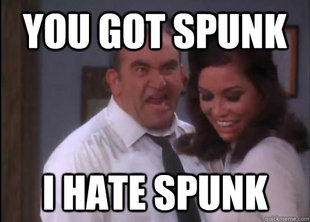
At work,  Mary was a sisterly presence. She was smart, did her job well, and could laugh with the guys. Although she hated confrontation, she could still muster up the courage to talk back to the irascible Lou Grant, her boss and editor. Eventually, even he had to admit how good a co-worker she was, despite her ‘spunk.’

As the series grew more popular, repeated viewing made anxieties about women in the work force seem silly .. after all, Mary was an Every Woman. They could relai-hate-spunkte to Mary. The normalization calmed their fears, and made people realize that they could relate to a drastic social change.
When Mary Tyler Moore died last week, I thought a lot about the contrast between how we are dealing with the vast social and economic changes of today, as opposed to then.

It’s frightening to those who want to cling to the world as it was. And yet at the same time, we don’t want to give up our ability to access pretty much anything we want online, order it with a click, and have it delivered to our door within a few days.  What we don’t see is that we’ve stopped shopping in stores .. and so those jobs and stores no longer exist.

global-gdpWe want to pay as little as possible for any given thing.  Corporations heard us; they outsourced manual labour to countries where they could pay lower salaries. And so those jobs, which we used to do here, no longer exist.

The reality of climate change, and the shifting of energy resources are, of necessity, pulling focus away from oil and coal, and putting the spotlight on renewable energy. Sure, there are more jobs available now in renewables, but what do you do if you’re a career coal miner? The mine’s been shut down, and those jobs are never going to come back.

Widespread automation is in our future; Oxford University predicted that 47% of all jobs – of every kind – will disappear in the next 25 years.

“The Trump campaign ran on bringing jobs back to American shores, although mechanization has been the biggest reason for manufacturing jobs’ disappearance. Similar losses have led to populist movements in several other countries. But instead of a pro-job growth future, economists across the board predict further losses as AI, robotics, and other technologies continue to be ushered in. What is up for debate is how quickly this is likely to occur.

Now, an expert at the Wharton School of Business at the University of Pennsylvania is ringing the alarm bells. According to Art Bilger, venture capitalist and board member at the business school, all the developed nations on earth will see job loss rates of up to 47% within the next 25 years, according to a recent Oxford study. “No government is prepared,” The Economist reports. These include blue and white collar jobs. So far, the loss has been restricted to the blue collar variety, particularly in manufacturing.

Robot ironing clothes

Unemployment today is significant in most developed nations and it’s only going to get worse. By 2034, just a few decades, mid-level jobs will be by and large obsolete. So far the benefits have only gone to the ultra-wealthy, the top 1%. This coming technological revolution is set to wipe out what looks to be the entire middle class. Not only will computers be able to perform tasks more cheaply than people, they’ll be more efficient too.

Accountants, doctors, lawyers, teachers, bureaucrats, and financial analysts beware: your jobs are not safe. According to The Economist, computers will be able to analyze and compare reams of data to make financial decisions or medical ones. There will be less of a chance of fraud or misdiagnosis, and the process will be more efficient. Not only are these folks in trouble, such a trend is likely to freeze salaries for those who remain employed, while income gaps only increase in size. You can imagine what this will do to politics and social stability. “   (http://bigthink.com/philip-perry/47-of-jobs-in-the-next-25-years-will-disappear-according-to-oxford-university)

Now, the thing is, good leadership would have been following up on this inevitable trend and coming class shake-up. And some countries have been following the curve, and are placing more emphasis on careers outside of the previous generation’s scope.

However, several countries have instead taken the opposite approach – the one known as sticking your fingers in your ears, closing your eyes, and chanting ‘la la la la la’ in the hopes that this will all go back to the way it used to be, when you reopen your eyes.

Sadly – that’s not in the cards. The genie is not going back into the bottle. Long term solutions need to broached immediately, if we are not to find ourselves in a Soylent Green world.

The economy will expect middle aged, middle class, workers to retrain or be left behind. There will be resistance to that idea, especially amongst those who have laboured under student debt from their previous career.

self-driving-truckAnd what role will self-driving vehicles play in a future economy? Long haul truckers, cab drivers and couriers will find themselves out of work – not tomorrow, but within the next decade. And that’s a whole lot of drivers.

These are real, valid concerns that must be addressed. A guaranteed basic income might be the only solution possible for as many as half of all country’s populations. We could be on the verge of a complete societal breakdown – or a future Utopia, a world in which people are free to pursue their interests, instead of working at jobs that just pay the bills.

Be that as it may, one thing that will NOT help to move countries or the economy forward is isolationism or pathetic jingoism. Time and again, this type of “America First” pseudo patriotism has proved a failure.

donald-trump-america-firstWhen Trump said,  “For many decades, we’ve enriched foreign industry at the expense of American industry; subsidized the armies of other countries” while depleting our own. And,: “The wealth of our middle class has been ripped from their homes and then redistributed all across the world, ” he was outlining ” a world in which foreign relations are collapsed into a zero-sum game. They gain, we lose. ” (http://www.nationalreview.com/article/444321/trump-foreign-policy-isolationsim-america-first-allies-nato-trans-pacific-partnership)

He is wrong. He is appealing to the petty, the un/ and under-educated, the greedy,  and the small minded who can’t understand why they can’t have all of the goodies of 2017, while living in a rosy coloured Disneyland complete with talking animals, and perfectly behaved women and children. A world where America does whatever the hell it wants, any time and anywhere.

A perfect example of that kind of mentality was shown on the weekend as Trump’s knee-jerk executive order targeted citizens from seven predominantly Muslim countries, forbidding them entry to U.S. soil – AND also targeted U.S. legal residents from the named countries — green-card holders — who were abroad when it was signed.

trump-protest-noban-jan-2017The order was signed as many were on planes, en route to America.

When those enforcing these bans, as dictated by the Department of Homeland Security, were asked by citizens or their lawyers to whom they must address their concerns, they were sneeringly told to  “Speak to President Trump.”

This should make Americans frightened. These actions throw out not only the Constitution, but democracy itself, with Trump as the ultimate arbiter for all charged with any offence he makes up on the spot.

The thing is … it’s not just Trump’s fault. It’s the fault of all of the governments and political parties all over the civilized world that have ignored the economic reality that has been creeping up on us for decades. Political parties that stirred up fear, painting a picture of a dystopic land, as Trump did when he described America as akin to a Hieronymus Bosch painting of ” American carnage,” with “mothers and children trapped in poverty in our inner cities; rusted out factories scattered like tombstones across the landscape of our nation; an education system flush with cash, but which leaves our young and beautiful students deprived of all knowledge; and the crime and the gangs and the drugs that have stolen too many lives and robbed our country of so much unrealized potential.

That is not a true picture of America, though it may well be the carnage he leaves behind after his time as President is over.

Americans were not being told, “you’re gonna make it after all.” Instead, they were being told that the only way to make it is to take it from others.
passing-the-buckPolitical parties that relied upon cutting taxes rather than shoring up their infrastructures and their citizens needs, just to get re-elected, are to be blamed. Every party, every country, big and small, passed that big buck along to their successors, enriching corporations and themselves in the process, while ignoring and angering their constituents, who had trusted them to explain what they needed to know and understand about their future.

They COULD have worked with the education system to update what is offered in order to live in a modern, automated society. They COULD have worked with scientists warning of the dangerous effects of climate change, and put into place safeguards that would have saved lives. They COULD have told corporations that they would not be allowed to hold consumers or governments hostage in order to raise corporate profit, but instead would be taxed at a rate that allowed the country to replace what was being taken from them.

But that would not have gotten them re-elected.

walking-dead-castAnd so, there were no television series like The Mary Tyler Moore Show, that allowed citizens to normalize a changing present and a very different future. Instead, there was a rise in conspiratorial, dystopic, dramas, and a rush to fairytale land, that deified cartoon superheroes, and fantasy characters. Reality shows, that weren’t really reality, appealed to the minority and the niche groups. And an entire genre of television catered to the needs of ‘preppers,‘ those that would stand alone and defend what little they had when the inevitable (to them) collapse of society occurred.

This is a tearing apart of society, a sorting process that places each individual into smaller and smaller groups, separating and dividing. Rather than a coming together of people to work with, rather than against, change, to accept globalization and automation as a positive advance, ‘disrupters‘ have chosen to tear nations apart, to pit citizen against citizen, for power, for wealth, and for their own self-aggrandizement.

I don’t miss the past; I’ve been there, and it wasn’t all it’s cracked up to be. But I will miss the days when politicians worked with and for the people, rather than for their own self-interests, and on the backs of the people they have forgotten, to whom they owe their jobs.


(originally published at bobsegarini.wordpress.com/2017/01/29/roxanne-tellier-where-is-mary-tyler-moore-when-we-need-her/)
 

That Was Sixteen. Going on Seventeen


2016 is gone. Moving on isn’t the slightest bit difficult. 2017 is going to be … interesting, oh yes it will. Doesn’t seem any other option than to muddle our way through whatever’s this way coming. Fingers crossed it’s not too wicked.

supermoon-imageFor me, this year has begun differently than many I’ve experienced in the past. Selling the house and moving into the city has brought a lot more freedom into my life. That light at the end of the tunnel turned out to be not an oncoming train, but rather a beautiful fat moon, always just out of reach, but wonderful to see.

Happiness doesn’t require that you have a lot of anything. In fact, I think if you have too much, you’re more concerned with keeping what you’ve got or of striving to get more, than enjoying what you have. No. “Enough” is what you want. Enough for freedom from want, enough to bMicrosoft Word - n2342-recycling.doce able to relax into your life and appreciate what you’ve got. Enough to be in control of your own life, but not so much that you seek to control others.

So in the first two weeks of this new year, I’ve seen more bands than I did in all of 2016, had several lovely brunches with good friends, and discovered that quitting smoking was the best gift I’d ever given myself. There’s been more laughter, and less tears. More singing and less coughing.

As much as I fear for what is in store for our neighbours to the South in the coming months, I also have relinquished the belief that anything I say or do will make the slightest bit of difference. It won’t. I can’t. So, although I’ll keep passing along jabs at the Orange Jayzus,  I’m handing over the burden of fear to those poor benighted Americans.

dead mans switch Outer Limits.jpgBut I do have a sneaking suspicion that many in government are not who or what they seem. Remember that Outer Limits episode, Dead Man’s Switch, where a lowly soldier mans the button  that controls activation of a final revenge weapon that will wipe out the earth should invading aliens turn out to be hostile? The final scene reveals that aliens are indeed parasites controlling the actions of those in charge, while the earth lies in ruin.
I’m not saying that TeeRump has an alien tucked under those oversized jackets, but there’s no denying that that makeup and spray tan can be seen from space.

******************

Here in Toronto, it would seem that Mayor Tory’s vision of a Music City‘ is more of a pipe dream. You can’t ask the venues to supercharge the city’s revenues, while simultaneously squeezing them for more taxes, charges and rents. Petty limitations and fines will not inspire club owners to new heights.

The venerable Hugh’s Room was the most recent victim of circumstance, abruptly closing it’s doors in the midst of financial struggle.  It does seem like there’s hope for the venue re-opening though, as a committee has been formed to focus on restructuring and reopening, and changing the club’s ownership structure to a non-profit, board-run model. I do hope so .. this is a prime venue, with so much well deserved good will and respect, that it would be a pity to just let it die on the vine.

One of the acts that was displaced due to the closure is Jan Kudelka‘s one woman tribute to Janis Joplin. She is bringing her celebration of Joplin’s 74th Birthday Bash to the Tranzac instead, this Wednesday the 18th, at 8:30.

“The Queen of Psychedelic Soul is back for one night only! After smashing sold-out shows in 2015 and 2016, singer and performer Jan Kudelka conjures and celebrates the beloved blues/rock trailblazer Janis Joplin with a 74th birthday bash on Wed, Jan 18, 2017 at the TRANZAC CLUB backed by her stellar band! Do not miss this intimate journey into the epic voice and tender heart of the Janis Joplin legend.”

jan-kudelka-janis-joplin-tranzac-poster

The Tranzac is a fascinating place. There’s the big room, where Jan will have her show, and then a smaller lounge, just as you enter, where the music never seems to end. The range of sound and ideas is astonishing, and you’re as likely to find yourself listening to jazz as alternative, or rock, or folk, or an evening of ukulele appreciation.  Seriously. Check out their calendar of events to have your mind boggled.

Calendar

I like the idea of venues offering music at earlier hours, especially as the weekend nears. My days of starting the night at ten p.m. are long gone –  my cats are cruel masters who demand feeding at 6 a.m., so I’m usually tucked up and snoring just as most bands karang their first chord. And so are a lot of my contemporaries, and those who have to go to work or school the next day. happyhourIt seems odd to me that bars and restaurants are content to open around eight p.m. ish, or be open during the day, but empty, until some mythical magic time when bands appear out of the mist. There’s money to be made in the feeding and entertaining of people who start the day early, and are ready to rock by dinner time.

And with the plethora of talented, experienced players who are available for gigs, it would certainly be easy for many venues to fill in the gap, and keep musicians and music lovers alike happy.

This past Friday, for example, I enjoyed Don Naduriak‘s extraordinary quintet at a little restaurant on the Danforth called Hirut. This is a regular gig for them. On the second Friday of each month, beginning at 8 p.m., E = and Don Naduriak Music “explore compositions by Don Naduriak with various of Toronto’s best musicians. The compositions draw on Jazz, Afro-Cuban and Brazilian influences. don-naduriak-band-hirut-jan-2017

This month the band features Bill McBirnie/Flute, Russ Little/ Trombone, George Koller/Bass and Joaquin Hidalgo/Drums-Percussion, as well as Don Naduriak on Keyboard.”

If you’re a long-time music fan, you’ll know that Don’s group contains some of Toronto’s musical cream. The room was packed with jazz lovers, drinking and eating and making money for both the venue and the band. Which is the way it used to be, and still should be, but somewhere along the line, the train went off the rails.

There’s something going on nearly every night at Hirut, everything from comedy nights to Ernest Lee‘s classic blues,  as well as a folkie style jam on Sunday afternoons run by Nicola Vaughan, starting at 3 p.m.

Rooms that are taking advantage of earlier gig start times, and of expanding their offerings to include more than music, are reaping the benefits all over the city. As with any industry, those who give the customers what they want will always be respected and rewarded.

feed-meThere’s a lot of room at the table, and a place for everyone, regardless of what time they want to listen, or what flavour they want to feast upon. Toronto’s got the musical munchies .. feed it!

2017 can be the year we come together, despite those who’d profit from a people divided. There’s no better time to listen .. or to be heard!


Living in the FaceBook Bubble


Dang! It always happens … I’m all gung ho about something I want to write about, and I get some of the research done, and then … life intervenes. Or, more accurately, social media. I’m looking at you, Facebook!

you're soaking in itOh, that Facebook. That sapper of time, that playground for those avoiding actual work, that stew of emotions so many of us find ourselves soaking in. I can give you a dozen reasons why being on Facebook is a good thing, with it’s ability to connect us to long lost friends and relatives around the world. But the honest truth is that most of us are just plain addicted to the rush of recognition we feel when someone out there ‘likes’ our posts.

And that’s part of the problem. We naturally tend to gather around ourselves those of like minds, and soon our interactions may be more about living in a bubble of agreement than actual dialogue. Any dissenting voice can be drowned out by a supporter, which neatly nips in the bud the chance to hear other sides to an argument. Facebook’s own algorhythms contribute to this bubble, since the sorting function places posts higher in your news feed if they’re from like-minded friends. Social_media_fearSoon, your view of the world can become distorted, leading you to believe that absolutely everyone, everywhere, feels exactly like you do. And then to be surprised when that does not turn out to actually be true.

The upcoming election has preoccupied me for some time – I truly feel that whoever is elected to steer Canada’s boat over the next four years will shape Canada’s future, for better or worse. Frankly, I cannot wait for it to be over. I intend to fight the good fight, right up until the last vote is counted, and then get a freakin’ life. Enough is too much, when it comes to politics. There are so many more enjoyable ways to spend my days.

What has been most surprising to me in the last few weeks is something I’ve seen coming, but have never seen so up-close and personal before. Divisiveness, knee jerking, vicious verbal assaults, and cruel name-calling have gone from being issues visible in the rear view mirror, to sitting right next to us in the passenger seat, breathing coffee and garlic in our faces. wwe tag teamsA seemingly innocuous remark can instantly transform your social media experience into a full-fledged WWE tag-team smack down presided over by Vince McMahon himself.

Yeah, it’s everywhere, I know. It’s in all politics, social media, and mass media. We can’t turn on our televisions or listen to our radios without hearing screaming hosts and responsive listeners blaring their opinionated and often misguided or misinformed thoughts, speaking over each other, and literally and figuratively giving each other the finger. Over the last few years, a lack of civility has gone from being politically incorrect to being highly rated entertainment, the more lurid and hyperventilated, the better.

political debateAnd so, with two highly significant elections approaching, our own Canadian one on October 19th, and the American race that will drag along to an illogical conclusion in 2016, we’re being bombarded with rhetoric, over-heated promises and denunciations, and the spectacle of grown men and women who believe they have what it takes to become the leaders of countries in the Free World, behaving like poorly informed members of a high school debate squad. On a losing team.

what's happend to politics bob raeAs Bob Rae said in his terrific book, What’s Happened to Politics, “The trouble with pursuing politics as a business is that it has helped to create a cynical, fractured electorate that doesn’t know whom to trust, or what to do.”  

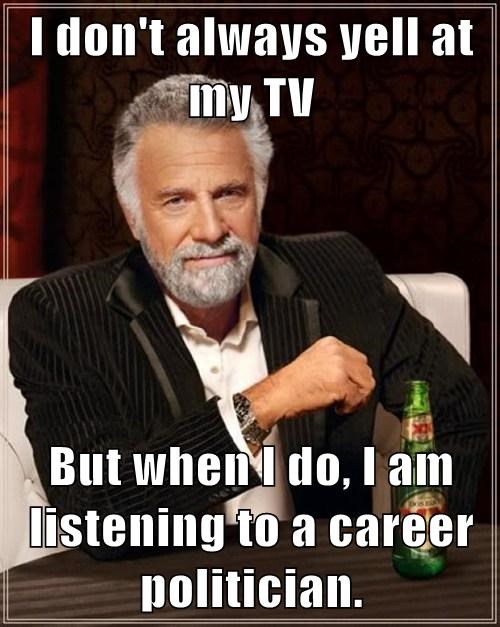
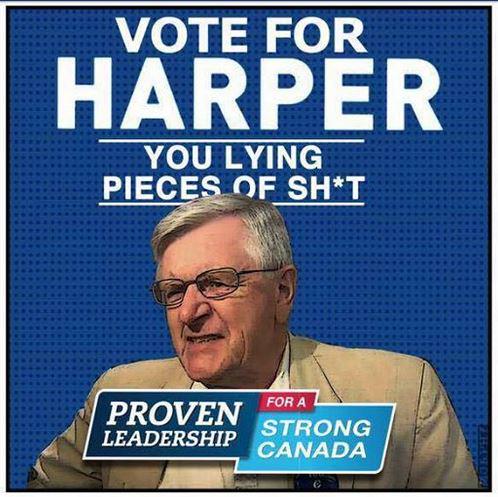
Career politicians have mined social media and harnessed the power of polls to find their supporters, which they then use in an effort to get elected to positions that seem to be little more than spring boards for their next kick at the electoral can. career politicianLess and less actual work appears to be getting done once they’ve secured their spot in the legislature; they’ve actually built large chunks of time into their tenure when the priority is re-election, rather than service to the taxpayers who are paying for their supposed expertise. Incessant campaigning squashes the possibility of responsible governance. That’s not devoting your life to public office and service – that’s devoting your life to BEING serviced. And apparently, it pays very well.

Once the politician’s fan base is in place, it’s carefully nurtured, by which I mean, manipulated , in such a way that it becomes unthinkable to actually parse either the actual words or deeds being done in the politician’s name. Partisan politics, as played by supporters who believe that a louder voice, and denial of reality, and most assuredly a lack of ability to tell truth from lies, has seeped into every crevice of our social and mass media.

The name players in the game, those leaders of the political parties and those fighting to become leaders, snap and point fingers at each other, defending minuscule slurs over the larger picture of policy and national stewardship. angry old guyAnd their base, emulating their masters, surge to defend this silly display with ever increasing intensity and rabid vehemence.

The Emperor has no clothes. The pickin’s are slim in these upcoming elections. The distinctions between political parties are narrowing, as corporate dollars seduce the candidates. You can’t offend those who pay for you to play, so each candidate, no matter how invested in a cause, eventually finds themselves beholden to the money that put them into their seat. Consequently, debates revolve around safer issues, or promises clearly designed to sucker in the largest groups of emotionally driven voters.

votewolfWe’re being fed slogans and talking points, while meaningful dialogue, and listening before replying, is seen as dated and old fashioned.

Which brings me back again to those of us who can’t get enough of Facebook and social media, a phenomena so virulent that it’s gone from being a pastime to an actual condition listed in the DSM-V (Diagnostic and Statistical Manual) as Internet Addiction, judged to be more powerful and insidious than the physical addictions of nicotine or alcohol.

internet addictionWe addicts may partake of the real world, walking and talking amongst you, but it’s when we hit the ‘Net that our most intense thoughts and words are free to emerge. Safe behind our glowing monitors, we take our scalpels to those who don’t live inside the same bubbles that we do, and defend our beliefs and opinions, even if those opinions were formed mere minutes before and based solely on a click bait driven headline intended to attract us to a site that will grab our personal data and sell it to the highest bidder.

FBAddict3Just a few more minutes … I’ve gotta school this fool whom I have never met on what’s REALLY going on!

We can blame the media, we can blame a decay in political morals, we can blame a citizenry now more accustomed to a violent offense than a thoughtful defense. Yeah, let’s do that. Because it would be unthinkable to decide that how we conduct ourselves, in public or on the Internet, has more to do with allowing ourselves to descend into a caveman-like brutality, and less to do with “speaking our minds” and “brutal honesty.”

donald-trump and farleyJust look at how many ‘likes’ that gets for Donald Trump.

(originally published Sept. 20/2015, in Bob Segarini’s “Don’t Believe A Word I Say”

Climate Change What Climate Change? … The Aftermath


  • Climate change denial, or global warming denial, involves denial, dismissal, or unwarranted doubt about the scientific consensus on the rate and extent of global warming, the extent to which it is caused by humans, its impacts on nature and human society, or the potential for human actions to reduce these impacts. (https://en.wikipedia.org/wiki/Climate_change_denial)

Part One: https://frustratedboomers.com/2015/08/12/climate-change-what-climate-change-part-one/

Part Two.https://frustratedboomers.com/2015/08/13/climate-change-what-climate-change-part-two/

It’s been a few days since I wrote parts one and two, and, not surprisingly, there have been those who have taken offense at my stance and my words.

Here’s one response:

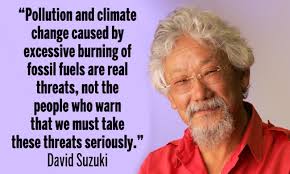
suzuki warning“your blog part one is just name calling. It’s like you are standing on a soapbox and ranting. You won’t get anyone to listen to you talking like that. I’m p**sed off reading it, and I’m your friend. I am not convinced that mankind is contributing to climate change. And you call me names because I am still weighing the evidence, looking for proof.

When I was writing part one, I weighed carefully how I should reference those still in denial of climate change, and how humans have contributed to the mess. I settled on “uninformed and part of the problem” as a way to describe this way of thinking.

Call me biased, but I think worrying about someone being offended by my words, while the majority of us are worried about becoming extinct if change is not acknowledged and tackled, is treading a little too close to a world where bruising people’s feelings is more important than facing the inconvenient truth.

jesus I'm no scientist“I’m no scientist, but …” Stop right there. No good comes from continuing that sentence. That’s mindless and lazy, and denies credence to the actual scientists, who are telling you what’s going on. It allows politicians to pander to a base that would prefer not to think about a future less cozy than the present.

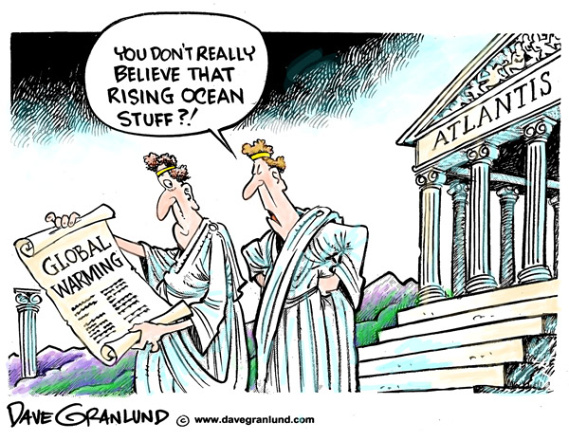
Climate change is the most important and relevant issue we are dealing with today. All else pales in the face of drought and starvation, which people in other countries are already experiencing. The fact that we have felt only the periphery of the impact should be appreciated, but should also sound a clarion call for action.

And yet still, after decades of warnings … some are still “weighing the evidence?” On which scale? Who’s got their thumb on which side? And just how long is this weighing going to take, because while we’re weighing, the problem is compounding.

false balanceImagine for a moment that you and 75% of mankind all believed firmly that, based on scientific data and research, a cataclysmic event was about to happen. Imagine also, that there was a chance that that event could be forestalled, if not completely prevented. At what point would you cease to stop talking about the problem, and actually start working to fix it?

At what point do you stop trying to reason with people who’ve had decades to see the reality of climate change and tell them to just get out of the damn way? This is not a win/lose argument, if you winning the argument means all of us suffering, and potentially mankind becoming extinct.

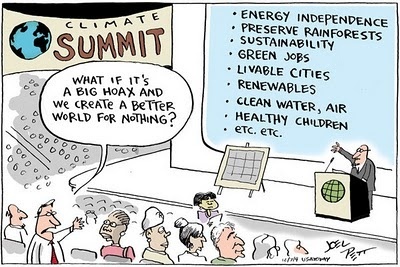
I can assure you, I will not gloat if I am right and you are wrong. If I am right, I’ll be too busy struggling to breathe, or begging for water to say “I told you so.” If you are right, what’s the worst that can happen? whatIfGetABetterPlanetForNothing

As Secretary of State John Kerry said recently,

“If we make the necessary efforts to address this challenge – and supposing I’m wrong or scientists are wrong, 97 percent of them all wrong – supposing they are, what’s the worst that can happen? We put millions of people to work transitioning our energy, creating new and renewable and alternative; we make life healthier because we have less particulates in the air and cleaner air and more health; we give ourselves greater security through greater energy independence – that’s the downside. This is not a matter of politics or partisanship; it’s a matter of science and stewardship. And it’s not a matter of capacity; it’s a matter of willpower.”

Not making a decision IS making a decision; a decision that might well doom the rest of us to not taking a proactive stance in working with the environment.

I understand that the thought that your children and grandchildren will not live in the same world you grew up in is frightening, but denying the reality of the changes around you is not the solution. Mankind is contributing to climate change. We ARE guilty. But we are presumably intelligent and brave enough to accept these facts and work towards solutions.

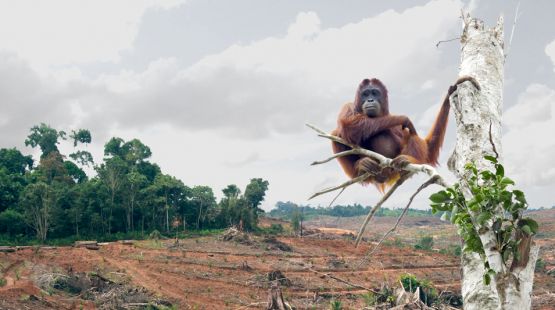
Those palm forests being grown in the smouldering coals of decimated rainforests throughout Africa, Asia, North America, and South America, are financed and put into place by large corporations who place profit over humanity’s future, while the country’s leaders are bribed to look away from their country’s destruction. orangutan palm forest

Palm foresting is linked to major issues such as deforestation, habitat degradation, climate change, animal cruelty and indigenous rights abuses in the countries where it is produced, as the land and forests must be cleared for the development of the oil palm plantations. According to the World Wildlife Fund, an area the equivalent size of 300 football fields of rainforest is cleared each hour to make way for palm oil production. This large-scale deforestation is pushing many species to extinction, and findings show that if nothing changes species like the orangutan could become extinct in the wild within the next 5-10 years, and Sumatran tigers less than 3 years.

In total, 50 million tons of palm oil is produced annually, supplying over 30% of the world’s vegetable oil production. This single vegetable oil is found in approximately 40-50% of household products in countries such as United States, Canada, Australia and England. Palm oil can be present in a wide variety of products, including: baked goods, confectionery, shampoo, cosmetics, cleaning agents, washing detergents and toothpaste.” (http://www.saynotopalmoil.com/Whats_the_issue.php

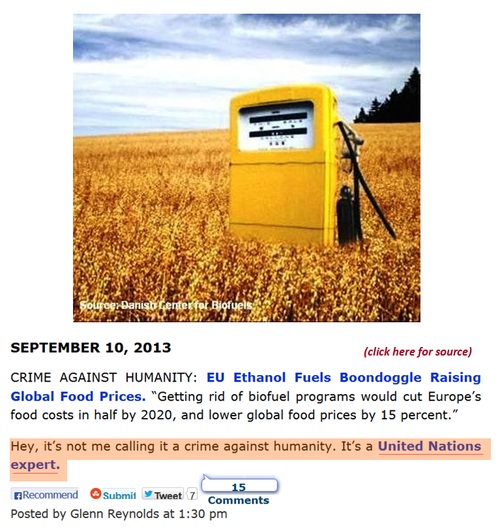
crime against humanityLook, no one is asking YOU, personally, to handle the enormous and expensive clean-up job that we need to do to try and save SOME of our species, and human life. It’s not down to you, personally, to have all the answers to how we continue to feed all the people in the world, or what we’ll do when oil runs out.

But it is down to you, and me, and everyone – every country, every world leader – to acknowledge that we can’t keep putting money over people. Those days, of mindlessly consuming without a thought to where all the goodies are coming from, are gone.

clean up your mess Mother EarthEvery day that passes ensures further compounding of climate change effects. What was once thought to be safely decades or centuries away, now looks to be our problem, not our kids’. (And why were you leaving it to your kids and grandkids anyway? This is YOUR mess .. YOU clean it up.)

The time for dithering over climate change and who’s responsible, is over. It’s now time for action. Let politicians know we will not allow corporations to suck down our country’s resources at the expense of the people. Protest, campaign, work with eco activists. VOTE!.

It would be an awful shame to lose mankind over a fear of causing offense to others.

coping with grief about climate change

For an interesting read on what it means to accept climate change, and all of the fear and sorrow and regret you inevitably feel, I recommend this column.

As the writer says, “To cope with losing our world requires us to descend through the anger into mourning & sadness, not bypass them to jump onto the optimism bandwagon or escape into indifference.”

http://www.ecobuddhism.org/wisdom/psyche_and_spirit/tgg

Running On Empty


It’s minus -21C today – that’s 5 below zero in Fahrenheit – and it’s so cold my cats have cat I has a sadgone beyond being angry and have become despondent, either staring sadly into space or denying the existence of the world with their heads smacked up against a wall. I’m sitting at my desk, wrapped in a black flannel poncho, and wondering where I’ve left my fingerless gloves.

I sprang from my bed this morning, rested and brimming with ideas of ‘great social and political import,’ but instead of researching, I’m waiting for oatmeal to cook – this is not the sort of day you face on an empty stomach.

On days like this I am very grateful for the science and technology that allows me to stay warm. I’m over the moon that I can flip a switch and have light to see by, and flip another switch to start up my computer and read mail and messages from family and friends. I’m really pleased that I have warm clothing that just rests in my closet until I want to wear it, and I’m grateful for the closet being part of a house that has walls and a roof that keep out the worst of the cold.

Silly-HolidaysWe often take for granted what less fortunate people would consider luxuries. We set aside a day here and a day there to give lip service to the giving of thanks, the honouring of lovers, parents, veterans and a host of others to whom we see fit to throw a bone. “Here you go, secretaries. It’s not much, but we’re calling today National Secretary Day! As soon as you’ve read that card, I’ll have a coffee with two sugars. Thanks for being you!”

Our culture has moulded us into people that can never have enough. Everywhere we turn we’re told that we’re missing out on something – a new power drill, an iPhone6, a bigger or tidier home, a more luxurious car, vacations in the sun, and most importantly … money, money, money!

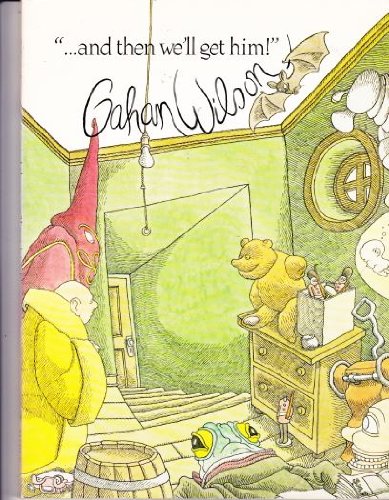
and then we'll get himEven though studies have definitively shown that those with heaps of money are not significantly happier than those with enough to comfortably cover their needs, we’re still told that it is only with the amassing of wealth that we can really be content.

In reality, rich people are not all tanning by their dollar-shaped pools while chatting casually with the men and women we’ve elevated to media stardom. They’re far more likely to be spending their time trying to get yet more money, in any way possible, and are probably more anxious and hostile than you are when trying to decide whether to go with a name brand tin of peas or the generic house brand.

Scrooge-PorpoiseBeing addicted to money is like being addicted to drugs; at first, a small amount gives you a buzz, but as time goes by, you need higher and higher doses to maintain the high. And if money is your drug, that upward spiral contains another component – a need to have more than anyone else, to have it all, regardless of whom it damages. Exorbitant, mindless wealth precludes empathy towards those who struggle to survive on minimum wage or government assistance.

“The peasants have no bread!” “Then let them eat cake,” tittered Queen Marie Antoinette. Her joke, rather than having them rolling in the aisles, soon had heads rolling from the guillotine instead.

That anecdote is likely only the fabrication of Jean-Jacques Rousseau in his autobiographical, “Confessions,” but has been used ever since as a cautionary tale of the perils of great wealth and self-indulgence in the face of social unrest. One would think the lesson would be self-explanatory, but apparently the accumulation of wealth does not always translate to the accumulation of historical knowledge.

In Canada, we can point to arriviste Kevin O’Leary, who, with a net worth of US$300 million that the true 1% would consider pocket change, can’t seem to stop patting himself on the back. When he’s not crowing over his own wealth, he’s exhorting the poor of the world to pull themselves up by their socks – even if they don’t own any socks.

But of course, that’s the dream we’ve been sold since the Industrial Revolution. “Come, work for me, make me wealthy and I will share my largesse. You too can be like me, all you need do is work hard, save your money, and keep your nose to the grindstone.” And we bought it, for decades. We called it the Protestant work ethic, and called anyone who didn’t agree lazy and stupid.

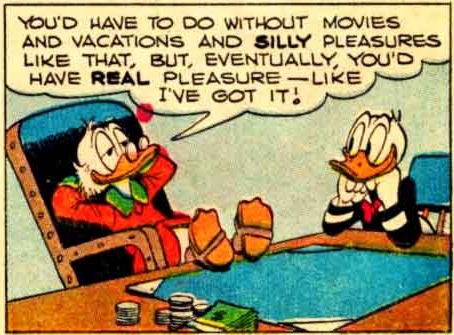
scrooge silly pleasures“The Protestant work ethic (or the Puritan work ethic) is a concept in theology, sociology, economics and history which emphasizes hard work, frugality and diligence as a constant display of a person’s salvation in the Christian faith, in contrast to the focus upon religious attendance, confession, and ceremonial sacrament in the Catholic tradition.

The phrase was initially coined in 1904–5 by Max Weber in his book The Protestant Ethic and the Spirit of Capitalism.” (Wikipedia.org)

We forget that his essay was his observations on the Germany of his time, and not a ‘how-to’ manual. Weber considered himself agnostic. His argument was that Catholicism, with its emphasis on doing good works in the hope of eternal salvation, rather than pursuing wealth for its own sake, impeded the development of the capitalist economy in the West.

Capitalism depends upon everyone in the society believing in the same goals. When the West had a booming middle class, there was room within the prosperity to dream of a country free of traditional constraints. We could reach out a hand to those who needed help, be they poor or infirm, or young or old. That sense of community resulted in government safety nets and a surge of infrastructure building that connected and included all of the people, regardless of their economic place.

North America looked at what they had wrought in the 1940’s and ‘50’s, and found it good. Good enough to not make a priority again until it started to collapse around us.

glittering TorontoIt’s been decades since the roads and bridges and communities were put in place, decades in which the needs of the wealthy became more important in politics than the needs of the tax payer. In Toronto, once Canada’s most glittering city, our highways are clogged with commuters, while our transit system is woefully inadequate to shuttle workers from their homes to their jobs. The local politicians have been arguing about whether to tear down the eastern end of the Gardiner Expressway since the 1990’s. And the majority of our subway system, which opened in 1954, is held together with patches and prayers.

business and politicsThere’s blame enough for everyone at this sorry state. Although we love to complain about ‘the system,’ every aspiring politician has to present a platform that will be seen to not only address community issues, but cost the tax payer less. Once in office, the newly elected official can point to budgetary concerns, and remind us all that there aren’t any funds since he’s cut taxes, just as we requested. Or that they are working on a solution, but we mustn’t hope to see real change until some year in the future where they will hopefully no longer be held accountable for the project and the additional costs incurred during the delay.

Politics on crosswordFor corporations, political concerns are less about the community, and more about expediting the accumulation of more wealth. Despite needing an infrastructure that allows workers to arrive at the work place on time, and roads and other delivery systems to get product to consumers, the emphasis is placed squarely on tax cuts that they have convinced politicians, and even many consumers, will result in a more equitable distribution of wealth.

Corporations spend billions on pushing forward measures that will deny workers fair wages and benefits, and will spend yet more on media essentially blackmailing consumers into giving them what they demand. Health care, no. More tax cuts, yes. Or we’ll take our ball (company, franchise) and go home. Many even believe that we have no other alternative but to agree.

The last several decades of austerity for the general public, but unheard of wealth for the few, is slowly shaping us into a timid, obedient mass, who are only valued as long as we are able to further enrich business through our labour and consumption of goods and services.

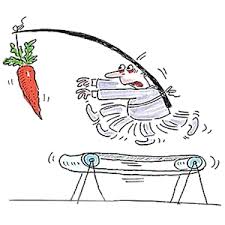
hedonic-treadmillThe pursuit of happiness has become a joyless pursuit of money, dooming its followers to an endless treadmill of greed and desperation. You’ll never catch up to the 1%, no matter how hard you try, but real happiness and satisfaction can be had in a life that encompasses empathy, generosity, and gratitude for what you’ve achieved.