(originally published Dec 13, 2015, on Bob Segarini’s WordPress)
My mum embodied the Spirit of Christmas. She loved everything about the holiday, and she made every one of my childhood Christmas’ as merry and bright as she could.
She’d grown up in the depression, and my family always struggled financially. But mum knew that Christmas wasn’t about money. When times were tough, she’d tell us it would be a “Hoodoo McFiggin” year – that meant the only presents would be things she had to buy us anyway, just to keep us clothed and fed – underwear, socks, boots. Presents were lovely, but some years, presents could wait. Christmas was about gathering with family, and sharing what we did have, and what we had to share was love.

She just had so damn much joy and childlike belief in the season that it all came naturally through her to us … the breathless lead up that began months before, when she’d start asking my sister and I what we were going to ask to receive from Santa, and the admonition that we must be very sure of what we’d tell the Big Man when the day came … this was serious business! We were to name only one important item we really, really wanted. If there were other gifts, they would be of Santa’s choosing. We’d spend hours arguing over what toys were best, what we really wanted, and we’d change our minds a zillion times before our visit to Santa’s Kingdom.
Nor were the needs of others to be forgotten. We’d be given a small amount of money, and a list of those we needed to delight with thoughtful gifts. It’s extraordinary how far $5.00 could go back in the sixties. We would have been mortified to not have a gift to give to any of the family who had brought a gift for us. Some years would find us digging through our own stash of precious things, in order to find something we could wrap quickly and present to an unexpected guest.

In the run up to the Day itself, we’d drag out the boxes of carefully packaged ornaments that Mum had collected through the years. She’d linger over the battered aluminum stars made from pie plates, reminding me that she and I had made those together, one year when I was very young, and recovering from the mumps. She’d carefully unwrap the fragile glass ornaments she’d had since she and dad first married, each colorful globe a warm memory. And she’d always linger over a set of orbs, some round, some tear-shaped, so transparent they reflected rainbows, so precious and delicate, “they’re like soap bubbles , Roxanne! Aren’t they beautiful?!”
We had to have a real tree. She felt there was no point in having a tree if it didn’t come with that delicious smell, and the scratchy feel of pine needles under foot. The tree would find a place of honor in the dining room, and strict instructions about its care and watering were delivered. After the tree was set into the metal holder, she’d draw a bright red and sparkly cloth gently around the base, and then add puffs of ‘angle hair’ to make the tree look like it was floating on a cloud.

She’d drape the tree’s branches with long strands of tiny glass beads, the beads a little more worn every year, but shining nonetheless. The box of tinsel was precious too; after Christmas we’d gather as many of the used strands as we could and save them for the following year. We had two special toppers for the tree – one, a paper plate collage of an angel adorned with cotton batting that I’d made in first grade, the other , a plastic doll dressed as an angel, it’s halo tipped jauntily to the left.
Christmas songs would be playing on the little record player, and we’d all sing along as we decorated. Jodi and I liked to make up new and naughty words to some of the classics, just to make mum laugh, before she’d chide us to “Behave! Santa hears and sees everything you do!”

Once the tree was up and decorated, we went into a two week hiatus, where the other 50 weeks of naughtiness were replaced by determined niceness. We’d wait breathlessly for the Christmas specials to appear on the TV; without video or DVD, you had to be home to see “A Charlie Brown Christmas,” “How the Grinch Stole Christmas,” or one of the other animated delights, most of which seemed to be Rankin Bass productions.
As my sister and I got older, we began to appreciate more adult offerings; Jodi loved “It’s A Wonderful Life.” My favourite was “Holiday Inn,” with the moment I waited for being when the heroine posed in silhouette against a giant red paper heart, before dancing through it … and breaking poor old Bing Crosby’s heart.
And of course no Christmas was complete without the scary, but ultimately uplifting, black and white classic … Alastair Sim in “A Christmas Carol.” God bless us, everyone!
There was also one special box that contained nothing but photos, recipes, newspaper clippings, song lyrics, and a few very treasured books. Our favourite to read and to have read to us was” Christmas and Snowbound in the Treasured Past,” a large full coloured collection of holiday poems, stories, artwork and photos, from 1961.
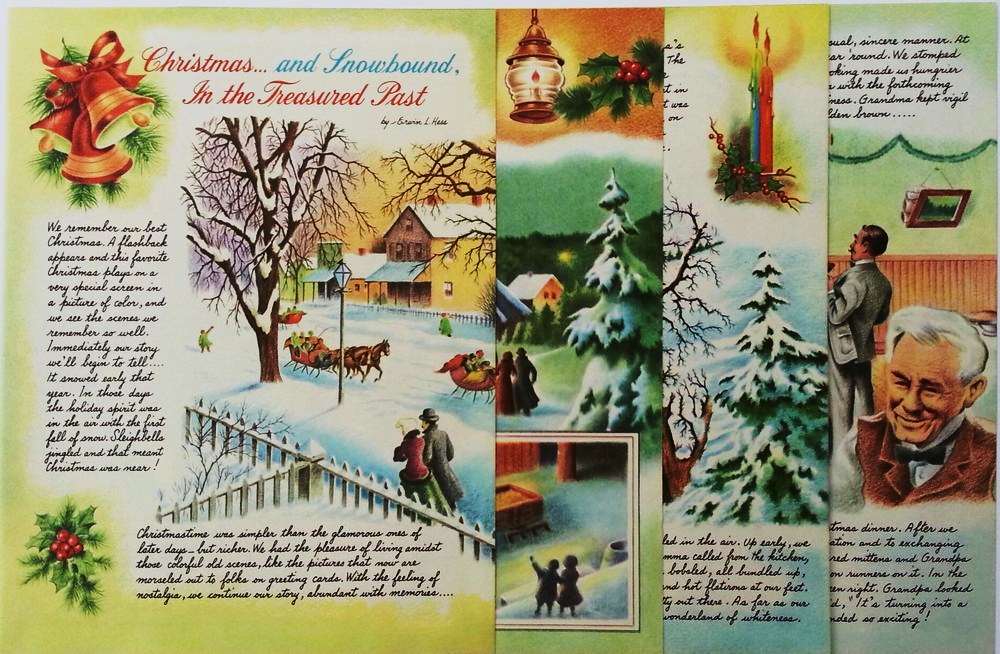
“We remember our best Christmas. A flashback appears and this favorite Christmas plays on a very special screen in a picture of color, and we see the scenes we remember so well. Immediately our story we’ll begin to tell … It snowed early that year. In those days the holiday spirit was in the air with the first fall of snow. Sleigh bells jingled and that meant Christmas was near!” Erwin L. Hess
We loved that book; it epitomized an ideal Christmas, one that we’d never had, nor likely ever would. But it held a promise, so much so that the phrase, “Christmas and snowbound in the treasured past” became our family code for how we imagined paradise to be.
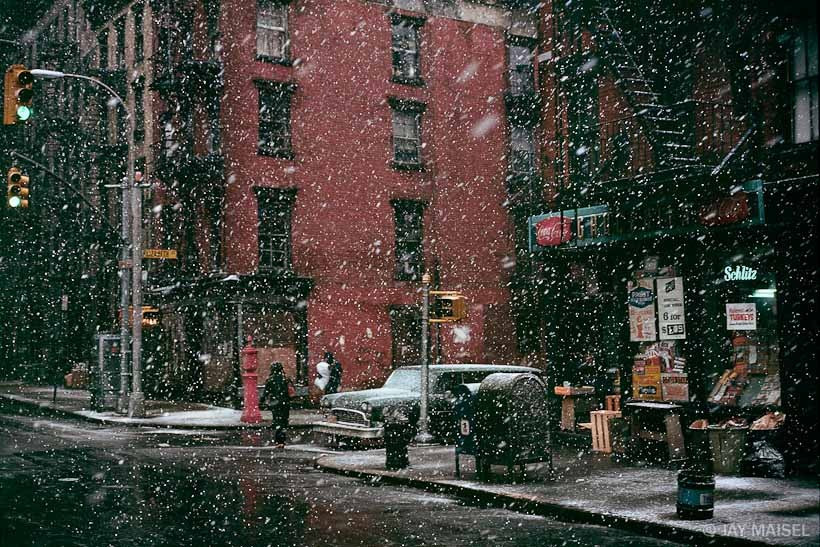
Were winters colder then? Not always … one memorable Montreal Christmas Eve, the family toddled off to church in summer dresses and sandals, only to emerge into a starlit night made brighter by soft, fat flakes of snow gently falling onto the sidewalks. But that was an aberration; most Christmas Eves were ‘see your breath’ cold, brightened by our new knit hats and mittens that Gram had made to keep us warm.


Cold, colder and coldest was more often the weather on Christmas day. During my teen years, the habit was to gather at one of the uncles’ house to carve the roast beast. The best parties were at Uncle John’s big house in Chambly, as there was plenty of room for the kids to play, and even a special room where we could have our own holiday meal, manners and decorum cast aside, while the adults ate, smoked, clinked glasses and laughed about adult matters. We felt a little sorry for them – they didn’t even get to watch TV while they ate!

No matter where the party was held, in time the celebrations would wind down, and we’d gather our outdoor clothing, say goodbye to the 14 cousins, and kiss all the ‘grumps,’ (grown ups) before piling into the car for the long ride home, across snowy roads and an ice-laced Pont Cartier, and then along Sherbrooke Street for miles, our bellies full and heads nodding, and inevitably slipping into sleep just before the car drew into the driveway. If we were small enough, we’d even get carried to our beds, where our new pjs and slippers awaited us.

It was a very different time, and, as with every generation that comes along, we were creating our own version of what Christmas should look and feel like. My mother’s memories were precious, but no more precious than the one’s she created for my sister and me.
Times change, and families are usually smaller than they used to be, and often times, a great deal more complicated. The name we give to that wonderful time of year when we get together to eat and sing and laugh and pray may be Christmas, or Hanukkah, Kwanza, Ramadan, or even Festivus. Heck, call it “Christmahanakwanzika“ if you want to.
What we call the holiday doesn’t matter – what matters is that we take the time to find that small, still place in our hearts, where peace and goodwill live. We gather with our families and friends to join our hearts and hands, to share what we have, and to give thanks that we … together … made it through another year, and are ready to enter another year, whatever it may bring … together.

=RT=














 Dang it. After three fun and family filled days in Montreal, with very little social or TV media contact, I’ve come home to some crazy tales of quasi legal business ‘negotiations’ that skirt ethical decency in favour of political arm-twisting and bullying, and that will have a long and lasting depressing effect on our province’s financial future.
 Globalization and commerce have a huge effect on our cities, as we seek to attain certain visual standards, and to compete for the valuable rental, retail, and corporate investments that bring in and circulate the wealth necessary to pay for yet more municipal growth.
 (I understand that CAMH has some amazing programs to deal with that level of addiction – unless that funding was also part of the death by a thousand cuts Ford’s been inflicting on Toronto for the last year.)
 That means you can kiss the possibility of luring multinational corporations, like Amazon for instance, into planning a long term investment in Ontario, when there is no certainty or surety in the integrity of the elected government. That kind of deal, only good as long as it pleases the “Emperor,” gives the big players no confidence, and no reason to invest in Ontario’s future.
 But if he’s going to remove the gloves, and expose himself to the world as someone who cannot be trusted, perhaps he can do Ontario a solid, and work on ‘fixing’ previous bad governmental sell offs, ripping them from their official owners, and returning them to the people in a display of eminent domain. He can start with overturning the 99-year lease on Highway 407, which was sold to foreign owners by the Tories in 1999 for a mere $3.1 billion. It’s now worth $28 billion, so let’s have that back, please and thank you.
 The Ford Government has now shown that it cannot be trusted to deal fairly with either the citizens of Ontario, or the businesses and corporations that enrich the province. I don’t know who Ford thinks will ultimately be helped by his bumbling, bullying, and braggadocio, but I do know that Ford’s actions have been repeatedly shown to most definitely not be ‘for the people’ and certainly his ballyhooed, ham-handed attempt to rebrand Ontario as ‘open for business’ has only led to a lack of confidence in the province’s fiscal future.
 I believe that my cousin Michael Leo Donovan, a man who loves the city of Montreal with a fervour I’ve never seen excelled, wrote a book about one of the cemetery’s denizens, the statesman Thomas D’Arcy McGee, after repeatedly seeing his tomb on family visits.
 “In 1867 he became a Father of Confederation. It was said that if Sir John A. MacDonald of Ontario and Sir George Etienne Cartier of Quebec were the architects of Canada. D’Arcy McGee was its prophet. He was murdered on April 6, 1868, in Ottawa, while returning home after a session of the House.” (A Shamrock in the Snow, 1996)
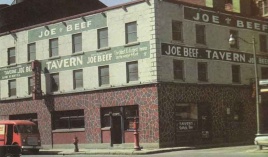 Montreal’s revered Joe Beef has a place of honour. “His real Irish name was Charles McKieman. He owned the famous “Joe Beef’s Canteen,” located near the port. His 3-storey building held a tavern, a restaurant with free food for the homeless, a dorm of 100 beds and a basement full of strange menagerie. He died in 1889 aged 54. His six sons and his wife organized a very impressive funeral for him. Every office in the business district closed for the afternoon, and there were representatives of workers from all classes in the procession.”
 There is also a section dedicated to some of the 76 small children who died in the Laurier Palace Theatre fire in 1927, an event so horrific to Montrealers that a law was summarily passed forbidding the entry of children under 16 to any theatre or cinema screenings. That law remained in effect until 1961
 But the most common ghost spotted on the mountain where First Nation peoples were also known to bury their dead is that of an Algonquin warrior.
 Growing up, I think I always took my family a little for granted. Maybe I just assumed that all families were graced with so much talent, in so many fields. We grew up with my uncle Dennis , co-creator and writer of The Beachcombers; my uncle Leo, whose majestic land and seascapes graced our homes; my uncle John, who was possessed not only of great writing skill, but also of a deep, radio friendly baritone speaking and singing voice; my aunt Pat, a writer, painter, and woman of enormous intelligence; and my own mother, who was a superb dancer, writer, and editor.
 With that sort of heritage, it is almost a forgone conclusion that the 15 children they brought into the world also possessed many talents, not only in the arts, but in social and computing skills. We just never thought that we wouldn’t be able to do whatever we wanted to do with our lives.
 Many of us write. I mentioned Michael, above, but there’s also Kieran, the poet and singer-songwriter; and Rita, who has won multiple awards for her nine books, short stories and essays.
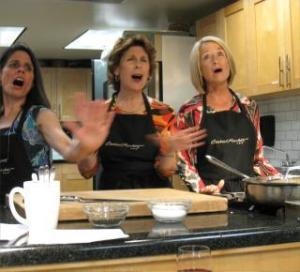 We all sing. Dianne toured with a Harry James tribute for years before settling down in Austin, Texas with her husband, where she also hosts Classical Austin on KMFA radio, produces a weekly vocal jazz show, “Voices in Jazz” for CKUA Radio in Edmonton, and has a new CD release, “A Musing,” featuring mostly original compositions. She also teaches a cooking class with her jazz trio, The Beat Divas. (dianne donovan beat divas.jpg)
 Some of us draw, sculpt and paint. My cousin Aileen took her dad’s painting skill and crafted it into a long career as a well known animal portraitist during her years living in the North West Territories with the Inuit peoples. She now focuses mainly on past life regressions for both pets and people.
 And I’ll get to see some, though not all of them, this week. While the occasion is solemn, visits to my city and my family are never terribly formal for more than a few minutes. We are a group that cannot be repressed for long – laughter, good humour, and our love for each other guarantees a boisterous reunion.
 I’ll bring that up with the clan at the wake next week, and see if anyone’s pencilled in a date for when we can get to the ‘growing up‘ part of life. With any luck, we can keep putting it off forever.

 When we sold our home in 2016, we didn’t worry about where we’d land up next. Surely we’d come up roses on a nice, new place to rent, someplace where we could keep our ‘stuff’ and exist comfortably for the foreseeable future.
 Gentrification has been excising the more interesting parts of the city for at least the last thirty years. Within another three to five years, Yonge Street south of Bloor will be as nondescript as a Scarborough mall, packed with chain stores, fast food franchises, Starbucks, and a Shopper’s Drug Mart on every corner.
 I know that this is no longer the city that I came to conquer back in 1976; there are new generations coming up behind me, young and hungry, and eager to prove themselves in their fields.
 And those who fall between the cracks will live in the tent cities that are now springing up to house the homeless.
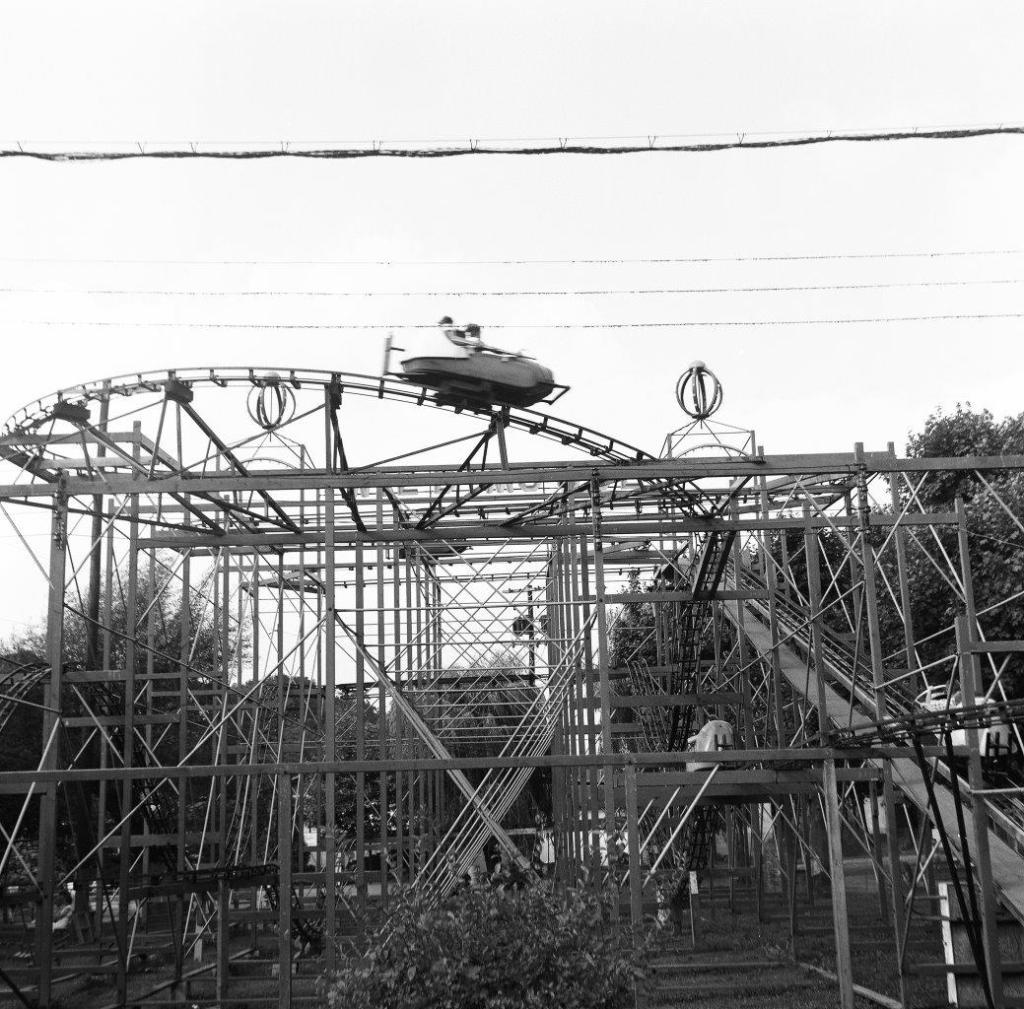
 The Ex holds less appeal for me every year. I’m still mourning the loss of the Alpine Way, and my ears still keen to hear the dulcet tones of the barker demanding that we come to see the “Gorilla Gorilla Gorilla GURL!”
 What did we do all day, I asked myself recently. How did we fill all of the hours when we weren’t minding the brat, fishing, picking berries, tending the smoky fire, or reading soggy comic books and True Romance magazines? Mostly we talked, for hours at a time, about our dreams, hopes, and fears. Some days, I’d make Marianne laugh so hard that she’d pee her pants. If I was in a mood, I’d keep it up until her week’s worth of undies were all strung up on nearby branches.
 king seat belts! And off we’d go, the gang of us, with maybe a dog, and a musical instrument or two for company, headlong down the steep road, high as kites, heading for the dam so that we could continue the revelry, at least until the purple micro dots wore off and/or the sun came up.
 I wonder what ever happened to Donna, the dreamy blue eyed beauty that loved the Monkees as much as I did, but chose a hardscrabble life mucking out barns instead, determined to stand by her longhaired, drug dealing, man. Is she still living in rural Canada or America, amidst macrame pot holders and peace symbols? Or did she wake up one morning and realize in a horror stricken panic that she could have been and done anything she wanted to, had she chosen differently?
 Because, it is implied, even if the art is not Louvre-worthy, that people of colour, and the inner city poor, should at least have the opportunity to feast their eyes upon such statuary. That the monument honours a man in support of slavery and a slave trade that treated the park’s attendees ancestors as human cattle, is a mere peccadillo in their eyes.
 Make no mistake; the decision to remove the statue was a democratic decision. The reasoning behind the removal was sound, fiscally conservative, and sensitive to ALL of the residents of the city, not just those who wanted it to remain.
 I haven’t been to the parade in years, though I did get to be one of the rabbit stole wearing girls waving from the back seat of a convertible many years ago as the “Miss Irish St Augustines,’ in Montreal.
 as well as Catholic. Prejudices ran deep in the north and could be seen in newspaper cartoons depicting Irish men as drunkards and Irish women as prostitutes. Many businesses hung signs out front of their shops that read “No Irish Need Apply“, or “NINA” for short. The initial backlash the Irish received in America lead to their self-imposed seclusion, making assimilation into society a long and painful process.”
  ey stumbled off the boats, fleeing famine and political strife. Many of those marching in St Patrick`s Day Parades today have no interest or stake in the politics of modern day Ireland, but the urge to celebrate their heritage remains strong.
 frustratedboomers