CERBing the Beat


by Roxanne Tellier

COVID-19 hit Canada hard somewhere around the second week of March, 2020. I remember it well, because the shutdowns began in earnest just days before my husband’s birthday, and right about the time that Mirvish Theatre sent me an email advising me that I’d be receiving a refund for the tickets I’d purchased for a show that week. The theatre had gone dark, as had most of the city’s offices, stores, services, and restaurants. 

There’d be no night on the town, no birthday dinner or musical event for us that year – nor the following. And when you get to a certain age, you’re not sure how many more birthdays you’re actually going to get to have, so celebrating them should be a priority.

Because we are older, and retired, most of the aspects of the lockdowns had less affect on Shawn and I than they did on those who are still in the work force. Sure, it was inconvenient, and learning to get up early enough to catch the ‘senior hour’ at the few stores that opened at 7 a.m. wasn’t much fun. But really, those pension cheques, small as they are, just kept showing up in our bank accounts like clockwork, so our income didn’t drastically change in response to the pandemic.

For most Canadians, however, COVID hit hard, and it made a beeline for their wallets. Layoffs, combined with unexpected costs, sent fear through the hearts of those in the gig economy. People that had travelled out of the country, whether for business or pleasure, were suddenly finding themselves having to pay for pricey emergency flights back home, their work or tours cancelled without notice. 
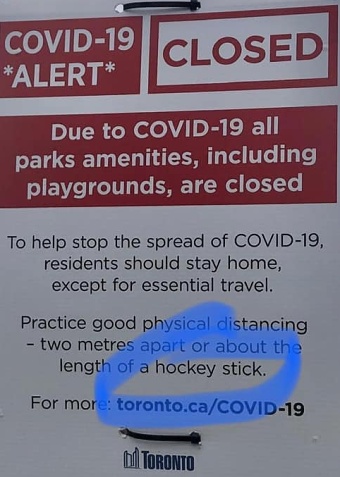
It soon became apparent that the entertainment business had a much longer reach in our economy than we had previously realized. For every musician, actor, and performing artist in Canada, there is a support team that can encompass a few in their personal orbit, or can stretch to cover a small city’s population of ticket sellers, ushers, hair stylists, makeup artists, agencies, seamstresses, catering companies, lighting crews, sound crews, and so many more.

For every restaurant that closed, the layoff of people directly employed there created ripple effects that spread across the country, as food chains were broken, and farmers wondered how to plan that year’s crops.

COVID-19 did not just upend the Canadian economy; it turned the economy upside down and shook it hard enough to loosen every dime that might have been put aside for a rainy day.  For a large proportion of Canadians, financial security was revealed to be an illusion.  

Ironically, many of those hit hardest were those that had embraced the idea of entrepreneurship, of pulling themselves up by their own bootstraps, and who had kicked over minimum wage jobs for a chance at the brass ring of working for themselves.

As many businesses closed their doors, the few that were allowed to remain open had to adjust to the implementation and costs of new social distancing requirements. As unemployment soared, the Canadian government had to act quickly in an attempt to safeguard jobs, protect businesses, figure out how to get funds to the vulnerable, and hopefully, avoid the nation falling into a debilitating economic depression that would take years to overcome.

Canada wasn’t the only country that acted quickly to protect its people. In advanced economies with solid unemployment and benefit systems in place, there are already methods in place that could ensure our neediest had a chance to receive benefits to tide them over. There were, however, special problems in distribution at times, often, in part, because of a lack of staff available to help those who fell between the cracks.

In the first few months of the crisis, Canada, along with many other countries, moved quickly to put into place wage subsidies for salaried workers, and compensation for the self-employed.

In Canada, France, Australia and Ireland, a weekly wage subsidy was available for all employees whose livelihoods had been impacted by business closure. The US, instead, spent most of their trillion dollars in subsidies on businesses, with just a small increase, in some states, to their unemployment insurance measures available.

I won’t pretend to be fully conversant with the vagaries of CERB – it was rolled out quickly, and then rolled back a few times, turning into a Frankenstein monster as bits and pieces were added on and then removed, seemingly on whims. For those that had filed taxes for the previous year that exceeded $5000, they were eligible for about $2000 a month in emergency response benefits, capping out at a maximum of $8000 for the initial four-month period.   

 A lot of people didn’t know how to apply, or applied in error through both Employment Insurance and the CERB structure, and yes, mistakes were made. Some applied to receive benefits over and above other benefits they were receiving, and then discovered that getting that extra money meant that they were on the line for paying extra taxes this year.

CERB ended on Sept 26, 2020, and was rolled into an enhanced EI program for those that continued to be unable to work, due to their employment being closed under government regulations. The amount that people can receive has been decreasing for some time, and, as the new Canada Recovery Benefit, provides a flat rate payment of $300 a week for up to 54 weeks, until October 23, 2021. Not everyone receives that full sum.

Between March 15, 2020 and October 3, 2020, when changes were made to bring the CERB response into line with the Employment Insurance benefits that would replace those payments, the Canadian government handed out $81.64 BILLION dollars.

It’s estimated that COVID-19 will cost Canadian taxpayers about $400 billion in benefits and business supplements. And that’s assuming we get back to business soon, and the economy reboots in a timely manner.   
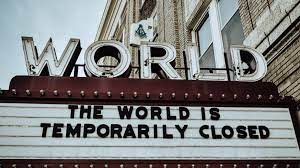
A once in a century pandemic was followed by something incredible – a “Great Pause” in which modern societies responded to a crisis by stopping and shutting down most social and economic activity. While it may have been inevitable, due to the public health crisis, this public policy crisis is an utterly unprecedented grand experiment, and we’ve not seen the end result yet.

It’s been a very expensive virus, for nearly everyone. And we’ll be digging out from under for years.

Except for the privileged few. Those people that worked in government never lost a penny. If anything, they had access to funds more easily than the Average Joe. People who worked in Big Business – especially those in upper management – pfft! If they even lifted their head from their tablets, it was to attend a ZOOM meeting. They worked from home, and most managed to save a ton of money from not having the costs of commuting to work.

Yes, there was a core of Canadian workers that actually profited, in small or large ways, from this pandemic. And those people … are the ones who are now fomenting anger against those who have chosen not to return to back-breaking, unsatisfying, dead end jobs.    

We need a new word to describe the sort of person who profits from a global crisis, and then mocks those who didn’t manage, as they did, to turn a profit on the screams and blood of the sick and dead. Something that sums up the gross entitlement and privilege that oozes from their pores as they troll those people still trying to get back on their feet after losing their jobs, and in some cases, homes.

I’m really glad and proud that Canada stepped up to help those people who would have been the hardest impacted by the government mandated closures of small businesses. The alternative would have been horrific, and something that no modern, civilized society should contemplate. We cannot have a large segment of our population going hungry or homeless, through no fault of their own.

But there are those who, without knowing much about what those workers have endured, are now frustrated at the workers who have had a change of heart about working in minimum-wage, low-paid, thankless, dead-end jobs. They want their haircuts, or their cold beer and wings, and they want it now! How dare these servers, hairdressers, and shop attendants not be on hand, ready and willing, to cater to these entitled swine?

They can’t envision, nor could they handle, the daily mental and physical assaults that those who serve the public endure regularly – a stream of abuse from customers, bosses and coworkers. No long term job security, no benefits, no holiday pay, or even a guaranteed holiday or weekend off. Little respect from the public, despite many servers being better educated or smarter than the customers they serve. I remember well those days when the tips were low, or the times I had to pay for someone’s Dine and Dish, but then still had to tip out to the rest of the staff. Yeah. Been there. Wouldn’t go back. 

I finally got a haircut the other day. It had been far too long. I enjoy the experience of being pampered, of having my head and hair washed and massaged. It’s calming, and a little bit of luxury I can afford. The young hairdresser and I chatted throughout. He told me that the “Great Pause” had been very hard on him, financially, but that the CERB had enabled him to spend some time enjoying his life, his family, his friend, and his city. He told me that, for many people his age, it had been a time when they had been able to re-evaluate their lives. It had been a time to reflect, and to get off the treadmill for long enough to see the other possibilities out there.

Millennials have a keen sense of right and wrong, and they know when they’re not being treated with respect. All workers deserve emotional, financial and legal respect, but in the past, a lot of workers have merely been surviving.
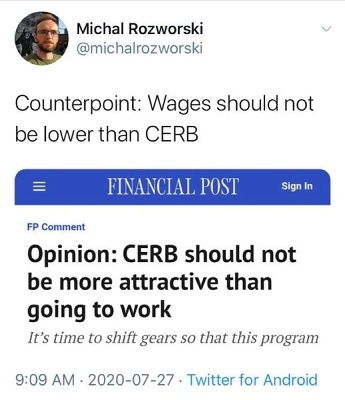
As the city begins to re-open, with more relaxed rules on how staff in hospitality and retail can interact with the public, there’s been a tendency to point an accusatory finger at the staff who previously filled the open jobs in stores, bars and restos, but are now reluctant to return.  

But there’s no hard data to support any claims of a labour shortage.

Wages in stores and restaurants remain very low, at around $15 an hour. If there were a true labour shortage, those wages would be rising. But they are not, because store and bar management are asking staff to return at low wages and rebuild the store or bars profits on their own backs. In truth, raising wages would only make it harder for management to recruit cheap, desperate, and often inadequate, labour.

Quote: “It’s no mystery how to recruit and retain a more stable workforce: offer better pay, stable shifts, decent benefits, and improved training and safety. Inadequate and irregular hours are actually a bigger disincentive than low hourly wages (almost half of hospitality staff work part time). Reorganizing schedules to allow predictable shifts and more full-time roles would support genuine career opportunities in these industries, rather than a culture of lousy precarious work.

…………………………………………

Other countries have shown that service sector work can offer stable middle-class career paths. Canada could do the same, but only if we prevent employers from taking the easy out — namely, providing them with still more desperate workers willing to work for any wage. If governments respond to complaints about a labour shortage by cutting income supports or importing migrant labour, that will only short-circuit the improvements in job quality these sectors ultimately need.

Only once did Canada’s economy truly run out of workers. That was during the Second World War, when a massive, government-funded war effort ended the Depression and put every able worker into a productive job. We aren’t anywhere near that situation today, but we could be, if we wanted to. We could launch an ambitious post-COVID national reconstruction plan, featuring massive and ongoing investments in green energy, affordable housing, and human and caring services. That would create hundreds of thousands of jobs, end mass unemployment and improve living standards in the process.“  The Toronto Star, August 2021.

Instead, newspapers like the Financial Post, itself a poster child for being dependent on government handouts to pay the bloated salaries and bonuses of it’s incompetent management, work to incite the anger of citizens who have no idea of how back-room businesses actually work.

While writing this column, I put up a request on Facebook for information on what is the current rate of CRB. I was immediately hit with a snarky comment from a troll who wanted to know why I wasn’t out patrolling the streets to find a new job. Yeah, he’s gone. And I’m retired. But if I were someone trying to get back on my feet after the lockdown, and the loss of income for the last 18 months, I would likely have felt assaulted and shamed for not fulfilling that idiot’s idea of what constitutes my right to live and work in this country.  

I don’t know how to explain to someone that vile how ugly, privileged and entitled they show themselves to be. Worse still, that they appear to wear that ugliness and ignorance with pride.

When we consider all that Canada and the world has endured during this time, when we consider where we’ve been and where we are now, it’s a real shame and a black mark on our society, that we have to factor in the likes of those trolls, who seek to foment yet more anger, and to further widen the inequality and inequity that diminishes any nation hoping to become a better place for all that live there.

Into the Home Stretch


by Roxanne Tellier

Okay – who stole July? It was just here a minute ago! In truth, I barely recognized it, under all that rain, but I know I saw it!

1969. I’m in class in my high school, ignoring the teacher’s droning voice, because one of the cool boys is softly singing to me that “Summer’s Almost Gone.” No! I tell him, it’s only May! In that infuriating way that an ‘older’ boy of 17 schools a ‘younger’ girl of 15, Gerry laughs derisively at my childish ways. Ah, he says, it’s gone before it even begins.

We had some good times, but they’re gone. The winter’s coming on. Summer’s almost gone.”

Gerry didn’t make old bones – he died fairly young, like so many dreamers. But he was right about how quickly time flies by, first metaphorically, and then in reality.

Summer used to be when I’d get into the ‘good trouble’ that my mum called ‘bad trouble,’ but it was all part of being young and feeling free. Summer was lying on Anne’s half-roof, slicked with baby oil, chasing the perfect tan. It was Summer Blonde by Clairol, and purple polka-dotted short shorts. Cranking the transistor radio and singing along to “Dizzy” by Tommy Roe. Motown. Learning how to French inhale, buying ‘weed’ that turned out to be parsley, but getting high anyway. Feeling sophisticated when the bottle being passed around the campfire was Mateus. Community swimming pools and boys boys boys!  

But Gerry was right. I blinked, twenty summers passed, and far too soon, I found myself watching my own daughter chase the elusive soap bubbles of teen summer fun. And then she blinked, and now she’s watching her own girls race into their adult years.

Summer’s almost gone.  

This has been such a crazy year. We’ve had highs. We’ve had lows. Many of us have eagerly pursued and received our double shots of vaccine, and have had the joy of embracing family and friends for the first time in nearly two years. I’m mask free when I’m in the still fairly empty streets, only masking up when I have to come in close contact with strangers. Shopping has lapsed into a benign activity, free of a frenetic fear of what you can buy this week, but not the next.

We are in the PushMe PullYou time of COVID-19. Television ads trumpet “Welcome back … back to normal … it was a long time, but now … welcome back ...” But it’s not really normal yet at all.

Baby steps have been taken. We tiptoe back into what was once mundane. First, we nosh on the patio, then, with hesitancy, we head inside the restaurant. Some remain fearful, their eyes darting around the room like woodland creatures at a rest station.

We hear rumours of live music happening, initially on the driveways of the musically inclined, and then, slowly, slowly, in outdoor venues. In some places, musicians play on the sidewalk, aiming their sound at the diners within the venue.   

And, as surely as the swallows return to Capistrano, with the first faint sounds of live music’s return come the first complaints of the music NIMBYs.   

From the Beaches to Birchcliffe, and along Spadina Avenue, the Devil’s Advocates begin their plaintive refrains.

“It’s not that I don’t LIKE music, it’s that I’m trying to be considerate of those that may not, “ they explain. “Even if I personally don’t live anywhere near where this music is being performed, I feel it my duty to complain on behalf of my brothers and sisters who may not be as forthright as I am.”  

“Music broadcasted outdoors in a residential neighbourhood is not considerate!” wrote one such Advocate this morning, about the Happy Pals afternoon outdoor gig at Grossmans.

Several musicians had responses for this ‘brave’ fellow, including one who helpfully suggested that “People who live near Queen or Spadina and are shocked when they hear live music outside, ESPECIALLY AFTER AN EXTENDED LOCKDOWN, will find Burlington much quieter, and they should move there immediately.”

And so say all of us.

Summer’s almost gone.

Can we really be rounding summer’s corner, stampeding into the fall, and heading straight into the last five months of this confounding year?

The new school year is roaring towards us at breakneck speed, neck and neck with dire warnings of a Fourth Wave of Covid-19. This year has had a few twists in the tail. We don’t know any better now, than we did 18 months ago, of what might be on the horizon. Lockdowns? Masking?  Will school age kids be the next group sacrificed on the COVID-19 altar?  

We can’t minimize the trauma that kids, teachers, and all the workers with children, have dealt with since the onset of this pandemic. Don’t wave off the hard work of everyone, parents included, who had to deal with a once in a lifetime public health crisis, while protecting and shepherding the minds of the young. And consider that they have also had to contend with self-important government officials who changed rules and tactics with the wind, and who regularly chose approaches that may have satisfied some economic ideal, but were often completely wrong-headed for the needs of children.

Assuming that Canada sidesteps another plunge into lockdown, our kids and those that care for them are going to be dealing with a lot of conflicting emotions. Getting everyone mentally and emotionally prepared to start a new school year is gonna take a little work.

Many will be drowning in ‘all the feels’ of a new endeavour, all at once. There’ll be fear, anxiety, excitement, sadness, relief, and curiosity, each fighting for attention. They won’t know what to expect, and to help ease that uncertainty, everyone’s going to have to choose some coping tactics to get through tough moments. Hopefully, having some good stress relieving strategies, like using deep breathing to take a pause, will alleviate some of the worst tensions.   

We are all like those children. We’ve been buffeted by trauma, and it’s going to take some time to re-emerge fully. This is the time to be gentle with each other, and to learn the lesson that the Big Pause should have taught us, that sometimes we ride Life, and sometimes, Life rides us.

Summer’s almost gone. August is the Sunday of Summer – Summer’s last stand.

Up Up and Away


by Roxanne Tellier

There was an interesting article in the New York Times last week that talked about a phenomenon known as ‘collective effervescence.’ This term describes the sense of energy and harmony people feel when they come together in a group in a shared experience. That could be anything from a gathering of friends in a restaurant, to the frenzy of wedding guests doing a line dance in synchrony, to the sort of nationalistic madness seen in Little Italy or Little Portugal when their country’s team wins the World Cup.

“Research has found that people laugh five times as often when they’re with others as when they’re alone. Even exchanging pleasantries with a stranger on a train is enough to spark joy. That’s not to say you can’t find delight in watching a show on Netflix. The problem is that bingeing is an individual pastime. Peak happiness lies mostly in collective activity.

Collective effervescence happens when joie de vivre spreads through a group. Before Covid, research showed that more than three-quarters of people found collective effervescence at least once a week and almost a third experienced it at least once a day. They felt it when they sang in choruses and ran in races, and in quieter moments of connection at coffee shops and in yoga classes.  

But as lockdowns and social distancing became the norm, there were fewer and fewer of these moments. I started watching stand-up comedy specials, hoping to get a taste of collective effervescence while laughing along with the people in the room. It was fine, but it wasn’t the same.

Instead, many of us found ourselves drawn into a dark cloud.“ 

(Collective Effervescence, The New York Times, July 2021.)

This lack of opportunity for ‘group joy’ during the pandemic should have paved the way to a global euphoria over any number of happy moments as lockdowns and quarantines ease off.

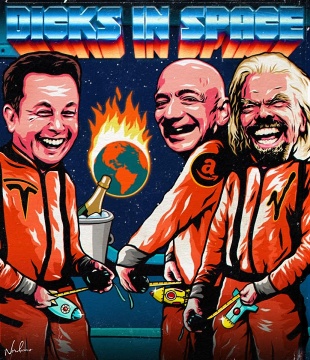
And you’d certainly think that the spate of current and future billionaire ejaculations into near space and actual space would quality as such a bonding moment.

But it seems that one of the many side effects of having 18 long months to navel gaze actually changed the way we think about our planet, and how we look upon those who have the wherewithal to improve worldly conditions, but choose instead self-aggrandization and yet another revenue stream to compound their interests, guaranteed to turn their billions into trillions.  

Billionaires dabbling in being astronauts? Or would they be better called ‘astropreneurs’, since the entire exercise of their expensive playing at space travel centers around their intent to further feather their own financial nests?

In a way, it sort of seems inevitable that some bullish business people would bumble their way into the future of space travel. After all, there’s just no way that an arrogant, madly incompetent, divisive, selfish and bumbling group of doofuses like the current Congress could ever work together to get another space mission organized. It’s laughable to even think they’d be capable. Were entities like the postal office not already in place, they’d never exist under the capabilities and political correctness of today.  Nations can no longer build collectively because we’re too divided and it’s too expensive. The future really does now lie in the hands of the billionaires and their untaxed largesse.

And what more logical series of events could ensue than that Richard Branson, richer than Croesus and a famed daredevil, who, in 2006 played an engineer on the ACTUAL Space Shuttle in the film Superman Returns, would choose to launch himself as the hero the Me Generation didn’t know they needed …Super Billionaire.

None of this hoopla would be happening without the cooperation of several entities, both governmental and social. The media is falling all over itself, terribly grateful to have something to fill up all those hours previously devoted to the prior president, and they’ve always been on the side of the rich – they know from whence comes the butter for their bread.  

So they’re lionizing these billionaires like they’re real life Tony Starks. Lookie here! Branson, Bezos and Musk are singlehandedly building a new endeavour – space tourism! Something that only the very wealthy will ever enjoy, but hey hey my my! If I every get a spare $55 million, I’m on my way to the International Space Station! Just like that!

Questioning the value of this ‘space quest’ isn’t about belittling space; it’s pointing out that that quest comes at a very high cost: exploited workers, the avoidance of taxes by the superrich, and the governmental handouts available to the wealthy while 80% of Americans live paycheck to paycheck.

Do we need space tourism? Not really. Those who are in the know and the most bullish on this new industry foresee revenues in the $8 billion range by 2030, so it’s not that big a deal for the economy. To put it into perspective – Americans already spend more than that, about $11 billion a year, on the carpet and area rug industry.

And that $8 billion is not pure profit. Remember, Bezos will still have to bring in about $5 billlion from his Blue Origin space venture just to recoup what he’s already spent.

By the way, how’d Musk, Bezos and Branson get all those billions to spend on this narcissistic ego splurge?  Well, first there was the tax fiddling, and avoidance of corporate or personal taxes, which, of course, is roundly and soundly encouraged by most right wing parties as the core of their “I got mine, Jack” mantra.

Then there was the $50 million bailout Branson received for Virgin Airline, that never did get spent on the airline. Thanks, taxpayers! (Branson’s VirginCare also grabbed several million from the NHS during the pandemic, for losing out on an $82 million pound contract. The reasoning seemed to be that, if they couldn’t provide children’s health care, then suing the pants off those who would be doing so was the next best thing.) 

And how on earth did the Billionaire Brain Trust manage to accomplish the takeover of a governmental space program? The same way those in the defense industry have always done it – by lobbying.

“Still, for a newbie industry, commercial space travel is quite well established. We know this because it already has its own lobby, the Commercial Spaceflight Federation (CSF). And that lobby is already more powerful than the U.S. Government.

Despite opposition from several quarters, the CSF has been successful in its special pleading with the U.S. Federal Aviation Administration (FAA) and with Congress that it’s much too early to certify the airworthiness of commercial spacecraft or the competence of pilots.

The budding commercial space industry deserves the “learning period” — legi-speak for regulatory laxity — that Congress has granted it until 2023.

The CSF and its Republican allies argue that robust regulatory safeguards in this newish sector would weaken America’s technological prowess.

That is hardly the first time Americans have been asked to put their country ahead of niceties — niceties such as being quite sure, in this case, that your pilot knows how to fly this thing.“                

Toronto Star, July 2021.

That lobby convinced the American space program to effectively shut down, and let the new billionaires on the block take over. 

So, to recap: the planet’s Bright Young Things are now heading off into space (or near space, really, in Branson’s case; Branson’s flight only got up to 92 km above the Earth’s surface. The Moon is about 384,000 km away from Earth.

They got the money to get there by being the best at selling stuff, avoiding paying their fair share of taxes, lobbying (i.e., paying off) the right people to get to put together a commercial version of spacecraft without much oversight or control, and intend to sell their vision to very rich punters who have a spare $200 thousand or so lying around to celebrate Granny’s 100th, or their own 25th anniversary.

Once they’ve established themselves as relatively stable and safe, they will be able to sell their services to any government, including the United States’, as an option that will essentially undercut the costs of maintaining permanent stations in orbit and on the Moon.

There’s also the possibility that their services could be co-opted, or even simply ‘kidnapped’ by entities with a yen to attack satellites, or harness information and intelligence integral to reputable governmental agencies on Earth.

I guess it will be up to each of us to decide if all of these consequences add up to a positive or a negative impact upon the planet.

The costs involved certainly could have had an impact. Last I checked, there was still a global pandemic going on; epidemics of homelessness and addiction; millions of hungry children and adults; climate change burning up half the planet while it drowns the other half; and trolls controlling social media in an effort to subvert democracy. For starters.

Meanwhile, the net worth of Branson, Bezos and Musk is roughly $400 billion. Each of them has more money right now than anyone could reasonably spend in a hundred, overly privileged, extravagantly Marie Antoinette styled, lifetimes.

So how COULD the money they’ve spent on fulfilling their childhood fantasies actually have impacted the 8 billion of us living right now, today, on Planet Earth? 

A mere $8.6 billion would be enough to cover the shortfall of 1.7 billion COVID-19 vaccine doses that will be needed for the 90 lower-income economies by early 2022.

They could easily afford to build affordable housing for every single one of America’s estimated 500,000 homeless people, and then cut cheques to each of America’s 1500 food banks, soup kitchens and food pantries.

Or alternatively, they could solve world hunger. I’m gonna guess that would warrant a little more excitement on their Wikipedia pages than a listing of the cars and houses they spent their fortunes upon.

But the arrogance and selfishness of the wealthy didn’t begin, nor will it end, with this trio. It is, unfortunately, just the way the rich and powerful have always, and will always, roll – at the expense of the many, for the entertainment of the few. Capitalism rewards sociopathy and endless greed.

“Let me just say that (Gil Scott-Heron’s 1970) track, “Whitey on the Moon,” changed the way I thought about the space race forever. It anchored the flight into the heavens, tethering it to the persistence of racial inequality, and pulling it out of the abstract, universal realm in which we like to place our technical achievements. Though I still think the hunger for the technological sublime crosses racial boundaries, it destabilized the ease with which people could use “our” in that kind of sentence. To which America went the glory of the moon landing? And what did it cost our nation to put whitey on the moon?”   

Alexis C. Madrigal, The Atlantic, May 28, 2011.

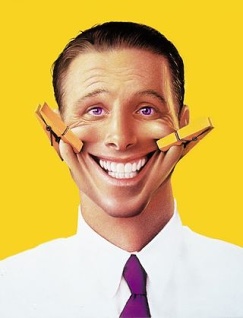
Smile Damnit. Smile!


by Roxanne Tellier  

To be honest, I haven’t much enjoyed the last five years or so. I’m not just talking about politics, though, if there was ever a time in which it became apparent how much politics affects every aspect of our every day lives, this was that time. 

I’ll bet even your grandmother learned how to use the “block” function on her Facebook page.

Almost imperceptibly, the world sustained a seismic fracture, dividing families, communities and nations into camps. On one side, those who believe in equality, and that everyone has human and civil rights. On the other side, those that SAY they sort of agree with those precepts, in theory – but have their reasons for why they really don’t. And, like door-to-door proselytizers, they’d be happy to bend your ear for hours on end, to let you know exactly why they don’t agree with what you’re saying. In progressively louder sentences.

I think the last eighteen months of COVID just did me in. It was the final straw. Eighteen months of fear, uncertainty, deprivation, and doubt. Eighteen months of never being sure what day or month it is. Eighteen months of not being able to come together to celebrate birthdays, weddings or anniversaries. No parties, no musical events, no theatre. And, perhaps the cruelest of all, no chance of gathering to bid a final goodbye to the loved ones we lost.

How could so many people that we love have died, and been buried, with so little recognition or fanfare? Some days, an old friend’s birthday circled on my calendar fills me with anxiety, as I wonder – did they make it through this year? Or were they one of the many who left our ranks with little to no fanfare?

Mustn’t grumble, we’re told. Yes, it’s all hard, but complaining won’t do any good. No, it won’t. Complaining won’t change a thing. It won’t bring back our dead, or our equilibrium.

But.

I’m sick of being expected to simply assimilate this decade’s horrors, compounded by all the crap that the Powers That Be rain down upon the masses, and just smile, smile, smile.

Smile as climate change burns one half of the planet to a cinder, while the other half drowns in torrential rains and melted ice caps.

Smile while our rich cities become unaffordable to the middle class, and smile as the city’s elected officials send hordes of police to evacuate and destroy the homeless camps that are filled with their fellow citizens, citizens who are financially unable to live in the cities they built with their toil and taxes.

Smile while the rich get richer at the expense of the poor, because only the wealthy can afford to run for leadership roles, get elected into power, and once in place, be relied upon to act to shore up laws and regulations that benefit the wealthy at the expense of the common people. 

Smile while federal and provincial leadership is so badly handled throughout a once in a lifetime global pandemic that, while half the city goes mad struggling to figure out how and where to get vaccinated, the other half holds anti-mask, anti-vax, super spreader rallies in the downtown core, unimpeded.

Smile as an orange madman’s most important legacy seems to have been his ability to teach his followers (in the US and Canada) two new commandments:

  1. call anything you don’t like or want to believe ‘fake news’, and,
  2. should anyone expect any accountability or ‘adulting’ from you, double and triple down on your ‘rights’ while denying any responsibility for your acts.  

It feels like there’s no one and no thing making much effort any more. Thanks to the internet, we live in a world where we’ve never been so aware of evil people and deeds, of corruption, of fraud, of social media voyeurs with a sadistic bent, of sickness, death and horror – present or impending – occurring on a global scale.

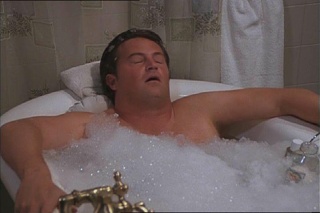
And yet, for the bulk of the population, rather than act, it’s a time to double down on escaping into the soothing waters of social media, where one can bathe in an uninterrupted stream of whatever turns your crank, until the day the grid topples.    

Apparently, it’s never the time to fight to change what seems an inevitable slide into the abyss. There’s something good on television, it’s too hot/cold/rainy out there, and what does it matter anyway? It’s not like anything I do can change the world, right? No, I’ll just stay home. And maybe sign this petition. It’ll be fine.

There is little to no response to any suggestion that our actions might have brought about the mess we are leaving to our heirs. The ability to feel remorse and/or shame seems to have been genetically modified out of our systems. Or have we just passed the buck for so long that we no longer remember what happens when we’re the last one’s holding it?

Our legacy of little horrors only begins with the hoards of useless and unrecyclable junk that broods in our basements and attics. Our children will live with their memories of a better planet. Our grandchildren will never know the world that baby boomers took for granted.

And I say to myself …. Where’s THEIR Wonderful World?

I will be honest; I don’t know where we go from here. The bus is on fire, and we may have missed our last chance to turn it around.

But I’m tired of smiling, and pretending that what we see happening around us, isn’t happening. That way madness lies.

All that’s left is to prepare in the way Maya Angelou advised, “Hoping for the best, prepared for the worst, and unsurprised by anything in between.”

What a Difference a Year Makes


by Roxanne Tellier

On January 25th, 2020, a Toronto man returning from Wuhan, China was the first presumptive COVID-19 case in Canada. By March, with the disease raging across Canada, the World Health Organization had declared COVID a pandemic, the NBA, NHL and most other sport leagues had suspended their seasons, while the Olympics were officially postponed to 2021, the Juno Awards were cancelled, Parliament went on break, and schools began to close from coast to coast.  

We went from zero to 60 in a matter of weeks, and many, many mistakes were made as countries and organizations began to try to manage this novel, and extremely frightening, attack on our health and ways of life. 

We began a global journey through a once-in-a-lifetime experience, which had much in common with the blindfolded fumblings of Sandra Bullock in the film Bird Box;   it’s a miracle either saga finally found a respite in which to take a deep breath, and you just know there’s still a further twist to the tale, which will involve yet more monsters.    

Mistakes were made. Many, many dumb and well-meant mistakes were made, by many very smart and well-meaning people. Remember when Dr Fauci told Americans that they didn’t need to wear face masks? As it turns out, that was because there were severe shortages of the personal protective equipment (PPE) needed to keep healthcare workers on the front line of hospitals safe. Some nurses and doctors had to resort to wearing plastic bags instead of proper gear, to try and protect themselves, and many died while trying to save the sick.

Sadly, experts like Fauci and the U.S. Surgeon General Jerome Adams knew that the same Americans emptying stores and hoarding toilet paper and hand sanitizer were likely to put masks on the ‘must have’ list, further endangering those health care workers. Were Fauci’s words a lie? A mistake? A true reading of the selfishness, greed, and lack of empathy they knew Americans were capable of exhibiting in a crisis?

16 months later there are anti-maskers pointing to Fauci’s words as justification for disobeying public health regulations currently in place, so I’m not sure that his impulse was his best career decision. It’s not right up there with injecting bleach into your veins, or shoving light sticks up where the sun don’t shine, but Fauci’s probably justifiably low opinion of his fellow citizens had a pretty serious rebound effect.

On March 30th, our PM Justin Trudeau announced a new wage subsidy program that would cover all businesses whose revenues had dropped by at least 30% because of COVID, and on April 14th, that aid was extended to nearly 5.4 million Canadians as CERB (Canadian Emergency Response Benefit)  Some received as much as $2000 a month, which, along with other pandemic discounts, like a reduction of primetime Hydro costs, allowed singles and families to limp along as stores were shuttered, and restaurants and bars closed their doors – some, forever.

For a very long time I kept a tally of the rising numbers of the dead, even as I noted in my calendar the passing of friends, whose lives were never officially celebrated, because of limitations on gatherings.  

Throughout the summer of 2020, families struggled to keep themselves and their kids occupied, as teachers frantically worked to put together some sort of curriculum that they still did not know if they would be presenting in person, or by ZOOM. Most teachers had to do double duty, and prepare prospectuses for both aspects.

At the beginning of October, as America neared the critical November presidential election, it was suddenly announced that then president Trump had tested positive for the coronavirus. He was whisked away for treatment, where a battery of specialists laboured to save his life. We now know that it was touch and go for him, and that he would not have survived had he been an ordinary patient without access to emergency and experimental medications. Still, insouciant and ungrateful, he was released from hospital within a few days, and triumphantly removed his face mask for the camera in a carefully posed for posterity, ridiculous, photo op. 

(And is it just me, or does that pic not scream it’s resemblance to the imagery and vibes of The Man In The High Castle?) 

Had he died, or had he finally told his followers how severe the disease was, and had he told them that simply masking themselves could help with slowing the spread, he might have saved hundreds of thousands of lives. But he did not, and the death toll in America soon hit a landmark figure – half a million American souls had died from this horrible disease.

Trump received 74 million votes, but there is no indication of how many of those were ‘mercy’ votes. Regardless, the tally was still lower than Biden’s, who received more than 81 million requests to take over before the ship of state went down for a third and final time.

The development of a vaccine was on the horizon. Although it normally takes about 10 to 15 years to produce a new vaccine, scientists had been working on something along the lines of COVID for a decade, since the SARS epidemic of 2009. Between that headstart, and the liberal application of government funding, at least three workable vaccines were produced in record time.   

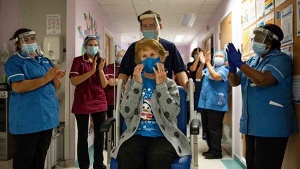
On December 8th, the first Pfizer vaccine was injected into the arm of 91 year old Margaret Keenan, of Britain, and on December 14th, both Canada and the U.S. began administering vaccines to their citizens.  

But there’s a difference between having a vaccine available, and getting that vaccine out and into the arms of those who need it, and in this case, about 7 billion people needed two doses of it, and STAT. Many, many more mistakes were made.

While governments struggled to put schedules into place for the procuring and administering of the vaccine, the toll of the sick and the dead continued to rise around the world. Quebec and Ontario were hard hit, and curfews and stay-at-home orders took effect, restricting our movements.   

Winter dragged listlessly into spring. Time became amorphous, and most days, I didn’t know if it was a Monday or a Thursday. Nor did I care. I applauded those that took creative control of the lockdown and produced work, but refused to beat myself up for not being industrious in traumatic times.

On April 7, 2021, a much more vigorous third province wide lockdown went into effect in Ontario, and Ontarians learned a new term – ‘non-essential goods.’  We discovered that this covered children’s toys, books, underwear, shoes and sandals, hobby supplies, and non-garden centre gardening items.

Everyone had their high and low points; I’ll never forget the day I nearly burst into tears in a Dollarama because the foam mannequin head I needed for a craft project was deemed ‘non-essential.’  It wasn’t the foam head I was mourning, so much as the very idea of simply entering a store, choosing an item, and being allowed to freely purchase said item. That’s what I’ve done all of my life. Having that ‘right’ denied cut like a knife. I had had enough. I did not want to play pandemic any more. 

On the day that Ontario’s shopping lockdown was lifted, consumers headed out in droves to satisfy their itch to buy-buy-buy. There were lineups at every store, including the dollar shops and charity outlets. One morning I wanted to shop at a local charity store. About twenty minutes before the store was to open, there were 17 people in line ahead of me. When I asked some of the waiting if they had a specific purchase in mind, they told me that just being able to get into a store, to see what was available, and to freely touch the items was all they wanted.  

We are not just human-touch starved, it seems. We are also starved of the everyday, ordinary tactile experiences that we used to take for granted.

Because I have certain health issues, I made it a priority to get vaccinated as early as possible. Shawn and I had our first jab April 6th, and our second on June 7th. We’re now covered and eager to get back to some semblance of a social life in the near future.

well, not quite THIS social … 😉

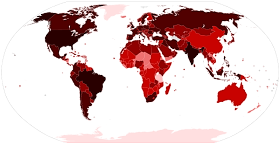
But sixteen months after our COVID-19 journey began, the world has actually had more COVID deaths in 2021 to date than it did in all of 2020.  It’s NOT over. We, the lucky and the vaccinated in the West, can’t afford to rest on our jabbed laurels; the ill and the dying in less wealthy countries are producing variants that may be able to sneak past our vaccine defenses.

Where are we now? The Delta variant of the virus still poses a danger for the unvaccinated, and it’s apparently more contagious and deadlier than the previous version. The fully vaccinated are probably protected. This variant represents a phase of the pandemic that focuses on the unvaccinated.  

Even as the number of Canadian hospitalizations and deaths fall, people around the world are reimposing mask requirements and death tolls are rising. In Africa, a third wave is surging, and threatening to be it’s most devastating and worst wave yet. India has recorded over 30 million cases, and nearly 400,000 deaths. In Sydney, Australia this week, at least half a million residents have been forced into lockdown for yet another week.

And still there are no plans to shelve the Tokyo Olympics, which open officially in just four weeks. One option in play is a ‘no-spectator games,’ but the situation changes from day to day, and organizers need to remain flexible to changes. Since there’s already signs of a resurgence of infections (1% in the last week) athletes have to roll the dice to decide whether or not participation is a wise choice for their health and their careers. 

Last week, two members of the Ugandan team tested positive for the Delta variant upon entry to Japan. No matter how extensive the testing may be, there are 11,000 Olympian athletes and 4,400 Paralympic athletes entering Tokyo, along with the tens of thousands of additional participants amongst the coaches, judges, and federation officials. That’s a lot of testing. And a lot of room for error and mistakes.

Covid-zero nations are working diligently to eliminate the virus through isolation and mass vaccinations. Biden’s White House has said that it will provide Afghanistan with 3 million doses of the J&J vaccine, of which only one dose is needed, along with oxygen and other supplies, in an effort to help with an outbreak of the delta variant.

Overall, the United States is donating 55 million doses to the world. Canada has plans to donate 100 million doses as part of the G7 effort to provide a billion doses to low- and middle-income countries, but for now, we are donating 13 million ‘surplus’ doses, which are mainly comprised of brands which we are either having difficulty bringing into Canada, or which haven’t been authorized for Canadian distribution.

It’s been a devastating sixteen months, and it’s not over yet. We’ve seen the best in people, and we’ve certainly seen the worst come from the words and deeds of the selfish and the ignorant. Many of us seem determined not to give those who got us here their due; again, there have been mistakes made, but we’re still standing, and in Canada, we’re closing in on the finish line, with reasonable numbers to show for this unexpected and overwhelming calamity.

We’ve learned that being elected can’t turn a bad politician into a leader, and that leadership doesn’t come naturally to all contenders. And we’ve learned that we, as a nation, are strong enough to make it through a crisis that brought other countries to their knees.

And for that, at least, we can be justly proud.

Forty Acres and A Mule


by Roxanne Tellier     

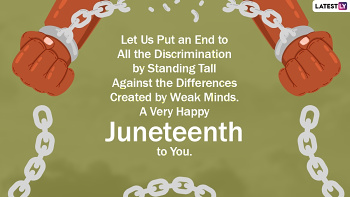
President Biden’s declaration of June 19th as a new federal holiday – Juneteenth – is an incredible moment for a nation in recovery from a global pandemic. At least half of America is rejoicing at this leap forward in race relations in the nation.   

The other half – well, they wouldn’t be happy unless they were celebrating the cancellation of the Civil Rights Act itself, really. You know, the Civil Rights Act was very nearly not a thing. Fact. The Republican Party was adamant that the Act not be authorized, despite the original powers contained being quite weak. The House passed the bill (290-130) on February 10, 1964, and after a 54-day filibuster, the Senate voted 73-27, for. (The filibuster was led by Democrat senator from Georgia Richard Russell, who said, “We will resist to the bitter end any measure . . . to bring about social equality and intermingling.”) However, it was not until a further amendment was added that the Civil Rights Act was signed into law on July 2, 1964.

There was a similar foot-dragging that went on concerning Martin Luther King Jr Day in 1983. You see, a president (in that case, Reagan) can propose a federal holiday, but that doesn’t make it so in all of the states. Neither the president nor Congress have the power to declare a national holiday. That’s one of those ‘states rights’ things. Which is why it took 17 years, until 2000, before MLK Jr Day was actually a national holiday.  

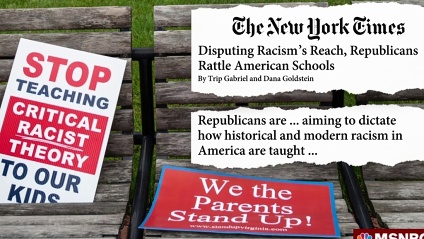
In the case of Juneteenth, I’m guessing we’ve got at least that long to go, if not longer. After all, even as Biden signed the bill, the GOP were enacting legislation outlawing the teaching of Critical Race Theory (CRT.) Eight U.S. states have already enacted laws banning its teaching, and nine others are very close to joining them.

Juneteenth is … complicated. Juneteenth commemorates something akin to a sick version of “Finders Keepers.”  By which I mean, if the slaves didn’t find out they were freed, the bad guys got to keep ‘em.

Let me back up.

So, President Lincoln issued the Emancipation Proclamation on September 22, 1862, which declared that all enslaved people in the Confederate States, and not in Union hands, were freed. That actually became effective on January 1, 1863, and there were many people of colour who awaited that day with baited breath, longing to be able to declare themselves free.    

However, it wasn’t until federal troops arrived in Galveston, Texas on June 19, 1865, that slavery was essentially ended. (I’ll explain that ‘essentially’ in a second.) It was believed that this was the last bastion of slavery in the nation, and that now, all of the original slaves were freed.

Which means that there were possibly thousands of slaves who were actually free men and women for two and a half years AFTER they had been legally freed by Lincoln, who remained in bondage, being used and abused by their owners, because no one had told them they were freed. Imagine being family to someone beaten or murdered in that time, believing their owners had the right to mutilate them or take their lives, because their lives were bought and paid for.

It would be akin to the concentration camps of Germany still operating in far reaching areas until 1950, because no one had told the prisoners that they were supposed to be freed, and the Kommandants and the SS were not going to be the ones that told them that the allies had won the war.

Anyway, the United States didn’t actually fully abolish slavery until the ratification of the 13th Amendment in December of 1865.  

But was slavery actually abolished? Sorta kinda. Because those people who made laws and had power at that time tended to be rich business people whose enterprises would be made vastly poorer if they had to actually pay the people who did the backbreaking labour on their plantations and businesses.

Slavery was not abolished even after the Thirteenth Amendment. There were four million freedmen and most of them on the same plantation, doing the same work they did before emancipation, except as their work had been interrupted and changed by the upheaval of war. Moreover, they were getting about the same wages and apparently were going to be subject to slave codes modified only in name. There were among them thousands of fugitives in the camps of the soldiers or on the streets of the cities, homeless, sick, and impoverished. They had been freed practically with no land nor money, and, save in exceptional cases, without legal status, and without protection.” W.E.B. DuBois

So, into that ‘emancipation’ law was snuck a little poison pill that far too many people of colour would be biting for decades to come.      

“Neither slavery nor involuntary servitude, except as a punishment for crime whereof the party shall have been duly convicted, shall exist within the United States, or any place subject to their jurisdiction.” 

13th Amendment to the United States Constitution

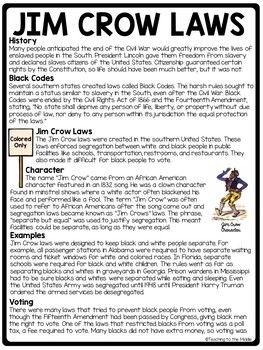
Since that would mean the paying of actual wages to workers, Southern states acted quickly to enact an incredible array of laws meant to criminalize nearly everything about the lives of former slaves. These were known as the Black Codes.   

Mississippi was first off the hop, when it passed an 1865 law titled, “An Act to Confer Civil Rights on Freedmen.”  This law would punish black workers for vagrancy, should they fail to contract themselves to white farmers by January 1st of each year.

“Blacks could be sentenced to forced labor for crimes including petty theft, using obscene language, or selling cotton after sunset. States passed new, strict vagrancy laws that were selectively enforced against blacks without white protectors. The labor of these convicts was then sold to farms, factories, lumber camps, quarries, and mines.  

After its ratification of the Thirteenth Amendment in November 1865, the South Carolina legislature immediately began to legislate Black Codes. The Black Codes created a separate set of laws, punishments, and acceptable behaviors for anyone with more than one black great-grandparent. Under these Codes, Blacks could only work as farmers or servants and had few Constitutional rights. Restrictions on black land ownership threatened to make economic subservience permanent.

Some states mandated indefinitely long periods of child “apprenticeship”. Some laws did not target blacks specifically, but instead affected farm workers, most of whom were black. At the same time, many states passed laws to actively prevent blacks from acquiring property.” (Wikipedia)

Far from the promise of ’40 acres and a mule’ being bestowed upon loyal workers post-emancipation, a world of hurt was about to descend, quite legally, upon those who had the misfortune to have so much as a drop of black blood in their veins.  

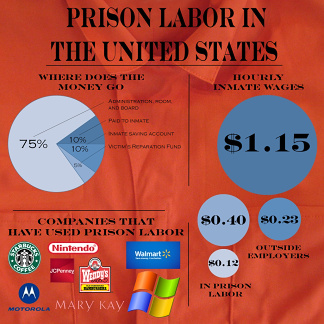
And it continues to this day. In the very much ‘for profit’ prison system in the states, people of colour are vastly over-represented amongst the millions who are used as – yes – slave labour. Since any one convicted of a crime forfeits their rights to freedom, and is technically a slave, wages paid to prisoners are … slave wages.

“Penal labor is economically important due to it being a source of cheap labor, with base pay being as low as 60 cents per day in Colorado.   …

Firms including those in the technology and food industries are often provided tax incentives to contract prison labor, commonly at below market rates. The Work Opportunity Tax Credit (WOTC) serves as a federal tax credit that grants employers $2,400 for every work-release employed inmate. “Prison in-sourcing” has grown in popularity as an alternative to outsourcing work to countries with lower labor costs.

A wide variety of companies such as Whole Foods, McDonalds, Target, IBM, Texas Instruments, Boeing, Nordstrom, Intel, Wal-Mart, Victoria’s Secret, Aramark, AT&T, BP, Starbucks, Microsoft, Nike, Honda, Macy’s and Sprint, and many more, actively participated in prison in-sourcing throughout the 1990s and 2000s. After the 2021 storming of the U.S. Capitol, it was noted that FPI would receive priority when the federal government purchases products such as office furniture to replace what was damaged in the riots.    

Critics of the prison labor system argue that the portrayal of prison expansion as a means of creating employment opportunity is a particularly harmful element of the prison-industrial complex in the United States. Some believe that boosting economic benefits at the expense of an incarcerated populace prioritizes personal financial gain over ensuring payment of societal debt or actual rehabilitation of criminals.”  (Wikipedia)

Many people of colour believe that the elevation of Juneteenth to a federal holiday is little more than a consolation prize; a day off work, though only for those employed by the government. Rather, many would prefer to see legal reforms, an end to the lack of accountability police unions enjoy, and an actual end to slavery, through a reassessment of the penal provisions in the 13th Amendment.

Institutional racism has been built into the United States since the first slaves were brought to its shores in 1619. That, and more, is what is causing so many Republican states to react violently against the concept of critical race theory.

The theory looks at how the law and legal institutions in the U.S. are inherently racist in how regulations and laws are enacted to maintain social, political, and economic inequality.

The very concept of the modern-day idea of ‘race,’ as a definition by which peoples can be enslaved and abused, without repercussion, really only came into general use alongside the formation of the United States. Prior to the 1500s, the term was rarely used, and then only to identify groups of people with a family relationship.

Our current definition of race refers to the identification of groups of people by their physical traits, appearance, and/or characteristics, and is an entirely human invention.

 In the 18th century, political and intellectual leaders began publicly to assert that Africans were naturally inferior, and thus best suited for slavery. This theory was gratefully accepted by Americans who had already decided that the native Americans who actually owned and lived on the lands the settlers coveted were weak, and unworthy of being part of this New Land. That sort of thinking allowed the settlers to ignore the horrors they inflicted on those they drove ever westward, to hellish reservation lands, and to eagerly accept the concept of slavery of Africans. 

Portraying those of different coloured skin as lesser-than, soon applied to any group that came or was brought to America. Slavery was a natural, and so cost effective. Exploitation of the First Peoples, of the Africans brought in chains, and then of refugees from other countries, most notably of the Chinese that built the railroads, brought enormous wealth to those that could not conceive of the humanity of any other than their own white, Christian brethren.

Critical race theory shines a klieg light on to the legal white racism that non-Caucasians have been subjected to for generations. The GOP wishes to condemn and cancel any talk of how the health, wealth and legal standing of people of colour are decided in their courts, but civil rights scholars have definitively shown that past and current American laws maintain white supremacy, and allow societal and structural racism.

The fight continues for equality. One small step at a time, we move forward … even if it means we do it under the burden of dragging the ignorant, the unwilling, and the racist on our backs to the finish line.

Happy Juneteenth!

Up With Pride!


by Roxanne Tellier

In the 50s and 60s, most of the gendered role models for kids were caricatures, physical and psychological distortions of what a ‘real man’ or a ‘real woman’ should look like, and how they should behave.  

There were manly men and voluptuous women, who conformed to rigid bodily descriptions. Then there was the supporting cast, the rebels and the roues, who could also be considered acceptable gender models.

Early television played a large part in what we came to view as acceptable romantic and sexual behavior of the very strictly defined genders. Strangely, there are still huge swaths of North Americans who retain the same parameters on how we should behave, even as fewer and fewer of us can actually live up to those physical or mental objectives.

And into that morass, we, who would become the Baby Boomers, waded, without so much as an armband floatie.

We’d like to think that we’ve changed since then, become more liberal and less rigid, but in truth, we’re still playing gender games, right from birth, when we begin to naturalize our newborn’s sexual orientation. With the right onesie, even a three-month-old can be a misogynist!

We oversexualize our kids, allowing little girls as young as four to climb on to the sexual bandwagon, caked in makeup and hairspray as they toddle down beauty pageant runways, styled like mini hookers. Their mothers cheer on the tiny sex objects from the sidelines, whispering to each other about how they despise the criminals who sex traffic minors.   

By grade school, most kids have already absorbed a definition of physical ‘perfection’ based on what they’ve seen on TV and social media. What they wish they could look like may well be unobtainable for their body types, but that perceived ideal, through societal pressure, will set some on a path that will have them trying to reach unrealistic goals for the rest of their lives.

Males and females alike develop eating disorders. Some children feel so objectified that they simply give up trying to be accepted, and self-harm to take themselves out of the ‘game.’  

Sex sells everything, from candy to cars. Good looking people who meet current standards of beauty dominate our screens, begging us to join them for a coffee, a date, or a cruise.  

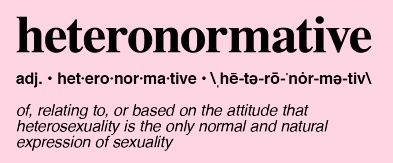
We may not like it, but we take all of this for granted as being simply part of our heterosexual culture. And we almost never wonder what it might be like if we weren’t oriented that way. 

Our straight kids never have to worry about coming out to their parents or their school mates – it’s just expected that sexually compatible mates will be available when the time is right.  

Kids who don’t gender conform have to spend a great deal of their lives explaining and justifying their needs and why they feel the way they do, first to their parents, then to the world.

Straight people are not asked, over and over, if maybe they’ve just never found the right person to change their sexual orientation, or if the attraction they feel to a partner might just be a ‘phase they’re going through.’  

And when a straight person is asked about their weekend or vacation plans, they rarely have to police their speech to ensure that they don’t let slip that their spouse is their same-sex partner.

Remember The Imitation Game, the film about cryptologist and father of the modern computer, Alan Turing? Despite his work helping to win the war for Great Britain, his homosexuality lead to his being convicted of gross indecency, and being sentenced to chemical castration. (After a year of government- mandated hormonal therapy, Turing committed suicide.)             

Same-sex sexual activity is a crime in 70 countries. In 13 countries of the world, including six nations that are members of the United Nations, being gay is punishable by death. In 26 other countries, the maximum penalty for being gay is prison, with terms varying from a few years to life imprisonment.

Same sex marriage is legal in 29 countries in the world, including the United States. However, individual American state laws have interfered in some celebrations when those opposing the unions have refused to make wedding cakes, or to process their marriage licences. 

You can’t lose your job for being gay in Canada. But in the United States, LGBTQ workplace protections depend a lot upon where you live. Since a Supreme Court ruling on June 15, 2020, it has been unlawful under federal law for employers to discriminate against employees based on sexual orientation or gender identity.

But that didn’t stop then President trump from slapping a blanket ban on all transgender people from serving and enlisting in the United States military. (A reversal of this policy was one of the first executive orders President Biden signed in January 2021, post-inauguration.)

Straight couples can do all the public displays of affection they want. Gay couples have to fear scrutiny, ridicule, retaliation, or even death, often for just holding their loved one’s hand.

We’ve known for decades that the lack of media representation of positive aspects of people of colour has had a numbing effect on the psychological and economical progress of that group.  

Recently there has been a movement towards a more accurate media representation of North American families.  I’ve been noticing a lot more advertisements, especially during the daytime hours of television, that feature a better kaleidoscope of the colour and flavour of our nations. I’ve even already heard a few complaints from people about how there’s not a lot of straight, white couples hawking laundry soap anymore. Deal with it, sistah.

But one stain removal commercial featuring a lesbian married couple does not a societal sea change make. There is far to go before it is equally acceptable for LGBTQ people to exhibit the same sort of sexuality that heterosexuals ‘shove down our throats’ day in, year out.

We happily cheer on straight people who, whether on screen or on the street, flirt, have awkward coming of age stories, who romance, marry, and stay together or divorce. We recognize the humanity of our straight brethren, but often attempt to minimize or deny the right of the LGBTQ community to enjoy the same pleasures.  

There’s a lot of decent straight people out there who like and support differently gendered people, but who continue to have a problem with what they view as inappropriate public displays of affection. You’ll often hear them say that they have no problem with the LGBTQ community, as long as their sexuality is not “shoved down people’s throats.”

But that’s such a strange thing to say, because of the questions it begs. Who’s doing the shoving? Do you mean you are literally being forced, against your will, to engage in sex or romance with someone of the same gender? Are you being forced to watch gay porn? Attend a gay wedding? Is someone forcing you to marry someone of your own gender?

And of course, none of that is what you mean. What you mean is that you don’t want to have to see gay couples doing the things that straight couples do – like hold hands. Like grocery shop. Like sleep in the same bed and even (gasp!) kiss. 

Can you tell me where you get to see those couples doing those things? Because it’s not on the tv channels I’m aware of. Although Netflix sure does have a lot of rom coms and dramas showing straight couples partnering up to their heart’s content.

Our culture, our society, allows heterosexual couples to indulge in all sorts of bizarre couple activity, with little more than a tsk tsk, if that. For North Americans, ‘opposite sex’ sexuality is the norm – we’re soaking in it, to the point were we hardly even notice it any more, unless the offense is so overt and grievous that we cannot ignore the sight.

There’d be a lot more truth in it if we were saying that it’s heterosexuality that is being crammed down our throats, since that is our cultural norm, our societal default, and literally inescapable.

No one is forcing anything down your throat at all. All we’re doing is beginning to treat the people of the LGBTQ community like the human beings they are, because they’re just as human as the rest of us.

Other people’s private lives are none of anyone else’s business. Happy Pride Month!

Straight Outta Facebook Jail


by Roxanne Tellier

I’m happy to report that the rumours of my death were greatly exaggerated.  I’ve only been dead to the social media world for the last 30 days. 

But, let me tell you – if you’ve ever wondered if people would miss you after you’re gone, take a long Facebook break. The majority will most certainly not even notice your absence. It’s a fast-paced world, and either you’re in the fast lane, or you’re eating everyone else’s dust.

this is great – never knew there were two versions of this Canadian Classic!

Facebook has really been cracking down on its users over every little thing since the last time Zuckerberg had to explain Facebook’s ways to Congress.  Zuck’s been able to rely on Section 230, which allows social media companies to self-regulate. It shields the platforms from liability, shunting any blame to individual users, who can be sued for posted content, while granting legal immunity for good faith efforts to remove content that violates their policies.

The key part of the provision reads: “No provider or user of an interactive computer service shall be treated as the publisher or speaker of any information provided by another information content provider.”

While there have been small inroads into Section 230 protections, lawmakers have only been able to do so much. In 2018, a law was passed making it easier to sue internet platforms that knowingly aid sex trafficking, but there’s the rub again … define and prove ‘knowingly’ when a cadre of well-paid lawyers are claiming ignorance. Federal crimes and intellectual property claims are further exceptions, but again, there’s a rallying cry of ‘prove it!’ whenever the platform is charged.

Zuckerberg and Jack Dorsey of Twitter claim that their platforms could not exist without the protections provided under Section 230, but at the end of the day, what stays or goes on these platforms remains solely under their jurisdiction.

Which is perhaps why we’re hearing more and more horror stories from Facebook users who are being penalized unfairly, without recourse, and lately, even for offences committed four to seven years ago.

Musician/radio personality Bill King noted today that there doesn’t seem to be an actual court of appeal for unfair charges.

“I was there (FB jail) recently for a humorous post of which I challenged, won, and still got a week. I’m serving a 60-day sentence for something from 2020. This is crazy.”

The most famous North American repeat offender is, of course, Donald Trump. The former president was banned ‘indefinitely’ from all Facebook platforms after the Capitol riot of January 6th, when his supporters ransacked the hallowed halls in an attempt to stop the certification of Joe Biden’s presidential win.

The ban was a disaster for Trump, since social media played a huge part in his campaign and subsequent presidential term. He appealed, which resulted in his claim being kicked upstairs to Facebook’s Oversight Board. There, the suspension was upheld, but the board chastised the company for not having a clear policy, and for imposing an indefinite time period.

Facebook’s principals responded by creating new enforcement penalties that deemed Trump’s ‘severe violation of our rules’ to merit the highest penalty available – a two-year suspension, effective from January 7th. This would keep his account suspended until January 7th 2023, when it was determined that he would only get his accounts back if “the risk to public safety has receded.”

Naturally, Trump’s furious over being held accountable for his sins. Although he was a supporter in the good times, now, like a belligerent husband furious that the wife is refusing to iron his underpants, he’s determined to break Facebook and Twitter, by any means possible.

Trump’s response:  “What Facebook, Twitter, and Google have done is a total disgrace and an embarrassment to our Country. Free Speech has been taken away from the President of the United States because the Radical Left Lunatics are afraid of the truth, but the truth will come out anyway, bigger and stronger than ever before. The People of our Country will not stand for it! These corrupt social media companies must pay a political price, and must never again be allowed to destroy and decimate our Electoral Process.”

And then, in a separate statement, Trump again claimed fraud in the 2020 election, because of course he did.

Meanwhile, there’s a pretty solid front of both Dems and Republicans who believe that all of social media’s big companies have become too powerful, and need tougher regulations to hold them more accountable for policing content.

Democrats, led by Biden, want Congress to revise Section 230, considering the lack of liability a big gift to Big Tech. They want social media to be compelled to remove hate speech, proven falsehoods, extremism, and election interference.

Unsurprisingly, Republicans, led by Trump, are more concerned about the Orange One being banned, conservatives being censored, and a limit to political reach on social media platforms. Florida’s Ron DeSantis recently passed a law that cracks down on the Big Tech platforms, claiming that they are conspiring against conservatives, and their free speech.

This law would make it illegal for Big Tech to remove political candidates from their platforms in the runup to an election, while also making it easier for Florida’s attorney general and individuals to sue these companies if they felt discriminated against.

(But DeSantis DID exempt ‘companies that own a theme park’ – such as Walt Disney Co, which runs Disney+, a streaming service. He knows which side of the Floridian bread is buttered by the Mouse.)

There are so many holes in this law that I imagine there are ACL lawyers across America wetting their pants over who will be the first to challenge this snowflake fest. Firstly, it’s unconstitutional. The bill is a violation of the First Amendment’s ban on government controlling the free speech of private companies.

Corbin Barthold, internet policy counsel for the Washington, D.C., nonprofit group TechFreedom, wrote, “The bill is extreme. It’s a brazen assault on the First Amendment. DeSantis wants to compel websites to speak. He can’t. He wants consumer-protection law to erase free-speech rights. It won’t. DeSantis is attacking the very constitutional principles Republicans just spent four years putting conservatives on the courts to protect.”  

Beyond that, it would seem yet one more example of DeSantis currying favour with Trump and his acolytes, by standing by his man. The snowflakes are thick on the ground down in Florida, it would seem.

There’s a lot of other factors going on here as well, since, no matter how you look at it, Facebook is near to keeling over from ‘death by demographics.’ 10% of Facebook’s advertising audience are 55 and older, while Facebook remains the most popular social network for seniors. 62% of Americans 65 and older use Facebook. And – fun fact! Guess who shares the most fake news on ANY social platform? Seniors! We’re Number 1! We’re Number 1!

As is the case in Japan, people over 65 make up the brunt of Facebook’s population, and that number is rising. Meanwhile, the ‘kool kids’ bolted years ago, to the hipper pastures of TikTok and Instagram.

So why do so many stay on Facebook, despite the arbitrary updates of it’s interface, unreasonable banning, lack of customer support, or recourse for common errors? Basically, it’s all about sunk costs.

It’s a lot like changing jobs or moving house; when you’re younger, there’s always a greener pasture to be found. But the older you get, the less you want to gather up all the energy you’ll need to get up and out of that comfy chair. So we stay, year after year, and simply take whatever the social media platform gods dish out.

There aren’t a lot of platforms that ring the same bells as Facebook. The current ‘next best option’ is Liker.com, which bills itself as the ‘kinder, smarter, social network’. Liker has recently gone through a serious overhaul and revamp, further to being hacked in March of 2021 by ‘politically motivated trumpers’, and allegedly in retaliation for the Gab data breach and scraping of data from Parler.  

I have re-upped with Liker, and hope to be setting up a new home over there as soon as it’s back up and running. With Facebook now so hair-triggered, it can’t hurt to have somewhere else to go, especially for those days when you get kicked off the platform for the despicable crime of quoting Shakespeare.

So, a month without Facebook. It was fine, really. After the first few days of withdrawal, I started to realize how much free time I had, when I wasn’t constantly monitoring the freeform thoughts of the masses. In a way, it was sort of like those first few days after Trump was originally banned from Facebook – at first, you can’t put your finger on what’s not bothering you anymore. Then you realize – it’s the absence of the white noise that was constantly permeating your environment, keeping you slightly off balance at all times.

I’ve been reading all the books on tech and social media and current social issues that I can carry home from the library. I’ve spent a lot of time on YouTube, scarfing down educational programs, TedTalks, documentaries, music specials, and watching the antics of The Sorry Girls. I’ve redecorated the front porch, started working on sorting out the back deck and the shed, and have a couple of document files I’m about to rework into eBooks to see if I can make a few bucks off that tech writing certificate I aced decades ago.

And the funniest thing is, once you get off the Facebook treadmill, you soon start to realize how little ‘new’ there’s been for the average person to marvel over, since around 2015. It’s as though the world was so fixated on trump and politics that actual societal progress halted, while the right gloated over the one bill they passed in four years, that being the one that made the rich even richer, while doing nothing for the other 99.9%.

We’re still fighting old wars. We’ve gone through a global pandemic, serious incursions upon our democracy, and we are making tentative forays into re-entering this post-pandemic world, without many people even noticing that nearly six years have passed, but very little has changed.

Thirty days away also gave me perspective on how seriously too many people take their Facebook presence. For the average user, any social media platform should be either an escape, or a legitimate business outlet.  But many people get so addicted to the place that they have to share every minor moment and experience of their lives, along with what they ate for lunch. It’s almost as though they believe that nothing is real unless it’s seen by an audience.  

Then there’s the huge segment of people who seem to think that the expression of their thoughts and opinions is tantamount to a ‘job.’ Facebook isn’t paying anyone I know to tell them ‘What’s on your mind?’ No one pays me to curate news items, or to be first with a link to the latest Randy Rainbow video. The water cooler we gather around is virtual, as are most of our friends, and if there was a break room, your sandwich would already have been stolen by a troll.

And, let’s face it – Facebook is also where you go to ask random strangers whether or not you should bring a baby to a ‘no kids allowed’ wedding. Or to seek the seal of approval on your not wanting to get vaccinated before getting on an airplane and going to said wedding.

So, yeah, back again, sadder and wiser. Thinking I’ll use Facebook for my business social media purposes, maybe keep another account for private convos.

But there are still reasons – which have nothing to do with how FB is run – to be on Facebook.

One, is finding the little precious nuggets hidden on the internet … I’d never have found this video, or seen these incredible, sensual contortions, had I not been pointed in their direction by photographer Anne J Gibson ….

(The 13th Floor Elevators – Roller Coaster – Footage by exotic dancers Janik and Arnaut, 1954.)

And of course, I’ve got a lot of people I really enjoy seeing and interacting with on Facebook.

But let’s face it, the odds of me being a recidivist are pretty high. I’m a terror, you know, a wild one, a granny with a grudge, a troublemaker that just doesn’t learn. Odds are good it won’t be long until they’ve sent me back to the pokey.

It’s just the way I roll. Unrepentant. A Facebook Felon. You’ll never take me alive, copper!

A Crack in the Patriarchal Egg?


by Roxanne Tellier

At the end of the Montgomery bus boycott, Martin Luther King Jr famously paraphrased the words of Theodore Parker, American transcendentalist and pastor, when he stated,

The arc of the moral universe is long, but it bends toward justice.”

There are many days when only that aspiration keeps me going. Some days, I’ll  find myself wondering if that’s a light up ahead, or just the headlights of an oncoming train …. but after this week, for a number of reasons, I’m liking the odds that it is truly a light. 

Three things happened this week to make me think that there might be some hope, and that, maybe – just maybe! we ARE gonna be okay. Maybe that arc really is moving in the right direction.

The first event was long in coming, but something I’d been rooting for; the investigation into Trump’s misdeeds has morphed into an inquiry. Hopefully, this is the beginning of the end of a shockingly corrupt and criminal abuse of power by America’s POTUS.

The way an impeachment works is regulated at the federal level, under the American Constitution.  First the Congress investigates, and then, based on their findings, the House of Representatives must pass, by a simple majority of those present and voting, articles of impeachment. Those articles will be the formal allegation or allegations of what are considered to be ‘high crimes and misdemeanors.’

According to the Harvard Law Review “The majority view is that a president can legally be impeached for ‘intentional, evil deeds’ that ‘drastically subvert the Constitution and involve an unforgivable abuse of the presidency’ — even if those deeds didn’t violate any criminal laws.”

So we’re in phase two now, prior to, hopefully, phase three, wherein the Senate will be called upon to try the accused. Many have said that the Senate will likely fail to actually impeach Trump, but there is some hope that these investigations, and the live television transmittal of the honourable men and women testifying to Trump’s misdeeds/crimes, at home and abroad, will sway the American voters, and by extension, the Republican Senators who are in danger of losing re-election in 2020 if they continue to align with trump.

One big hope is that the Dems get their way, and voting is done by anonymous, secret ballot. If that were to happen, it’s guesstimated that at least 30 Republicans would vote with the Dems, thus ensuring impeachment.

Can’t you just hear the theme to Curb Your Enthusiasm playing right now?

Meanwhile, the POTUS is flailing as the truth emerges about his endeavour to tempt the new President of Ukraine, Volodymyr Zelensky, into corruption. He dangled Congressionally approved military aid for the Ukraine, that would shore up the embattled nation in their war with Russia .. if Zelensky would just grant trump ‘one favour’ … 

When Mr. Zelensky said Ukraine was almost ready to purchase American Javelin anti-tank missiles so it could better repel armored assaults by Russian-supported fighters, Mr. Trump pounced.

“I would like you to do us a favor though,” Mr. Trump responded, beginning a series of pointed requests. The president pressed Mr. Zelensky to use the help of Attorney General William P. Barr in opening an investigation of a company involved in the beginnings of the F.B.I. inquiry of Russia’s 2016 election interference. He also wanted a corruption investigation connected to former Vice President Joseph R. Biden Jr., a Democratic rival.

Both held the potential to benefit Mr. Trump politically. And in case Mr. Zelensky needed reminding, Mr. Trump was quick to point out that “the United States has been very, very good to Ukraine.”

Mr. Trump’s suggestion that American law enforcement be directly involved and in contact with Ukraine’s government marks the first evidence that the president personally sought to harness the power of the United States government to further a political investigation.”  (from the New York Times, Sept 25/2019)

Actually, trump wanted THREE favours …  from Vice’s coverage of the memo,

1. He asked Zelensky to “look into” Joe Biden

2. He asked Zelensky to speak to Rudy Giuliani and Bill Barr , while insinuating that Giuliani had the real information on corruption in the Ukraine, and smearing the American Ambassador to the Ukraine, Marie Yovanovitch, saying, “The former ambassador from the United States, the woman, was bad news and the people she was dealing with in the Ukraine were bad news so I just want to let you know that.”

3. He oddly asked Zelensky to investigate Crowdstrike

 “I would like you to find out what happened with this whole situation with Ukraine, they say Crowdstrike… I guess you have one of your wealthy people… The server, they say Ukraine has it. There are a lot of things that went on, the whole situation,” Trump continued.

In a nutshell, trump sought to impel Zelensky, a new president, swept in on an anti-corruption platform, to agree to commit corruption in order to receive monies that had already been pledged to Ukraine, by the American Congress. Trump had NO right to a say in the over $400 million due to Ukraine, yet he behaved as though it were his personal money, bribe money to be used to get what he wanted … a public, foreign investigation into the son of his main opponent in the 2020 election..

Ambassador Sondland tried to explain to me that President Trump is a businessman,” Bill Taylor, the top U.S. diplomat in Ukraine, told House investigators. “When a businessman is about to sign a check to someone who owes him something, he said, the businessman asks that person to pay up before signing the check.”

Except that this was not a business transaction, it was a diplomatic, Congressionally approved, transaction, Zelensky owed trump nothing, and it wasn’t trump’s own money. But since trump couldn’t take a cut of the millions, he took the opportunity to attempt to blackmail Zelensky, a move that would seem to be straight out of the Putin Playbook for “how to use kompromat to tie another country’s president to you in perpetuity.” (with at least one chapter on how to best preserve sheets used for golden showers by wannabe presidents.)  

There can be NO logical explanation or excuse that makes what trump asked of Zelensky anything other than an attempt at bribery, potential blackmail, an attempt to elevate a conspiracy theory that excuses Russia’s role in election meddling by placing Ukraine in that role, and a gross abuse of power, despite how many frantic and hysterical tweets he vomits up on Twitter.

Hopefully the Republicans will soon see that their desperate attempts to smear those who have the courage to testify is backfiring upon them. Or maybe they’re still too terrified of the ‘wrath of trump’ to realize that everyone around trump eventually winds up under the bus, no matter how good they are at sycophancy.

*********************************************

The second event – la deuxième étoile ! – that heralded a sea change to our society happened, not when Don Cherry said,

You people love, that come here, whatever it is, you love our way of life, you love our milk and honey, at least you can pay a couple bucks for a poppy or something like that,”  

No, it happened when Rogers/Sportsnet caved to the flood of callers who demanded that Cherry be summarily dismissed. That’s the Free Market that so many extol; in this case, it worked against those who have pedestaled their hero and that notion. The market/shareholders spoke, and Don Cherry, still refusing to apologize, fell.

Don ‘Sour ‘Grapes’ Cherry is 85, worth $14 million, makes $800K a year, and is still a miserable cuss. He plays to the mob, and relishes any chance to punch down at his targets.

Political correctness aside, Cherry was spewing hate and spreading misinformation on Hockey Night in Canada. That’s not free speech, it’s hate speech. As a public figure, and on a platform that reaches millions, his commentary targeted people already vulnerable, because Don Cherry and his fans feel free to look down upon people of colour, and of those who aren’t  ‘pur laine’, Canadians. 

And whether he liked it or not, he had a signed contract that prohibits certain forms of speech.

This kind of xenophobia and bigotry is unCanadian, even when it comes from a man who was once honoured by being ranked at number 7 in the 2004 CBC miniseries, The Greatest Canadian.

Cherry should have cleared the ice before it all turned into a gongshow.

********************************************************************

Event three – and one that, I’m gonna guess, huge portions of this column’s readers missed entirely, happened on Wednesday night, on a double episode of Survivor – Island of the Idols.  Survivor got #MeToo-ed.  

Survivor: Borneo

From the very first episode of Survivor:Borneo, in the summer of 2000, the reality series has spoken to a huge swath of Middle American viewers. In that first season, crusty Rudy Boesch, a 72 year old retired Navy Seal, and still the oldest contestant to ever play the game, kept a stiff upper lip as Richard Hatch, openly gay, and flagrantly arrogant, spent many hours parading around naked in an attempt to rattle the other players. Rudy and Richard became good friends over the course of the game, and when Rudy died recently, Hatch was one of the many mourners to pay him tribute. The Rudy/Richard friendship influenced how many viewers felt about people who, on the surface, appeared completely unlike themselves. The viewers learned that appearances and even long held opinions, could be deceiving. 

During these 39 seasons, viewers have learned a great deal about opinions, prejudices, and why it’s foolhardy to have preconceived ideas about any other person. Viewers have seen the game, with it’s motto of “Outwit. Outplay. Outlast,” change with the times, even as the definition of what constitutes normalcy, equality, and  ‘fair play’ changes as American society itself changes.

In 2003, contestant Jon Dalton told what host/producer Jeff Probst would call “the greatest lie in Survivor history” when he concocted a scheme to manipulate his fellow players by saying that his grandmother had died. She had not. Although ‘Johnny FairPlay’ entered Survivor history, he didn’t win the series, and his name became synonymous with UNfair play in the game.

In 2013, bread baking Mormon mama Dawn Meehan had not the slightest qualms about voting off her best buddy Brenda Lowe, despite Brenda having salvaged Dawn’s dignity by finding the missing false teeth Dawn had lost in a pond. It’s a game, and anything that gets you further in the game is by definition ‘within the rules.’ How you live with yourself afterwards is your problem.; if you win, you’ll have a lot of fans, and a million dollars to keep your warm.

In 2019, we are once again revisiting the idea of what exactly constitutes ‘fair play’ in the contest.   

Kellee Kim, Dan Spito

As the two tribes merged, contestant Kellee Kim, a 29 year-old Harvard grad and MBA student, realized that she’d once again have to deal with contestant Dan Spito, a 48 year-old LA talent manager who had a little ‘issue’ with his physicality when female players were near. Kellee had briefly dealt with him at the beginning of the game, and told him in no uncertain terms that she did not like or want him to touch her. Dan seemed to accept that, and fate sent the two players off in different directions for the first half of the season.

But since the two teams had merged and converged in one small area of the island, Dan’s hands were at it again, tiptoeing through the ladies. And Kellee was not at all happy with his presumption that her body and hair,  as well as that of other female contestants, were fair game.

“At the merge feast last night…. I feel someone wiggling my toes, and I’m like, I wonder who it could be? And it’s him.” said contestant Missy It’s inappropriate touching. I’m not an object.”

In one of the segments, Kellee tearfully told team mate Janet that she found Dan’s attentions upsetting. Janet hadn’t really noticed that Kellee and several of the other young women were being targeted.  But she was ready to help, if she could.

But as Kellee told the camera, “It’s super upsetting, because you can’t do anything about it. There are always consequences for standing up. It happens in real life, in work settings, in school … and you can’t say anything because it will affect your upward trajectory, it’s gonna affect how people look at you.” 

The show’s producer, in an unprecedented move, broke the fourth wall, saying, “You know, if there are issues to the point where things need to happen, come to me and I will make sure that stops. ‘Cause that’s…I don’t want anyone feeling uncomfortable.”

A title card then appeared on screen, which read, The following morning the producers met with all the players, both as a group and individually. They were cautioned about personal boundaries and reminded that producers are available to them at all times. Based on the outcome of those discussions, the game continued. In addition, producers met privately with Dan, at which time he was issued a warning for his behavior. Producers continue to monitor the situation.”

If that had been the end of the situation, as usually happens in our society, it would have been just another day in misogyny. But what happened next was a REAL lesson for Middle America; two of the other female players, Elizabeth and Molly, decided to use this moment to hatch a plan that would smear Dan while saving themselves, by making Dan and Kellee targets for elimination. Worse still, they abused the trust and faith of Janet to do so, knowing that Janet would see it as her place, as an older, mother figure, to do whatever it might take to help the girls.  

Elizabeth, Missy, Lauren, Aaron

In truth, neither Elizabeth nor Molly actually felt unsafe or uncomfortable around Dan. If anything, they thought he and his wandering hands were a non-issue, easily ignored.

Inevitably, #MeToo came up squarely against game strategy, and it was Kellee who was voted ‘off the island’ while Janet was left to understand that the other girls had willfully played upon her better nature to further their own game, at Kellee (and Janet’s) expense.

At a later tribal council, the women tried to defend their actions by calling it ‘game play,’ while a male player, Aaron, refused to believe that it had happened, because, “if it had, I would have known.” 

Jamal Shipman

Jamal tried to explain why Aaron was wrong, saying, “This whole idea that you would have known about it – that’s exactly what happens in the real world, guys. When a woman brings up a charge, and people want to negate whether or not it’s legitimate, they say, well if it was such a big issue, then she would have brought it up last year, two years ago, three years ago. We are not entitled to ‘know’ things just because we’re men, or just because we’re in power. “

As Kellee had said, “There are always consequences for standing up. ” For his pains, and his insight, Jamal was the next to leave the game.

As Jeff Probst later said, “Survivor is a microcosm for our real world. Situations just like this one are playing out in offices and bars and colleges across the country and the world. “

And that is, of course, sadly true. However, it was the enormous backlash against the two female players, for their deceit, and their ugly manipulation of Janet’s protective nature, that raged mightily across  social media on Thursday morning that really gave me hope. Is it possible – can it really be – that sometimes the right people will actually be punished for making the lives of others miserable, just because they can?

This is the week that #MeToo came to reality TV, big time, and Middle America got to see how it works, from all sides and angles. Anyone that watched the double episode play out is now in possession of all the information they need to make life better for 51% of society (that’s women, by the way.)   

The question is, will they? Can they be bothered? Or is life a whole lot easier when we just toss off the island those people who are only asking  to be treated like people instead of objects?

I will continue to hope that the light at the end of the tunnel really is dawn breaking somewhere.

Nostalgia, Russian Assets, and Canada Votes


by Roxanne Tellier

If this column doesn’t actually get written, edited and/or published until February or March of 2020 …. don’t blame me.

NO ONE can resist the call of nineties arcade games! Remember Commander Keen,  Bio Menace, Mr Blobby, Duke Nukem and the rest of the Apogee Games? They’re back, baby! and as addictive as ever. I can’t believe this DOS dump of 2500 hot titles of the nineties .. the list is endless .. well, at least until you look for game 2501 ….

Here’s the link. Don’t say I didn’t warn you!

***********************************************************************

Over the last few weeks, I’ve had to come to the conclusion that America’s POTUS is, in truth, a Russian asset. I know – now you’re laughing and want to throw me a tinfoil hat.

But bear with me for a bit. Take a look at everything that has been accomplished in Trump’s first 1000 days – does America look any better than it did before he was inaugurated? Are America’s lower and middle class wealthier, or indeed even happier, than they were before he arrived? Is the country more secure, better positioned, now that most of her allies have been driven away, and her strategic alliances have been irreparably damaged?

Is America’s farmland protected from the devastation of Trump’s trade war that has seen family farms go bankrupt, only to be snapped up by Russian and Chinese investment companies?

For that matter, with the flood of rollbacks of regulations and legislation that once protected America’s parks, wildlife and water … are you happy with the devastation that’s been allowed to happen throughout the nation?   

Or are most Americans sick to death of the constant flood of criminal nonsense flowing from this White House?

It begs credulity to not see the strong link between Russia and Trump; he’s repeatedly  insisted that all of the Intelligence Agencies, venerable pillars in American governance, are against him, and are wrong in their conclusion that Russia interfered with the 2016 election. He’s insisted over and over again that Russia needs to be back in the G7, since he believes that it was only Obama’s prejudice against Putin that resulted in the sanctions against Russia, that he’s tried repeatedly to remove.  And at this very moment, Trump has his puppet, Attorney General Bill Barr, traveling the world, in a totally bizarre attempt to prove those intelligence agencies wrong about Russia’s part in the election.  

Putin’s long term plan to bring down America as a world power has always been to destroy it from the inside, and that seems to have been what has happened. The nation is divided, there’s no progress being made although trillions of dollars are being spent on nonsense, this president may well be the first to be not just impeached, but imprisoned, and his supporters are threatening a civil war should anyone be mean to their fair haired, orange faced, tweetheart.

And then there’s this ….

Gee. That’s not suspicious AT ALL.

And is it just a coincidence that Trump gave Turkey the go ahead to besiege Syria, and to begin a genocide against the Kurdish fighters who’d saved America’s bacon against the rebels … on Putin’s birthday?

Here’s a portion of what the Kurds’ commander in chief says about America’s betrayal of Syrian Kurds.  

Turkish-backed Syrian fighters evacuate a wounded comrade

” We lost 11,000 soldiers, some of our best fighters and commanders, to rescue our people from this grave danger. I have also always instructed our forces that the Americans and other allied forces are our partners, and so we should always make sure that they are not harmed.

Amid the lawlessness of war, we always stuck with our ethics and discipline, unlike many other nonstate actors. We defeated al Qaeda, we eradicated the Islamic State, and, at the same time, we built a system of good governance based on small government, pluralism, and diversity. We provided services through local governing authorities for Arabs, Kurds, and Syriac Christians. We called on a pluralistic Syrian national identity that is inclusive for all. This is our vision for Syria’s political future: decentralized federalism, with religious freedom and respect for mutual differences.

The forces that I command are now dedicated to protecting one-third of Syria against an invasion by Turkey and its jihadi mercenaries. The area of Syria we defend has been a safe refuge for people who survived genocides and ethnic cleansings committed by Turkey against the Kurds, Syriacs, Assyrians, and Armenians during the last two centuries.

We guard more than 12,000 Islamic State terrorist prisoners and bear the burden of their radicalized wives and children. We also protect this part of Syria from Iranian militias.

When the whole world failed to support us, the United States extended its hands. We shook hands and appreciated its generous support.

At Washington’s request, we agreed to withdraw our heavy weapons from the border area with Turkey, destroy our defensive fortifications, and pull back our most seasoned fighters. Turkey would never attack us so long as the U.S. government was true to its word with us.

We are now standing with our chests bare to face the Turkish knives”  (ForeignPolicy.com)

By every measure, Trump’s treachery has resulted in the deaths of thousands more innocents, and his botched attempt at stopping the horrific wave of genocidal murders only gave Turkey’s leader everything he wanted .. and more .. since the validation of Turkey’s annexation of Kurdish land came with the stamp of approval of the American government.

 “The cease-fire agreement reached with Turkey by Vice President Mike Pence amounts to a near-total victory for Turkey’s president, Recep Tayyip Erdogan, who gains territory, pays little in penalties and appears to have outmanoeuvred President Trump.” (The New York Times)

“This is essentially the US validating what Turkey did and allowing them to annex a portion of Syria and displace the Kurdish population,’ the senior US official said. ‘This is what Turkey wanted and what POTUS green lighted.’(CNN)

America’s president gave Russia quite the present for it’s leader’s birthday. It would seem that Putin’s work here is done.

Some Trump followers are lauding the withdrawal of American troops from Syria as honouring a campaign promise to ‘end endless wars.’ However, the troops that are currently abandoning the Kurds to a bloody fate are not going home – they are being deployed to Saudi Arabia to be a PAID military for the Saud’s own war. 

Trump has remade the United States military in his own image… now .. they’ll murder for pay. Once proud soldiers are now mercenaries. You have to wonder if that is what all of them signed up for.

************************************************************************

So .. is Tulsi Gabbard, a Democratic presidential contender, also a Russian asset, as Hillary Clinton claimed? All things considered.. she’s certainly not much of a Democratic asset . I’m hearing so much back and forth on this today; on the one hand, people are scoffing at the very idea. On the other, well, Clinton has been right many times before. Can you really afford to just pooh pooh the idea?

The funny thing is – Hillary didn’t name Gabbard. Gabbard just immediately grabbed the quote and ran with it.

If we look at Gabbard’s voting record, it’s pretty easy to see a not so Democratic bent to many of her decisions.

From 2014 onward, Gabbard appeared regularly on Fox News to lambast the Obama administration for avoiding the phrase (“radical Islam.”) In one interview, she told the host that “the vast majority of terrorist attacks conducted around the world for over the last decade have been conducted by groups who are fueled by this radical Islamic ideology,” a statement that may be technically true due to the violence and instability plaguing Middle Eastern countries, but is wildly misleading considering that non-Muslims make up the vast, vast majority of terrorist perpetrators in both Europe and the United States.

In the wake of the Charlie Hebdo shootings in January 2015, Gabbard complained on Fox News that by “not using this term ‘Islamic extremism’ and clearly identifying our enemies,” the administration couldn’t “come up with a very effective strategy to defeat that enemy.” She told Neil Cavuto that “this isn’t about one specific group,” but about “this radical Islamic ideology that is fueling this,” and that it needed to be defeated “militarily and ideologically.” She characterized Obama’s refusal to “recognize” the enemy as “mind-boggling” and “troubling.”

Gabbard flirted with joining the Trump administration, taking an interview, and she also refused to denounce the appointment of Steve Bannon in the Trump administration. Breitbart, Bannon, and others quickly praised her. ” (The Daily Kos)

While Gabbard is basically a non-issue this election, I’d keep an eye on her performance over the next few years. It would be a shame for America to find itself with yet another Russian asset, next time around.

***********************************************************************

Canada, you will have a chance to make a difference to your nation tomorrow.

On October 21 – VOTE to elect members of the House of Commons to the 43rd Canadian Parliament.  

And remember ……