Use Your INSIDE Voice, Please!


debate shoutingI have a few well-meaning friends who think that I would be just great if I would only listen and agree with their viewpoints, and the people who share their beliefs. I’m always willing to listen to well-reasoned arguments – that’s how we learn and grow – but I have a real problem with some of the people who feel the way to reason is through shouting down other voices.

The loudest voice in the room is not necessarily the most right – but it is always the rudest.

oreilly shouting memeI can’t watch Fox TV’s Bill O’Reilly, for instance, ‘debate’ with any of his dissenters. Not only is his belligerence insulting to those he is supposedly giving a public forum, but it’s unseemly, as it is actually his show, run by him and those who are paid to make sure O’Reilly is heard. Perhaps the most telling thing about O’Reilly’s interviews – which he inevitably claims to have won – are the people he and his network will NOT allow on “The O’Reilly Factor,” for fear that, even with Bill’s louder voice, they will actually show O’Reilly’s opinions up for the smug, over-bearing and self-entitled views they actually are.

In this article, O’Reilly is once again shown as a master manipulator of his own image.

http://mediamatters.org/blog/2015/01/21/bill-oreilly-lies-about-his-role-pushing-debunk/202207

“O’REILLY: All right, we got a minute. The mayor of Paris, Anne Hidalgo, said she’s going to sue Fox News for reporting on so-called no-go zones in Paris. They’re dominated by Muslims and police hesitate to go in there — at least that has been the reportage in some places. I didn’t have anything to do with this. But I will point out that the mayor is a socialist.”

I’veno sense of humour increased self importance become rather inured to O’Reilly’s entitlement and self-satisfaction, but I have to admit, this next clip made me laugh.The man is so convinced of his own self-worth that he played this video on his show, and ‘joked’ that he should have taken top place. Maybe he and Nancy Grace can arm wrestle for the spot.

ush-limbaugh-handsRush Limbaugh has been an American commentator since 1984, mercilessly criticizing what he considers a liberal bias in politics and policies on main stream media. He’s also one of the highest paid talking heads in the U.S. media. A staunch, ultra-conservative Republican, he’s been praised by President Ronald Reagan (1992,) has won numerous awards, including the William F. Buckley Jr. Award for Media Excellence, and has even been named the 2014 Author of the Year for his book Rush Revere and the Brave Pilgrims: Time-Travel Adventures with Exceptional Americans by The Children’s Book Council.

rush limbaughHe also had this book written about him, which hit #1 on the New York Times Best Seller list in 1996. Franken has said that he chose to make the book’s title an ad hominen attack as “an ironic comment on the fact that Rush makes ad hominem attacks all the time.”” (Wikipedia.org)

And yet – The Rush Limbaugh Program is the highest-rated talk radio show in the United States. Only Howard Stern’s “Howard 100” show, netting a “cume” of 1.2 million listeners, comes close. On Limbaugh’s program, “For three hours every day, the program airs live and consists primarily of Limbaugh’s monologues, based on the news of the day, interspersed with parody ads, phone calls from listeners and a variety of running comedy bits (some live, some taped). Limbaugh also does live commercials during the show for sponsors. He sometimes promotes his own products, such as his political newsletter, The Limbaugh Letter. Occasionally, Limbaugh features guests, such as a politician or fellow commentator. A toll-free telephone number is announced for incoming calls from listeners. However, Limbaugh generally takes far fewer calls per show than most other national talk radio programs. (wiki.org)

His fans, known as “Ditto-heads,” are legion; his estimated listeners are believed to be more than 13 million per week. His opinions are deliberately controversial, and often racist or sexist. Callers who dissent receive the “Caller abortion” treatment. (Limbaugh’s term for disconnecting an unwanted caller, accompanied by the sound effects of screams, a vacuum cleaner and a toilet flushing) I guess that’s how you get the big money.

shouty manTalk Radio is big in Canada as well. But our talk radio tends to be confined to local areas, and be more locally focused. The two largest talk radio networks in Canada are CBC’s Radio One and the French language Premiere Chaine. However, we, too have our share of shouty men with fixed opinions.

On some of the call in shows, the host first reads a bit of current news, gives his opinion on the subject, and then opens the phone lines. Callers are screened, and, while our dissenters may be treated a little less rudely, other sides of an issue are rarely given much time. Over the course of the next several hours, callers who agree with the host grind down on the day’s subject, adding their own experiences, which are usually negative.

The problem with this is that, with no dissenting voices, it becomes a morass of “that’s terrible!” “I know, right? And it happened to me too … and even worse!” and several hours later you have a great number of people who have been stirred up about some tiny issue, and have nowhere to relieve their mental tension. It’s an exercise in negativity and a futile windup of people who were likely just having a normal day, until they were dragged into a group of people who had an axe to grind and bad experiences to share.

The listener has become part of the show; unhappy, angry, tense, their stomachs knotted … this can’t end well.

In a true dialogue, people talk rationally, and explain why they feel the way they do. Their passion does not have to be exemplified by a louder, dominating voice, because truth will eventually out, and ring truer than lies. The other person may not hear or accept your truth, but screaming your truth won’t affect how the other person believes. It just adds to a morass of anger, and a division of people.

debateWe have freedom of speech in Canada, and that, we rightfully defend. Our talk show hosts, just like the ones in the United States, have the right to say what they believe, and the technology to let listeners agree with their perspective.

I’m just asking that they try and keep their voices down so that I can hear what everyone is saying .. . not just the one’s with an agenda already in place, in a forum where those who disagree are summarily dismissed before their own freedom of speech can be exercised.
Running On Empty


It’s minus -21C today – that’s 5 below zero in Fahrenheit – and it’s so cold my cats have cat I has a sadgone beyond being angry and have become despondent, either staring sadly into space or denying the existence of the world with their heads smacked up against a wall. I’m sitting at my desk, wrapped in a black flannel poncho, and wondering where I’ve left my fingerless gloves.

I sprang from my bed this morning, rested and brimming with ideas of ‘great social and political import,’ but instead of researching, I’m waiting for oatmeal to cook – this is not the sort of day you face on an empty stomach.

On days like this I am very grateful for the science and technology that allows me to stay warm. I’m over the moon that I can flip a switch and have light to see by, and flip another switch to start up my computer and read mail and messages from family and friends. I’m really pleased that I have warm clothing that just rests in my closet until I want to wear it, and I’m grateful for the closet being part of a house that has walls and a roof that keep out the worst of the cold.

Silly-HolidaysWe often take for granted what less fortunate people would consider luxuries. We set aside a day here and a day there to give lip service to the giving of thanks, the honouring of lovers, parents, veterans and a host of others to whom we see fit to throw a bone. “Here you go, secretaries. It’s not much, but we’re calling today National Secretary Day! As soon as you’ve read that card, I’ll have a coffee with two sugars. Thanks for being you!”

Our culture has moulded us into people that can never have enough. Everywhere we turn we’re told that we’re missing out on something – a new power drill, an iPhone6, a bigger or tidier home, a more luxurious car, vacations in the sun, and most importantly … money, money, money!

and then we'll get himEven though studies have definitively shown that those with heaps of money are not significantly happier than those with enough to comfortably cover their needs, we’re still told that it is only with the amassing of wealth that we can really be content.

In reality, rich people are not all tanning by their dollar-shaped pools while chatting casually with the men and women we’ve elevated to media stardom. They’re far more likely to be spending their time trying to get yet more money, in any way possible, and are probably more anxious and hostile than you are when trying to decide whether to go with a name brand tin of peas or the generic house brand.

Scrooge-PorpoiseBeing addicted to money is like being addicted to drugs; at first, a small amount gives you a buzz, but as time goes by, you need higher and higher doses to maintain the high. And if money is your drug, that upward spiral contains another component – a need to have more than anyone else, to have it all, regardless of whom it damages. Exorbitant, mindless wealth precludes empathy towards those who struggle to survive on minimum wage or government assistance.

“The peasants have no bread!” “Then let them eat cake,” tittered Queen Marie Antoinette. Her joke, rather than having them rolling in the aisles, soon had heads rolling from the guillotine instead.

That anecdote is likely only the fabrication of Jean-Jacques Rousseau in his autobiographical, “Confessions,” but has been used ever since as a cautionary tale of the perils of great wealth and self-indulgence in the face of social unrest. One would think the lesson would be self-explanatory, but apparently the accumulation of wealth does not always translate to the accumulation of historical knowledge.

In Canada, we can point to arriviste Kevin O’Leary, who, with a net worth of US$300 million that the true 1% would consider pocket change, can’t seem to stop patting himself on the back. When he’s not crowing over his own wealth, he’s exhorting the poor of the world to pull themselves up by their socks – even if they don’t own any socks.

But of course, that’s the dream we’ve been sold since the Industrial Revolution. “Come, work for me, make me wealthy and I will share my largesse. You too can be like me, all you need do is work hard, save your money, and keep your nose to the grindstone.” And we bought it, for decades. We called it the Protestant work ethic, and called anyone who didn’t agree lazy and stupid.

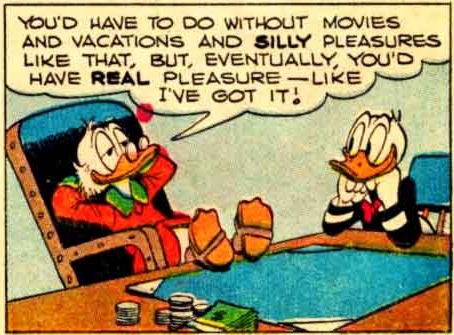
scrooge silly pleasures“The Protestant work ethic (or the Puritan work ethic) is a concept in theology, sociology, economics and history which emphasizes hard work, frugality and diligence as a constant display of a person’s salvation in the Christian faith, in contrast to the focus upon religious attendance, confession, and ceremonial sacrament in the Catholic tradition.

The phrase was initially coined in 1904–5 by Max Weber in his book The Protestant Ethic and the Spirit of Capitalism.” (Wikipedia.org)

We forget that his essay was his observations on the Germany of his time, and not a ‘how-to’ manual. Weber considered himself agnostic. His argument was that Catholicism, with its emphasis on doing good works in the hope of eternal salvation, rather than pursuing wealth for its own sake, impeded the development of the capitalist economy in the West.

Capitalism depends upon everyone in the society believing in the same goals. When the West had a booming middle class, there was room within the prosperity to dream of a country free of traditional constraints. We could reach out a hand to those who needed help, be they poor or infirm, or young or old. That sense of community resulted in government safety nets and a surge of infrastructure building that connected and included all of the people, regardless of their economic place.

North America looked at what they had wrought in the 1940’s and ‘50’s, and found it good. Good enough to not make a priority again until it started to collapse around us.

glittering TorontoIt’s been decades since the roads and bridges and communities were put in place, decades in which the needs of the wealthy became more important in politics than the needs of the tax payer. In Toronto, once Canada’s most glittering city, our highways are clogged with commuters, while our transit system is woefully inadequate to shuttle workers from their homes to their jobs. The local politicians have been arguing about whether to tear down the eastern end of the Gardiner Expressway since the 1990’s. And the majority of our subway system, which opened in 1954, is held together with patches and prayers.

business and politicsThere’s blame enough for everyone at this sorry state. Although we love to complain about ‘the system,’ every aspiring politician has to present a platform that will be seen to not only address community issues, but cost the tax payer less. Once in office, the newly elected official can point to budgetary concerns, and remind us all that there aren’t any funds since he’s cut taxes, just as we requested. Or that they are working on a solution, but we mustn’t hope to see real change until some year in the future where they will hopefully no longer be held accountable for the project and the additional costs incurred during the delay.

Politics on crosswordFor corporations, political concerns are less about the community, and more about expediting the accumulation of more wealth. Despite needing an infrastructure that allows workers to arrive at the work place on time, and roads and other delivery systems to get product to consumers, the emphasis is placed squarely on tax cuts that they have convinced politicians, and even many consumers, will result in a more equitable distribution of wealth.

Corporations spend billions on pushing forward measures that will deny workers fair wages and benefits, and will spend yet more on media essentially blackmailing consumers into giving them what they demand. Health care, no. More tax cuts, yes. Or we’ll take our ball (company, franchise) and go home. Many even believe that we have no other alternative but to agree.

The last several decades of austerity for the general public, but unheard of wealth for the few, is slowly shaping us into a timid, obedient mass, who are only valued as long as we are able to further enrich business through our labour and consumption of goods and services.

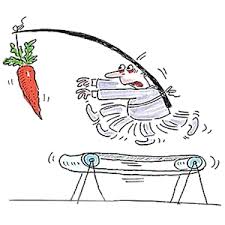
hedonic-treadmillThe pursuit of happiness has become a joyless pursuit of money, dooming its followers to an endless treadmill of greed and desperation. You’ll never catch up to the 1%, no matter how hard you try, but real happiness and satisfaction can be had in a life that encompasses empathy, generosity, and gratitude for what you’ve achieved.

Writing? Me Arse!


Some days I wake up charged with ideas and passion, unable to sleep as I mentally write the day’s blog. Other days, I’m like the Marion Keyes’ character in “The Woman Who Stole My Life,” who, while trying to begin a woman who stole my lifesecond book, finds herself spending hours in front of the keyboard, only to finally type just one word … arse.

This is an arse day.

charlie-hebdo-cartoon2Oh, I have lots of thoughts reeling through my mind, on many subjects. I’m trying to parse my feelings about the Charlie Hebdo massacre, and reading compelling follow up articles that have different takes on the ongoing siege and tragedy. I’m listening to what others have to say, whether they come from a militant or pacifist angle.

I’m receiving mail and messages commenting on the role of empathy in a democratic society, and decrying the position the Far Right has taken in regards to the less fortunate. The loudest voices always seem to demand more for those that already have so much, and less for those with basic needs.

I’m contemplating the ‘bad eggs’ in society, those who continually get away with actions that would land an ordinary citizen in jail, but whose allegiances with corporate or political factions keep them safe and in powerful positions. speak the truthAnd, despite the world’s embracing of the “I Am Charlie” manifesto, and the vaunted demand for freedom of expression, I’m a little frightened myself to talk against those in power, for fear of reprisals.

I’m inwardly chuckling over people who use their 15 seconds sarah palin ebolaof fame to insert their feet so thoughtfully into their mouths. What would we do without the Rob Fords, Sarah Palins and Kardashians of the world? They seem to exist solely to play the role of court jester in the mainstream media.

I’m mulling over how easy it is to be misunderstood when presenting one’s ideas. MISUNDERSTANDING-facebookWith few cues in the printed word beyond exclamation marks and emoticons, communication can become muddied through what is written, and how it is perceived. A simple sentence, tossed away in easy face to face conversation, can be taken in social media as a declaration of war. Perhaps the pen is indeed mightier than the sword. wink smiley

Certainly there are days when a winky smiley face can defuse a hothead.

I’m also feeling very grateful that I can count so many intelligent, creative and fascinating people amongst my friends, both on social media and in real life. Not everyone agrees with what I have to say, but that’s a good thing – if we all spent time in complete agreement on every subject, we would soon be bored. The key to understanding any part of life is listening to all sides of the story. As long as we can listen to other viewpoints without losing our tempers and stalking away, we keep the dialogue open and let fresh air into our minds.

So perhaps it’s not so much an ‘arse’ day as it is a day to regroup one’s thoughts, and decide where energies should be concentrated. mental-health-dayWriting clarifies thinking, and concentrates random concepts so that they can hopefully be understood both by the writer and the reader. In order to present ideas that are ideally both important and well-expressed, the odd ‘arse’ day may be as necessary to a writer as a mental health day to those more gainfully employed.

At least that’s today’s excuse. (insert winky smiley face.)

ThinkingClearly Mitch Blunt

The Short-Sightedness of Corporate Greed


In the midst of those post-holiday, January credit card blues, the Toronto Star business section headline on New Year’s Day trumpeted, “CEO pay returns to ‘glory days.’ Canada’s top 100 CEOs earned an average of $9.2 million in 2013, hitting pre-recession highs.”

While I’m sure the 100 families who benefited from those riches preened in delight, I thought the timing a little harsh for the rest of the country. The average Canadian worker has received little to no raises in the last ten years, and even those on a yearly review schedule can rarely bank on more than a pitiable 2-4% increase.

The average Canadian earned $47,358 in 2013.  ceo-salary-cdn

“The list of high-flying executives was led by Gerald Schwarz, CEO of Onex Corp., who earned $87.9 million in 2013, most of it in stock options. Nadir Mohamed, who was then CEO of Rogers Communications Inc., earned $26.7 million. Michael M. Wilson, of Agrium Inc., earned $23.8 million. All five CEOs of Canada’s biggest banks were in the top 30.(Toronto Star, Jan 1, 2015)

I don’t begrudge anyone a good income. But these figures are insane by any measure. While it must be said that the CEO’s earning these high wages did so through stock options, and hopefully, good corporate leadership, there is another side to their recompense; the people who work – or used to work – in the companies they manage.

“Canada’s highest-paid CEOs earned 195 times the average Canadian in 2013. That’s up from 105 times in 1998, the oldest date for which comparable figures are available. … However, even the lowest-paid CEO on the list earned more in 2013 than in 2008. While little data is available on CEO pay prior to the 1990s, it is generally accepted that the ratio of executive pay to average pay in the late 1980s was 40:1 in the U.S. and somewhat lower in Canada.” (Toronto Star)

There are only a few ways that a business can continually increase profit over previous years, which increases the value of the stock, and thereby compels the Board of Directors to approve a CEO’s earnings (which include options and bonuses); by introducing a new product so fantastic and coveted that consumers flock to purchase the item, or by reducing assets and/or staff and/or increasing prices.

That’s where the human toll comes in.

(In the 1990’s) “compensation experts came up with the idea of granting a portion of CEO pay in stock options, in which executives are granted options to buy shares at a “strike” price, usually the current market value of the share. Executives can’t “exercise” the option until a future date, at which time the share might be worth more or less than the original strike price. If the shares are worth more, the executive can opt to “buy” the stock and then immediately sell it at the new, higher value. If they are worth less, he or she can simply let the option expire at no cost to them.

Boards of directors were sold on the idea that options would more closely link executive pay to company performance. Instead, the practice encouraged share price volatility at the expense of long-term value, critics say. Among other things, they say, stock options have encouraged executives to cut costs, lay off staff, sell assets and merge with other firms — all to boost the share price in the short term, often at the expense of the company’s future value. They have also led to the rise of activist investors and hedge funds that buy shares in companies with the goal of splitting them up in order to unlock shareholder value.” (Toronto Star)

I suppose the greed is understandable, even though at that level, money becomes little more than paper to be shuffled about. Greed, accompanied by hubris and a massive sense of self-satisfaction, coupled with a belief that the party will never end, and bolstered by his/her cronies in the same tax bracket, good lawyers and accountants, and a taxation system that treats stock options as capital gains, despite stock options carrying none of the risk associated with normal stock purchases.

A dollar earned through a stock option is worth two dollars of salary income. The difference amounts to a public subsidy paid to these already highly compensated executives.” (author, economist Hugh Mackenzie, Canadian Centre for Policy Alternatives)

These executives would also have superior benefits, perks befitting their pedestaled positions, and a golden handshake agreement that would see them being even better recompensed should they ever be asked to leave the corporation. In contrast, the staff remaining after deep cuts and asset sales would find themselves clinging desperately to their jobs, despite usually having to shoulder the additional responsibilities of their now dispatched former co-workers.

In the long term, that corporate greed that has created such high unemployment in Canada (about 6.6% as of November of 2014, which will drop after seasonal positions are gone,) translates to nearly 1.3 million potential clients and customers who no longer have the income to purchase goods or services from the purveyors. 90% off store

(That figure only includes Canadians who continue to actively seek employment. It does not include those who are underemployed, or who have given up on ever finding another salaried position. To put it yet another way, in a population of 35.16 million, only 17.7 million have jobs.)

Between the shrinking job force, smaller cash reserves available for purchases, and an aging population, the wealthier of whom may move to a warmer country or the poorer who may have to rely solely on government support during their old age, it soon becomes clear that the highest paid executives are playing a zero-sum game.

working-man-vs-parasite

(added Jan. 7/15 – from Huffington Post: “Some 70 per cent of businesses expect growth this year, but only half of them will hire. The result? Stress and burnout for workers…

National Bank chief economist Stefane Marion says Ontario’s growth will be slowed by the fact that the manufacturing sector was gutted during the financial crisis and recession. During previous economic recoveries, Ontario had excess capacity in its factories and could quickly benefit from an increased demand for exports.However, much of that capacity was lost after the last recession and will take some time to rebuild, Marion says.”

http://www.huffingtonpost.ca/2015/01/06/hiring-canada-employee-burnout-hays_n_6424332.html

Whatever happened to the Angry Young Men?


Angry young men inspired the beatniks of the 50’s, and the hippies of the 60’s. Sadly, we then devolved into the disco bunnies of the 70s, but everybody’s got something to hide except for me and my monkey.
When I googled the origins of the phrase, here’s what I googged:

angry young men, term applied to a group of English writers of the 1950s whose heroes share certain rebellious and critical attitudes toward society. This phrase, which was originally taken from the title of Leslie Allen Paul’s autobiography, Angry Young Man (1951), became current with the production of John Osborne’s play Look Back in Anger (1956). The word angry is probably inappropriate; dissentient or disgruntled perhaps is more accurate. The group not only expressed discontent with the staid, hypocritical institutions of English society—the so-called Establishment—but betrayed disillusionment with itself and with its own achievements. Included among the angry young men were the playwrights John Osborne and Arnold Wesker and the novelists Kingsley Amis, John Braine, John Wain, and Alan Sillitoe. In the 1960s these writers turned to more individualized themes and were no longer considered a group. (source:The Columbia Electronic Encyclopedia®.)

Born in the 50s, I claim those men as my heritage. Their ‘anger’ allowed my generation to express their frustration at a world mired in tradition, social stigmas, and suppositions. Champing at the bit to change the world we had inherited, we burned our bras, sat in for peace, started communes, and created more art and music than you could shake a joint at. We thought we had invented sex, drugs, and the Age of Aquarius. Then we all grew up, got married, had kids, and changed into slightly weirder versions of our parents. A lot of us died far too young, many from self-inflicted life choices.

But here we remain, the largest population group in history, the Baby Boomers, the enormous bulge in the tummy of society’s snake, all of us getting older, some of us getting wiser.

January 1, 2011 officially begins the era of the “Golden” Baby Boomer, those Boomers who are about to retire from a career or profession. That’s not me on both levels; I’m not retirement age, and, due to my own choices, will never properly ‘retire’, as I never stayed in any career or profession long enough to build a retirement fund. Most of the people I know are in the same boat – musicians, artists, writers who didn’t get the brass ring or the gold watch.
And just as Boomers have affected every other decade through their sheer numbers, we are about to impact society with our physical and mental health needs, leisure choices, and economics. Those of us who didn’t ‘die before we got old’ are going to get older, sicker and poorer. Society will have to deal with our issues – hopefully not in a ‘Soylent Green’ fashion – and our kids will likely have to bear the cost of our retirement and health care. (note to self: be nicer to the kids.)

But on the bright side, most of us also benefited from decent schooling, and inherited the backbone and street smarts of parents and grandparents, who lived in simpler times, but managed to live through two World Wars, the Great Depression, and, ultimately, us. And we’ve lived long enough to have a fairly good overview of life’s ups and downs. We’re neither as cynical nor gullible as we once were. We’ve realized that yes, Life’s a Bitch, but so are we, when provoked.

And that’s why I have started this blog. I know that, for many of us, the last couple of years have been tough, with problems coming at us like a swarm of flies. We’re the Sandwich Generation of caregivers now, as well, with kids still at home, but parents still hanging in. Fish are dropping out of the sky, Haiti’s still a mess, and now Japan has been sucker punched. Crazies are lining up to see Charlie Sheen’s meltdown up close and personal. If you hate your job, tough, ‘cause there aren’t any others out there for you. Today’s music, overall, just can’t beat the music of our youth. And if you want to get out to a club to hear a band and maybe meet someone, you can’t soothe your nerves with cigarettes, and you better stick to one drink or you could get busted driving home.

WE are the new ‘angry young men’, those of us who still give a damn. With the perspective of age, we look back on what worked and what didn’t, and look forward to an increasingly litigious, PC, over controlled world. That, my friends, is frustration.
Frustrated Boomers unite!