It’s Boom Town for realtors in Toronto these days. 243,400 houses were sold last year, and as of April of this year, the average residence in the city had a starting price tag of a cool $921,000.
My old house in Scarborough, which we sold last July, was re-sold twice more by speculators before the year ended, each time jumping another $100K or so in price. It’s now been demolished and rebuilt as a monster home. I wouldn’t recognize the place, they tell me.
Fine by me. We sold, we moved, and I can barely remember the person I was when I lived in my big, old bungalow. Turns out it’s great not to have the onus of house maintenance, and the constant waiting for the next expense to drop. Renting, after 30 years of owning, may not lend the same sense of autonomy, but it also comes with a lot less responsibility and chores.
Taxes can be a burden on the home owner as well, since your residential tax is based on current value, not what you paid for the place at the time of purchase. If you lucked out in the eighties and bought your dream home for around $100,000, you might be considering a second job just to keep the taxes paid and the utilities flowing.
Good ol’ Rompin’ Ronnie Hawkins has his big estate, Hawkstone Manor, up for sale. Again. He tried to sell it for $14.9 million back in 2013, and failed. But it’s up again, this time listed at $4.3 million. If it goes to a bidding war, which is not out of the question, he could still get closer to the $10 million mark.
From the Toronto Star, April 2013:
““It’s a $100 house on a million-dollar property.”
The nine-bedroom, five-bathroom home is really only notable for the lifetime of memories that line its orange living room walls. A buyer would likely bring in a bulldozer.
But the house sits atop a rare piece of prime Kawarthas real estate — 165 acres gently sloping down to almost 4,000 feet of waterfront that, on these sought-after shores of the Trent-Severn Waterway, can go for $5,000 a foot.”
The Order of Canada recipient is 82, and not in the best of health. Whatever the final price, he and his wife will be able to cash out big and find somewhere a lot cosier to shelter them in their golden years.
And that’s the ideal situation to be in, in the market right now. If you’re selling and have to purchase another place in the city – good luck to you. They want ridiculous money for so much as a garage, without a house attached. It’s madness. Tiny bungalows, like the one I’m renting, list for $800K and sell for over a million.
And when the interest rates rise in a bit, it’s gonna be even crazier. How can the average person buy so much as an entry home in the city, without a family income somewhere in the $300K a year range? It’s nuts. Rock, meet hard place. Rock musicians … move to Hamilton.
Funny thing, though, about this real estate madness – with hundreds of thousands of properties changing hands in the last two years, there have never been more paper millionaires minted in the city than it’s likely seen in it’s history.
Not just millionaires – multi-millionaires. If you’re one of those lucky enough to have pretty much retired the mortgage, and are ready for retirement yourself, you could be walking away with more money than you ever dreamed you’d have. (Not me, I hasten to add – we did alright but didn’t hit Scrooge McDuck status. We’re barely McDucklings. We’re Ova McDuck, if anything.)
Barring a lotto win, which is unlikely, since I keep forgetting to buy a ticket, I’ll probably spend the rest of my days in rental properties, of decreasing proportions. Part of me would love to be a home owner again, but the rational, sensible part of my brain is quite comfortable with letting someone else worry about the roof, the septic tank, and the tyranny of ‘keeping up with the Jones.‘
I’m liking this downsizing, says the unrepentant hoarder. I’m liking trying to fit everything that once overflowed a 4000 square foot sprawler into this teensy tiny, less than 1000 square foot bungalow. It’s given me the chance to actually sift through all of these souvenirs and memories, and sort the metaphorical wheat from the chaff. I’m culling the hoard. It’s great to tear willy nilly through the detritus, and toss out the junk. It’s fun to put boxes of odds and ends on the lawn, under a big sign that says ‘Free!’ and watch cars screech to a halt, their drivers eager to find some little treasure to haul home.
It’s really heartening to go through all of the boxes of clothing, shoes, books, craft items, and linens, choose what can be redistributed within our family and friends, and then pass on the overflow to people who will appreciate what we’ve donated. There are so many who have so little, while others have three of everything. Distributing some of my bounty to those who can use it liberates my home AND my heart.
I didn’t need three apple corers. In fact, I have never even used one of them, not even once. Ditto the cherry pitter.
For the first time in my life, I’m no longer buying stuff ‘just in case,’ or with a view to some future purpose, because my future is now, and I want to be present.
I’m happy for those who are selling their properties for a tidy profit. I’m happy for those who are finding their dream homes. I worry about Torontonians who missed the real estate roundabout, and are now trying to find something affordable to rent. But this is all going on around me, and like you, I have very little say in what the Toronto of tomorrow will resemble.
Owning a home is not for everyone. It’s a very nice thing, and can certainly be wise and profitable in midlife. But when it comes time for retirement, home ownership is more like an anchor around your neck, keeping your proverbial boat stuck in one place. To enter new waters, you’ve got to haul up that anchor, and unfurl the sails, letting the fresh breeze take you somewhere new and exciting.
Avast, me hearties … I’m bound for uncharted shores!
Canadians … we love our country, but that’s never stopped us from having our beefs with how it’s run. Unlike many other countries, we feel free to speak up about what angers us. For all our reputation of being a polite and respectful people, we reserve the right to disagree with those who would impose their will upon the nation.
We love our healthcare, but are aware it needs tweaking to be all that it should be. We know that it is not ‘greedy’ or ‘entitled’ to demand that the healthcare that we pay for with our taxes, works for every Canadian.
We love our democracy, but want to ensure that we remain democratic, which calls for electoral reform. We don`t want to run the risk of any party taking control of the system and bending it to it`s favour – we won’t accept trickery or gerrymandering in our elections.
Many were angry at the direction we took in the last decade, under the Conservative prime minister . We now have a Liberal prime minister, and likely just as many have issues with his party. In our Canadian way, we will protest against what we dislike, and in due course, vote for the direction we would like to have in the future.
Because this is not a “my country – love it or leave it‘ place, we can and will criticize those in power, and insist upon our right to do so.
On July 1, we honoured the establishment of Confederation in 1867. But the interesting thing about the adoption of the July 1867 date is that, at that time, Canada consisted of only four provinces; Ontario, Quebec, Nova Scotia and New Brunswick. While Canada Day acknowledges an important national milestone, it’s not really celebrating all of the country we now call Canada.
Nor does the concept of Canada Day include the indigenous peoples who were here before the settlers came from Europe. Even our national anthem ignores the fact that this is not our native land. Instead, we live ON native land, 89% of which is Crown Land administered by Indigenous and Northern Affairs Canada, and still in dispute, hundreds of years after the first treaties were written.
The First Nations people have been here for over 13,000 years, and for many, the celebration of Canada Day amounts to ” celebrating resource extraction of our territories. The Indian Act is still in place. The government is not allowing First Nations to have a voice. So why would I ever celebrate?”” (Anishinaabe traditional storyteller and teacher Isaac Murdoch.)
The #Resistance150 movement was created nearly eight months ago by Murdoch, Michif visual artist Christi Belcourt, Cree activist Tanya Kappo and Métis author Maria Campbell, as the group discussed the festivities planned by the Liberal government for Canada 150. They found it increasingly difficult to accept that the government, while giving lip service to plans of reconciliation, continued to ignore the ongoing fraught relationships between native Canadians and the rest of Canada.
Their resistance movement was developed to inspire other indigenous people to reclaim what they lost during colonization; their land, language and traditional ways.
The group created a camp for indigenous children and youth to attend called Nimkii Aazhibikong on Ompa Lake, located about 20 kilometres north of Elliott Lake, Ont. this year. Here the children can immerse themselves in traditional languages, explore their culture, and discover their environment under the tutelage of visiting local elders.
“Beyond attention to culture, Murdoch`s group also wishes to send a strong message on the negative effects of climate change and the First Nations longstanding dispute with the government over land ownership.
All over the country there’s this free-for-all in resource extraction that’s happening,” he said. “First Nations people are screaming and saying, ‘No’ and Canada just keeps saying, ‘Yes.’”
On top of sounding the alarm over how resource extraction and pollution is hurting the environment, Murdoch said the #Resistance150 movement is also calling for the abolition of the Indian Act, which was first introduced in 1857 by the British colonial government, and reads very much like a treatise from the Southern Baptist religionists banning dancing in the 1984 film Footloose. Cruel, vindictive and petty, the Act aimed to crush the people and their culture, by any means available.
” Over the next hundred years the Indian Act was amended a number of times but each time was aimed at a more efficient means of assimilating First Nations into white society. The Act was amended to ban the “Sun Dance” an important ritual among the Lakota and other Plains aboriginal cultures. On the west coast the “Pot Latch”, an elaborate ceremony of feasting and gift giving was also banned. With an eye to forced assimilation, the Act authorized the forced removal of children to Residential Schools and stripped any Indian who obtained a University Education or Ordination of his rights under the Act.
The act vested title to reserve land to the Crown represented by the Minister of Indian Affairs deeming it “Crown Land set aside for the use of a Band of Indians.”
The 1876 act also made it illegal for an Indian to sell or produce goods without the written permission of the local Indian Agent, who became the de-facto ruler of Indians on reserve. (this includes fruits, vegetables, and farming, to this day.) Indian Agents had to give written permission for Indians who wanted to leave the reserve for any reason.
Status Indians were not allowed to vote until 1961.”
When I speak with many middle aged to older Canadians about the past, present and future of our First Nations people, whether status or non, it’s clear there is a confusion in what is believed to be true and what is fact. Sadly, the contents of the Truth and Reconciliation documents mean little if you’ve already made a pre-judgment on the nature of a people.
However, fairness and justice is what we should be working towards, for all Canadians. There are specific problems that need to be addressed amongst indigenous people. Some of these problems are brought about by where the reserves are located. There are currently about 150 long-term and short-term drinking water advisories in First Nations communities that are difficult to reach in good weather, and impossible to reach in winter.
In some of these far flung communities, suicide rates, especially among the young, are five to seven times higher than the national average.
First Nations and Metis are 2-3 times higher at risk for diabetes than the non-Aboriginal population, while tuberculosis – almost nonexistent among non-Aboriginals, is 26.4 times more prevalent in First Nations Canadians.
I am proud of my country, but I know that my country has to include ALL of it’s people – those who came before us, and those who will join us in the future – to be strong and united. As a country, we can do so much better. And I have faith that we will work towards being a better, stronger, fairer country in the coming years.
In an article on what it means to be a Canadian, Prime Minister Justin Trudeau said, ” “This is something we are able to do in this country, because we define a Canadian not by a skin colour or a language or a religion or a background, but by a set of values, aspirations, hopes and dreams that not just Canadians but people and the world share.”
And as writer Mike MacNeil responded to those concerned that the Canada Day150 celebrations ignored Canadian history and absolved us of our crimes against the First Nations people, “ It”s not the pilfering and genocide that’s being celebrated. It’s instead – and finally – the recognition that something positive is being done to correct decades of misuse and mistreatment. It’s slow, granted. It’s imperceptible, granted. The pace of change could be infinitely faster, granted. But the change – however it’s characterized – is there.”
In June 2012, Amazon picked The Age of Miracles by Karen Thompson Walker as one of the month’s best reads. A combination coming-of-age story and apocalyptic page turner, the novel focused on how people would react to a changed world, where “theEarth’s rotation slows, gradually stretching out days and nights and subtly affecting the planet’s gravity. ”
The book outlines how a young girl, along with her family and friends, cope with this adjustment, as the planet wobbles off to it’s slow demise. Meanwhile, the best laid plans and schemes from governments fail to make much difference in how the Earth’s denizens cope with the disaster.
And that’s kind of where we’re at these days, isn’t it? We’re in a vague malaise, unable to confidently say what the weather will be like today or tomorrow, while hapless governments, even if they agree that there is a problem, struggle to find bandaid solutions to the earths’ sores that have been left to fester for too long.
Except this guy .. this guy thinks he knows better than anyone on the planet, be they incredibly educated scientists or those who have spent their lives dedicated to studying the effect of climate change on people. This guy is an asshat.
It must really be pointed out how completely insanely and selfishly Trump and his band of reverse Robin Hood Merry Men are behaving. They’re hooting and hollering like ignorant hillbillies as they seal the environmental fate of those fools who voted for them to make life altering decisions, in the name of ‘economic change.’ These corporate raiders of the environment are convinced that money and power will save them from dying from a lack of clean air and water. But just them. The rest of us? Dream on. We’re all going down with this ship.
Remember when the first rumblings about a change in the planet’s clime began to hit the middle class consciousness? Those who could see the bigger picture were worried about how even a slight shift in warming could damage our environment, the least of our worries being an increase in natural disasters, as melting polar ice caps brought about flooding, and extreme weather swings were tempered with more frequent and deadlier droughts.
Others smiled at the thought of palm trees growing down the main streets of large northern cities. With a thorough lack of understanding of the fragility and interweaving of climate and landmass, some hoped this warming would bring about new tropical beaches in heretofore frigid areas. These foolish humans thought they could somehow control where and when climate change would happen, and bend it to their wishes.
All of their fantasies depended upon where they were located, and hinged upon a lack of empathy for those who would see the opposite of these desires. In order to have the tropics brought to your front yard, many countries would have to be completely displaced or disappear from their current sites. In order to have Floridian temperatures in Boston, New York or Toronto, you first have to lose Florida.
But, of course, they were attempting to take a world problem, and make it into a personal triumph. Still, Man proposes, god and the environment disposes. You’ve only to look locally, to the disastrous flooding on the Toronto Islands and the economic battering Toronto is taking on this matter alone, to see that we have no control whatsoever when Mother Nature gets pissed off. Instead of a tropical beach, you have land masses swept away, along with coastal areas being eroded, possibly never to be returned in our lifetimes.
I wonder what Trump will think when his precious Mar-a-Lago is swallowed up by the sea? It will happen, and I can only hope it will happen sooner than predicted. Right about now works for me.
And when I think about those who continue to claim that our actions are too miniscule to have any sort of immediate impact upon the planet, I’m struck dumb by the hubris, and the inability of some to look at the damage we all regularly inflict upon the planet, and not see how integral each and every living creature’s actions are to maintaining this delicate balance. Where once we knew, instinctively and intuitively, that the lowliest butterfly snatched from our timeline could have an impact upon the food chain, we now struggle to throw off responsibility for the most damaging of indignities and raping of natural resources ever seen in human history.
But don’t we love to talk about the weather! Talking about it, singing about it, trying to forecast what might be on the horizon, and molding our protective coatings around what we hold precious … this is what we have always done, since caveman days. Through the centuries we learned more about how the planet moved through it’s cycles, and how the sun and moon determined how best we could use the land and waters around us.
We learned to measure how precipitation complicated the times when seeds could be planted, in order to feed our populations. We began to understand that chemicals, seeded into the lifeblood of the planet, the very earth and air, could and would damage the reproductive cycles of all living creatures. We learned how to forecast what the weather might be in coming days, and when we would need to protect our bodies with clothing that would keep us warm, or sunscreen that would fend off the increasingly irradiating rays of the sun, which were no longer impeded by the thick coating of ozone we had taken for granted.
All of these things we learned over time, through observation of the repetition of the seasons, we now blithely toss aside in favour of commercializing and exploitation of resources, an exploitation that seems less inclined to profit humanity, but certainly enriches corporations with no concern for the actual ‘owners’ of the lands they rape.
We looked to the seasons as metaphor for our lives. The cycles of the seasons echoed the natural order of life. Spring reflected our callow youth, and Summer mirrored the fullness of being an adult. We understood that the fall indicated a slowing of days, and winter … dark, cold, unforgiving winter … symbolized a time of aging, and eventual death. The days have the same length, but there are fewer of them.
When the natural order of the seasons is displaced, when you can no longer count on April showers bringing May flowers, our human minds have difficulty grasping that which we’ve always taken for granted – the flow of time reflected in our environment.
The impact of climate change doesn’t end with the physical damage that’s being inflicted on the world. Now, those who study our psyches are beginning to see a change in how humans respond emotionally to the trauma and shock of weather events. Even if we try to avoid focusing on the earthquakes, tsunamis, droughts, floods and landslides which now occur more frequently, our minds are aware of these catastrophes, and our ability to absorb these disasters is lessened. Our empathy is impacted, leading to a rationalization of isolation, and of a need to protect what we have from those displaced by events beyond their control.
We are, in effect, living in a state of post traumatic stress and shock. Some might feel a low grade sense of depression and anxiety, while others, perhaps more sensitive to this imbalance, may have behavioural issues, ranging from substance abuse, to interpersonal and job-related difficulties. Other symptoms can include a heightening of violence and aggression towards others. It is no accident that the rate of suicide has risen in the last decade, as some decide that there’s simply no reason to carry on, in a world so out of balance.
Climate change on our planet will eventually impact every one of us, wherever we live. In recent studies (Bryant et al., 2014,) (Simpson et al., 2011,) it was noted that, “ Changes in climate affect agriculture, infrastructure and liveability, which in turn affect occupations and quality of life and can force people to migrate. These effects may lead to loss of personal and professional identity, loss of social support structures, loss of a sense of control and autonomy and other mental health impacts such as feelings of helplessness, fear and fatalism.
Extreme temperatures in their own right have a unique influence on behavior and wellbeing. As research by Craig Anderson (2001) and Simister & Cooper (2005) has shown, aggression increases as temperatures rise. Thus as summers get hotter, so might our tempers — likely due, the researchers explain, “to the impacts of heat on arousal, which results in decreases in attention and self-regulation, as well as an increase in the availability of negative and hostile thoughts.” Heat can also impact our ability to think clearly, they add, “which may reduce the ability to resolve a conflict without violence (Pilcher, Nadler, & Busch, 2002).” Higher temperatures have also been found in other research to increase the risk of suicide (Lee et al., 2006).
Add to this mounting fear and anxiety derived from watching the world around us change in irreversible ways — coupled with the helplessness of feeling as if we cannot stop or reverse global warming— and you have another effect of climate change on mental health:
“Watching the slow and seemingly irrevocable impacts of climate change unfold, and worrying about the future for oneself, children, and later generations, may be an additional source of stress (Searle & Gow, 2010),” the authors write. “Albrecht (2011) and others have termed this anxiety ecoanxiety. Qualitative research provides evidence that some people are deeply affected by feelings of loss, helplessness, and frustration due to their inability to feel like they are making a difference in stopping climate change (Moser, 2013).”
While it may be expedient and profitable for climate change deniers to continue on the path to ecological destruction, those who deny what is happening to their own psyches are impeding any kind of healing for the rest of us. Seasons change, and we must change with them. But more gently.
The Na-Me-Res (Native Men’s Residence) lucked out with the weather for the annual traditional Pow Wow held Saturday, June 24th, at the Fort York historical site. The day was sunny, yet breezy, and very well attended.
Barbette Kensington and I were early to this celebration of song, dance and ceremony. From the impressive Grand Entry, through an entire day filled with the pounding heartbeat of the drums competing to be heard over the cheerful chatter and laughter, the old Fort was a sea of smiling faces of all shapes and colours
Powwows honour Native tradition, and I was grateful to our emcees, Steve Teekens and Jay Lomax, who outlined the elaborate etiquette and protocol that is integral to understanding the rituals and colourful regalia.
The Grand Entry, for instance, is not to be photographed nor videotaped, since this is a sacred moment during which the members of the procession may be praying for loved ones or members of the community. The regalia, often the work of many hands over a long period of time, represent the totems of the wearers, with the colours reflecting their spirits. No one may touch any part of a dancer’s regalia without first asking permission.
” The moment you take on the role of an initiated dancer, a great deal of pressure is put on you by the people, not only to perform, but to be a role model, to be honorable. When you put on regalia, you take on the essence of the sacred animal, honor culture, tradition and the Creator.
“Being humble should be the number one priority for any dancer, thankful that you are allowed to dance with the animals you wear, your sweat and suffering are for the people, making people proud of who you are, showing your respect, because you represent them,” said Elder Antoine Littlewolf.
One of the unwritten rules of powwow is that no one should touch another’s regalia without first being given permission by the maker or owner.
Eagle feathers, which traditionally are earned, and all feathers, for that matter, should be treated with special care. It’s necessary to be humble and respectful to each feather being worn. The spirits of all animals being worn must be respected above all else.
Arena Director Earl Oegema handily kept the dancers in line in accordance with all of the tradition and protocol. “Powwow etiquette and tradition dictates that the Grass dancers be the first to enter the arbor, symbolically stomping down the grass to provide a flattened circle for the rest of the dancers to follow. They enter the arbor from the south entrance and go clockwise with the drum, following the wheeling movement of the sun, moon and stars.”
The Grand Entry is next, followed by songs and prayers, during which the attendees are asked to stand as a sign of respect. The beauty, colours, and the dignified spirituality on display before us brought tears to my eyes.
We’d run into Vicki and Bill Wood (the Woodies, Eye Eye) on our way in to the Pow Wow, and spent some time chatting with them. Now it was time to begin our walkabout through the 50 craft vendor and information booths on site, chatting with old and new friends.
We were on a mission to find the Anishnawbe Health Toronto booth, as Barbette had some questions for the staff. On the way, we flirted and chatted with some of Toronto’s finest, part of the Aboriginal Peacekeeping Unit, established in September 1992 , the first major urban police service in Canada to establish a unit to deal specifically with the issues faced by the Aboriginal community.
With lunch on our minds, we were happy to see our friend Shawn Adler‘s Pow Wow Cafe was represented with a food booth on site. From the moment the Cafe opened, the foodies were lined up for blocks; the food IS that good. So we were lucky to see the multitalented artists, Annalee Orr and Nancy Beiman, close to the head of the very long line up for his Indian Tacos. They asked us to join them, and with little persuasion, and some apologies to those we’d line cut, we did, and soon had our plates of bannock smothered in beef, vegetables, salad and sour cream clutched in our hands.
Annalee and son Daniel had established a little ‘camp’ under the one tree in the Fort, and there we quickly polished off the tacos. Bellies full, it was time to visit the vendor booths.
Barbette knows many of the craftspeople and vendors from Native Centre encounters, so we made a very slow promenade, admiring the jewellery and artwork, being inspired by the craftworks, and chatting with some of the artists.
Dancers in full regalia drifted through the crowds, brilliant visions of colour and sound as the jingles attached to heels rang.
We were delighted to run into Leslie Saunders, former manager of The Meeting Place, a community drop in centre for those in need in the Bathurst/Queen area. Nearly half of the centre’s participants are First Nations people.
And it is always a joy to encounter David DePoe, community activist, retired teacher, and Kensington Marketeer, best-known for his activities in the late 1960s as an unofficial leader of the Yorkville hippies, and founder of the Diggers movement in Yorkville.
What a pleasure it was to be introduced to the legendary, multi-disciplinary, artist, Stella Walker. The woman’s energy is breathtaking! She’s a singer, writer, actor, producer, comedian and painter, and in the middle of producing a new musical comedy that includes content from award winning Newfoundland writer, actor and comedian Andy Jones, and will be directed by John Mitchell. Barbette appears in one of Stella’s many videos – Under the B .. Busted.
As the day wore on, my energy was starting to flag, and we made our way out of the Fort, stopping briefly to watch the talented hoop dancers and inter-tribal dance exhibitions. If we had stayed, we would have been welcome to join in the Feast, and to enjoy the evenings musical offerings, which included Crystal Shawanda, the award winning country music artist.
If you’ve got Pow Wow envy, you’ll have another chance to join the fun on Wednesday, June 28th, when the 8th Annual Aboriginal History Month Celebration at Yonge & Dundas Square begins at noon.
There’s a great line-up of entertainers, including Amanda Rheaume performing at 7 pm, along with an all day Kid’s Arts & Crafts Tent, craft vendors, and Indigenous agencies showcasing what’s available in the community. Hope to see you there!
When we first sold our house, worrying about finding a space that would be safe, affordable, and have amenities nearby didn’t seem like such a big deal. Really, we reasoned, how hard could it be? I, for one, thought that our biggest problem would be agreeing on location.
Wrong.
Since our search for housing has begun, I have passed through all the stages of grief; denial, anger, bargaining, depression and acceptance. I now accept that my entire life is on hold, and that I will be a quivering mass of anxiety and frustrated tears until this home hunting issue is resolved. Or one of us kills the other.
I had no idea that so many of the baby boomers who had dutifully bought their suburban homes during good times would all be taking advantage of a seller’s market, with an idea of moving back into the city where they could enjoy their golden years. The hive mind’s plan was to sell before the real estate bubble burst, find a little place to squat until the madness calmed down, and then decide what to do next, secure in our gains and pensions.
Our lovely little bungalow was snapped up, and flipped again within the month. A friend just sent over a photo of it being demolished. As glad as I am that we are now ‘Former Scarberians, ‘ I did feel a pang at the sight of the rubble.
What we did not fully comprehend was that as the price of real estate rose, so did the greedy little hearts of landlords seeking to cash in on square footage. We’ve had rent control in Toronto for decades, but that only covers units built (or occupied) before 1991. The easing of rental controls was meant to encourage new rental units to be built, but was not acted upon – in the decade between 1996 and 2006, 95% of all new housing built was private residential ownership.
But having committed to the house sale, we established an east end home base, with an eye to sorting ourselves out before finding a ‘forever home.’ Unfortunately, when your stuff is in boxes, in storage spaces, and scattered to the winds, a sort of inability to move forward takes over … when you don’t know where you’re going, you can’t see any road ahead. Easier to lie back in the poppies like Dorothy than to sort through hundreds of cryptically labelled boxes to find the potato masher.
We made up a wish list of what we could and couldn’t accept in housing. Accessibility to amenities, shopping, libraries, etc was priority number one, since I don’t drive. So this palace had to be close to the subway line, and roughly west of Woodbine station, and east of Ossington station.
High rises were just out, right off the bat, after hearing countless horror stories about tenants battling cockroaches and bed bugs. Low rises were a low priority – still so much noise and too many neighbours!
A three bedroom would be best, a large two bedroom acceptable IF there were separate dining and living rooms. Parking would be great, street permit parking would be considered. A little back yard for the cats, or at the least, an enclosed balcony, was also on the list.
We established a maximum monthly rental cost that we could comfortably afford, with the knowledge that rental costs would inevitably increase yearly. If we needed to include utilities in the costs, electrical heating could not considered if we were to be able to afford both heating and eating.
Oh, how the Gods laugh, when humans list what they will and will not accept!
Our first forays into the rental world were fun and interesting. Thirty years of home ownership had us lulled into a false confidence. Hours were spent burning out corneas, sifting through Kijiji, Craigslist, ViewIt, and countless other rental sites. We were ready and willing to explore what was out there.
Preliminary research done, it was time to inspect what was available. We saw apartments, condos, tiny houses, and lofts. We looked above stores, under stores, and at underground parking.
And every time we’d find something that was either ‘just perfect!‘ or ‘close enough to be almost perfect!’ we’d be scooped by some other renter frantically trying to avoid homelessness. Everything, it would seem, was fair in apartment hunting … lies, bribery, tantrums …
Landlords today are the Gods of the past. They can drive a grown man to tears, never mind a small French girl. They are merciless. They can not only demand more private and confidential information from you than your doctor will, they can gleefully skip over rental/tenants agreements willy nilly, banning everything from smoking, to small pets, and cooking smells. They can demand thousands of dollars in certified cheques be handed over, before they’ve even looked at your 11 page rental application.
It is to weep.
Over and over, we’ve been told, despite having responded to an ad only two hours old, that there were several people who’d seen and applied for occupancy before us. Our impeccable credit ratings meant nothing, if another applicant fanned a wad of cash in front of the landlord, and agreed to pay hundreds more than the stated rental price. It is back to the dark old days of ‘key money,’ and laws and legalities be damned.
I no longer look forward to viewing living spaces, nor do I mentally dress them in my mind. I have no reason to expect that finding anything more than four walls and, hopefully, a roof, await me. To quote an old Monty Python sketch, I’m beginning to realize that I may soon be living in a cardboard box in the middle of a busy street. In the game of apartment hunting, I have had my tenant heart broken.
When the hunt for a home resembles the worst of the Wild West, it’s a lose/lose game for both the renter and the rentee,. Those who finally win a place to live at any price feel no joy in the victory, no loyalty to the landlord, and no need to be a responsible tenant, if that success has come at a cost that will prevent them from enjoying the rest of their lives.
Nor does the temporary flush of money, money, money help the landlord when he discovers that he’s rented to someone willing to cough up the extra dough so that the space can be turned into a grow op or a crash pad for six other friends. Good luck evicting bad tenants .. that’s one place where the law not only comes down heavily on the side of the resident, it’s actually followed to a fair thee well. Your squatter may be around for a very long time.
Setting aside the morality and ethics of rental wars, there’s an impact on society at large.
Anyone who falls through the cracks, economically, is hopelessly disenfranchised in this battle. Kids in college, or right out of college coping with short term employment contracts, or gawd forbid, unpaid ‘internships,’ are right out of luck, along with the disabled, the elderly, the vulnerable, and those who don’t pass the scrutiny and whims of landlords. Demoralization and often, homelessness, loom in their futures.
When greed rules the markets, lawlessness runs rampant. We cannot balance a Trumpian ‘smart business practices’ fallacy with a failure to acknowledge that Toronto‘s historically low vacancy rate of 1.3% will have a negative impact upon the social and economic success of the city. Short term gain is never the equivalent of what can be achieved by long term, responsible, financial planning that takes into account the needs of all of a city’s inhabitants.
Meanwhile, I’m waiting to hear if we have been chosen for an apartment that, while not ideal, ticks a few of our wish list boxes. But I’m also getting ready for yet another ‘go see’ of a space that could be made into a cozy space for two to curl up in.
We’re lucky – we have options, although it often seems that our options keep narrowing, and the lines we drew around what is habitable keep getting redrawn. How those without those options will cope is beyond me.
Life’s been pretty good, overall, since I shook the dust of Scarborough off my shoes, and returned to my old Danforth stomping grounds. It’s such a treat to just walk up the street to a good restaurant, or to pop into a local bar to hear friends playing. I no longer have to pack my purse with overnight supplies before heading out to do groceries, or to visit my chums in the downtown core.
This retirement stuff seems to be working out just fine! I am totally down for the ‘Live, Love, Laugh” groove.
One aspect to the whole getting older/taking better care of one’s fragile corporeal self has been a downer … who knew all these bits and pieces needed maintenance or they would wear out? Sit down, keener nerdling, yeah, you knew, but I had more fun on the ride.
Bodies wear out, minds get warped, it’s all in the game. Some cope better than others; some win the genetic lottery. The rest seek relief at the hands of professionals, and even some gifted amateurs.
Shelley Marshall is a talented, award winning, comedienne, actress, keynote speaker and producer. She’s also the doyenne of The Mental Wellness Living Loft,a comfy place for those who’ve been bruised by life to relax, meet other people of like minds, or to simply sit quietly, knitting or colouring, without fear of being asked to ‘move along.’
Tuesdays and Thursdays, between 2pm and 6pm, Shelley and her husband Jason welcome all to their home loft in Leslieville. Shelley suffers from what her doctor has called complex post traumatic stress disorder caused by childhood trauma. She’s known many people who are unable to cope with modern day life, and who struggle with mental health issues. When a bout of agoraphobia kept Shelley away from being with friends, she realized that she could have her friends come to her, and make everyone happy.
And she certainly has succeeded in her quest. If you are interested in attending, please call 416-821-1754.
Laughter might be the best medicine, but music is a close second, in my case, and I was lucky to get a double dose of the good stuff when our fearless editor and modest rockstar Bob Segarini was persuaded to reunite the Alzeimer Appreciation Orchestra and Chorus for a good cause – we all needed a night out and a hang.
Musical Director Peter Kashur brought together Bob, Drew Winters, and a motley crew of Kid Carson, Craig Riddock, Connor Walsh, Annette Shaffer and myself for a rollicking 45 minute set that grew, like Topsy, into an hour and a half of bluster and blather.
Despite the terrible weatheriness of the weather, we had a solid crowd of family and friends, and a good time was had by all.
Video courtesy of Jean E. Trivett, aka JeanDaGnu or GnuJet.
Last night was the March 17th Birthday Boy‘s final treat – a Nature Boy salon featuring Jane Siberry, with special guests Mary Margaret O’Hara and Geneviève Marentette.
The singers, ably accompanied by pianist Michael Shand, performed for an appreciative crowd in a private home in the Annex. These salons are a wonderful way for musicians to make a living, performing in a comfortable setting, where the attendees are fans, grateful for a chance to capture an intimate moment in time with their musical icons, and even have a conversation with them after their show at the reception.
Ms Siberry did not disappoint, as she wove her musical web over the rapt audience, performing several songs off her new CD, “Angels Bend Closer,” as well as takes on classic tunes such as “Nature Boy” and “The Girl From Ipanema.”
On this evening, Jane was the headliner, but on Friday night, it was Geneviève Marentette’s night to shine, and I’m very sorry to have missed that. I was not familiar with her work, but was impressed with her vocal additions when the three vocalists harmonized. I’m even more impressed since listening to her recent CD “Gigi” and watching her collaborations with luminaries such as David Clayton-Thomas and the much missed Don Francks.
Mary Margaret O’Hara’s Sunday night (tonight) show sold out immediately, and a second show has been added for Monday – but that’s sold out as well. Mary Margaret kept the crowd in stitches throughout the evening, with her trademark yips and sounds. O’Hara’s 1988 release, Miss America, is still regarded as a seminal recording, and the singer has been described as “a force of nature, a remarkable singer and composer whose crystal-clear soprano acrobatics and hypnotic songs defy accepted conventions”
Today the sun is shining, the sky is blue, and it’s supposed to get up to 15 C/59 F today. Time to see if I can still ride the old bicycle without breaking a hip. Yeah, I could get used to this groove, especially living in Toronto, with all that’s offered.
It’s been nearly four months, and still, several times a day, it feels like a rat is trying to gnaw it’s way out of my belly. I’m still craving the instant hit of nicotine that was my constant companion for nearly 50 years.
I remember precisely when I first inhaled a Benson and Hedges menthol cigarette … I was 13 years old.
A friend had come in from Edmonton to enjoy the wonders of Montreal and Expo 67, and she brought me the habit. I’ve never forgotten that day. We giggled even as we gagged, and blew the smoke out of my bedroom window. I felt very grown up, as she showed me how to ‘french inhale.’
She also turned me on to shoplifting, but I was such a terrible thief that my first attempt in the downtown Woolworths found me nabbed and ‘barred for life’ from the store.
But back to cigarettes. My grandparents smoked into their nineties, and both of my parents smoked, as did most peoples’ parents back in the sixties. People smoked, and they smoked EVERYWHERE. At the local Steinbergs, a large grocery chain store, there were ashtrays affixed to the shopping carts, so that you need never go without your nic fix as you weighed your bananas.
We smoked in offices, in hospitals, in church basements, in stores, on elevators, in restaurants, on the street, on airplanes, in our cars, and in our homes. MPs smoked in Parliament. Talking heads smoked during television interviewers. Doctors recommended brands in print and TV ads. Even cartoon characters smoked.
We smoked indoors and outdoors, and few, if any, ever waved a hand to shift the smoke from their faces, or the faces of their children.
At that time, 50% of Canadians over the age of 15 smoked. I’m guessing it was closer to 80% in Quebec, where no macho, hockey playing, swaggering boy would be seen without a fag hanging from his lip, and a deck tucked up inside his white t-shirt’s sleeve.
Cigarettes were quite inexpensive, less than fifty cents a pack, and were even cheaper in the States. The top tobacco brands competed fiercely for market share, in both Canada and the U.S., but the magazines that came from America almost always included coupons for free packets of ciggies.
But there had been rumours coming from the United Kingdom (where 80% of males smoked) as early as 1950, that a Dr Richard Doll had discovered a link between smoking and cancer, while pursuing a possible link between the tar in road construction and patients with lung, stomach, colon, or rectal cancer. Over a period of several years, he interviewed patients, and over 40,000 British physicians, and came to the inevitable conclusion that smoking was a main factor in lung disorders, cancer, and cardiovascular disease.
Since no one wanted to believe that our delicious smoking habit could possibly be bad for us, most people thought it was just some nonsense brought up by do-gooders who had a hate on for smokers and drinkers. After all, 9 out of 10 doctors said Camel cigarettes were ‘toastier,’ while dentists recommended Viceroys! Clearly your health and safety concerns were just a question of finding the right brand.
But the evidence was mounting. In 1963, Canada’s federal health minister, Judy LaMarsh, warned that smoking contributed to lung cancer, prompting the Canadian Medical Association to urge doctors to stop smoking, at least while attending their patients.
And despite the 1964 report from the U.S. Surgeon General that linked cigarette smoking to lung cancer in men, and possibly in women, despite that same report citing smoking as the most important cause of chronic bronchitis, and despite the fact that I was studying voice and music, and considering a career as a vocalist … I took up smoking in 1967 and didn’t look back for decades.
In 1972, the first ‘warning’ messages began to appear on the side of cigarette packages, and by 1989, it was made mandatory for packets to have a health warning . By 2001, Canada mandated picture warnings that covered 50 per cent of the boxes.
Like most conscientious, quasi-hippies of the sixties, I quit smoking and drinking while pregnant with my daughter, and stayed off cigarettes for a few years after her birth. But nicotine is highly addictive, so by 1976, I was back on the demon weed, despite now pursuing full time singing gigs. I was young, healthy, and I couldn’t feel any side effects from my habit, so why not?
For a few years I’d continue on an on-again/off-again pattern, quitting sometimes for years at a time. But despite trying every trick in the book, from acupuncture to hypnotism to counselling and medication, nothing worked permanently. I was always just an excuse away from sliding back into the addiction.
And then, about four years ago, I heard about a paid research study on nicotine addiction being done by CAMH, (the Centre for Addiction and Mental Health Care,) and decided to give it a go. They’d pay me to be in a double blind study that focused on the use of Zyban, a nicotine replacement medication. AND they’d give me the medication for free. Only thing was, I wouldn’t know if I was on the actual drug or a placebo. Still, I was game to give it a whirl.
Beyond the medication, the study focused on mindfulness, and an understanding of what part our addiction played in our day to day lives. The study required that I make a note of every cigarette I smoked during the day, and any emotion I was feeling when I felt the urge to smoke. Since I had been using an old fashioned cigarette making machine with tobacco and tubes for my daily fix, I hadn’t any idea that my cigarette intake had risen to 40 cigarettes a day.
I also discovered that I had certain attitudes about smoking. Years of social conditioning had convinced me that I could neither relax nor concentrate without a smoke, and that I certainly couldn’t write without a cigarette smouldering away in the full ashtray beside me.
When I’d talk to other smokers, the males would commonly exhibit bravado about continuing to smoke, despite health concerns, while most of the women would agree that sneaking a cigarette break really meant allowing themselves to stop the world and it’s unending demands for a minute. Even though we intuitively knew that we were doing physical damage to our bodies by smoking, we still had a “this I do for me” attitude about the habit.
When the study concluded, I was nervous about keeping off the ciggies on my own, so I was referred to the CAMH Nicotine Independence Clinic, where I would have access to outpatient treatments, assessment, medical consultation, group counseling and medications to quit/reduce smoking.
I’m so glad that I lucked into that clinic. From my first visit, I was welcomed by their friendly staff, and treated by top notch doctors and nurses that encouraged me to fight towards nicotine independence. Month after month I’d have to face those professionals and explain why I, an intelligent, motivated, woman, could not seem to get the nicotine monkey off my back.
The first surprise was that I had spent three months on the placebo, rather than the medication. And when I was prescribed the actual Zyban, I discovered that I couldn’t tolerate the drug; I wasn’t smoking, but only because I couldn’t stop vomiting.
However, with the clinic’s support, and a constant supply of free nicotine replacement treatments, (patches, lozenges, gums, inhalers) I struggled through the next four years, promising myself and my mentors that I would indeed quit .. soon. Just not today.
During a particularly harsh Harper budget year, the rules for the clinic were changed; patients could now only receive the nicotine replacements for six months at a time, although they could continue receiving medical consultations and counselling. After a further six months, patients could again receive replacements. Those six months on/six months off made it very hard for many to stay nicotine free.
When I returned to the clinic last fall to begin yet another six months of treatment, I desperately wanted to get off the addiction treadmill. I was sick of being sick, of seeing the effects of years of nicotine use etched on my face, and in it’s detrimental effects on my health. It had almost become a joke that I had been attending the Clinic for longer than some of their staff.
I waved a breezy ‘hello’ to Natalie, the receptionist. But it was the sight of a woman patiently waiting to see the doctor that really gave me pause. The woman was chipper and in good spirits, despite being hooked up to oxygen tanks, and needing a walker to get around. She happily told me that she was certain she could finally quit smoking, although it was too late to do much more than halt the progress of the COPD (Chronic Obstructive Pulmonary Disease) that she’d acquired through her years of smoking. The woman confided that she was a decade younger than me.
When it was my turn to talk to the doctor, I told him that I could deal with aging, but I couldn’t deal with being a sick old lady. I wanted to bang away at this nicotine monkey with everything I had, and that they could give me. The doc loaded me up with patches, gum, lozenges and inhalers, and wished me good luck.
For all my good intentions, however, and even while wearing nicotine patches that added up to 63 milligrams of nicotine replacement to my blood, I still found myself smoking to ease tensions and relax. I could tell myself that the stress of selling the house and moving gave me an ‘out.’ I DESERVED the occasional cigarette, dammit!
And the story might have ended there, in an endless loop of me going to the clinic, getting medical help, and still smoking, except for a bad thing that turned out to be a good thing.
November and December were tough months, what with the move, the weather, and all of the physical changes in my life, which culminated in a bunch of health issues, including a cold that turned into bronchitis and then into a nagging cough that just wouldn’t go away. I coughed 24/7, even in my sleep. I coughed so constantly and theatrically that I finally had to find a new doctor that might be able to help me stop coughing, and allow everyone to get a decent night’s sleep.
This doctor listened patiently to my story, and then produced a medication. “The good news, ” he said, “is that this medication will stop the cough. The bad news is that, if this medication works, you likely have COPD. We’ll have to do testing to find out if that is the case.”
In that moment, time stood still.
Although I’d have to wait a week for the tests to be done and assessed, I knew that I had finally passed the threshold I’d always dreaded; I had done terrible damage to my lungs, and now I’d have to pay the price.
I stopped smoking that day, nearly four months ago, and haven’t had a cigarette since. The tests came back, and although I’d done a lot of damage to my lungs with the smoking and the coughing, I did not have COPD. With care, and time, the damage would repair itself. All I had to do was not smoke.
So I didn’t. And I won’t. Even when the craving is so intense that I feel like screaming, my mind flashes back to that moment in the doctor’s office, and I don’t light up. I dodged a bullet – no way will I put myself back in it’s path again.
I’m still wearing the nicotine patches, although with time, I’ll wean myself off them. And I have nicotine replacement inhalers in every pocket, purse and room of the house. I have the support of my family, friends, and doctors, all of whom remain cautiously optimistic that I’ll keep on the straight and narrow.
I’m not saying it’s easy, nor am I throwing myself a ticker tape parade, but I’m very grateful for the help and support I’ve received, and quietly confidant that I’m too sensible to let my addiction wiggle it’s way back into my life.
I smell better. My clothes and my house smell better. I no longer have to worry if my smoking will harm other people, nor do I have to fear long periods of time in places where you can’t smoke. I don’t have to leave an event and traipse out into the cold or rain to have a ciggie. I don’t look up at a darkening sky and wonder if I have enough cigarettes to last through a snow storm. I don’t have to calculate the cost of cigarettes into my budget.
I no longer have to justify a habit that took the lives of my father and mother, amongst other millions of smokers.
I am a non-smoker.
(first published bobsegarini.wordpress.com/2017/03/26/roxanne-tellier-shock-the-monkey/)
If you didn’t get your chance to get your Irish on on Friday, March 17th, Torontonians will get another chance to do so today, when the annual St Patrick’s Day Parade starts at noon. The route begins on the corner of Bloor and St George, heads east on Bloor, south on Yonge, and west on Queen St, before finishing up at the parade reviewing stand at Nathan Phillips Square.
The parade is still a big deal for many of Irish descent .. and there are a lot of us! As of 2006’s census, the Irish were the 4th largest ethnic group in Canada, with 4,354,000 Canadians (or 15% of us all,) have full or partial Irish descent. And more than two million Irish Canadians are in Ontario!
I haven’t been to the parade in years, though I did get to be one of the rabbit stole wearing girls waving from the back seat of a convertible many years ago as the “Miss Irish St Augustines,’ in Montreal.
When I was a teen growing up in Montreal, St Paddy’s was always a big day. My grandfather, whom I’d never met as he’d died before I was born, was literally “a man without a country.” His own parents had fled Ireland’s economic woes, and he was born, mid Atlantic, before they docked in New York‘s harbour. They stayed briefly in the United States, before moving to Montreal.
My family loved their Irish heritage. A musical lot, they were the sort to gather ’round the piano to play and sing the songs of the ‘ould country.’ I was brought up listening to a mix of classic Irish tenors, as well as the rebel songs, and of course, the lighter ‘stage Irish’ fun songs peddled in theatre and film.
There were two sides to the Irish connection, in my world. On the one hand, I loved the singalongs, the funny accents, and the camaraderie, especially on the holiday itself, when I could be guaranteed a fine old time. On the other hand, and always present, were the realities of a divided Ireland and ‘the Troubles.’
My mother’s family were not prone to arguing over politics, which was a good thing, considering that my grandmother was British, and my uncle Dennis had married a Dubliner. Hard-line rebel songs were strongly discouraged, but we’d always be in for a‘cead mile failte.’
There are some that look down upon the ‘stage Irish’ of the Irish Rovers, or even der Bingle’s portrayals of kindly Irish priests, but it must be remembered that the Irish faced a great deal of discrimination on their first arrival in North America. Early Irish entertainers and newcomers could rely on getting a rise from a hostile audience by sending up their own people as friendly, ginger, alcoholics, quick with a joke and a laugh.
“Irish men and women both had a hard time finding skilled work in the U.S. due to the stigmas of being both Irish as well as Catholic. Prejudices ran deep in the north and could be seen in newspaper cartoons depicting Irish men as drunkards and Irish women as prostitutes. Many businesses hung signs out front of their shops that read “No Irish Need Apply“, or “NINA” for short. The initial backlash the Irish received in America lead to their self-imposed seclusion, making assimilation into society a long and painful process.”
But the Irish played a significant role in American society, especially in teaching and policing occupations. Eight of the original signers of the Declaration of Independence were of Irish descent. Irish Catholics have served in all layers of American government, in every capacity, from mayors to Presidents.
Ontario is rife with towns named after the places and last names of Ireland, including Donnybrook, Dundalk and Dublin, Enniskillen and Galway. and Tara and Waterford.
Canada has had our share of notable Irish-Canadians, in every field, from the arts, to sports, and politics. Writers like Morley Callaghan and W.P. Kinsella have explored the many facets of Canadian lives, as have my cousins Rita Donovan and Michael Donovan, while Stompin’ Tom Connors and Denny Doherty have shaped how we sound. Add to that list my husband, musician Shawn O’Shea, also of Irish descent, who’s even born on March 17th! (In a bizarre coincidence, two other members of the heymacs, Kid Carson and Carlyle Walpola, were also born on March 17th.)
I can’t picture Canadian comedy without the stylings of Mary Walsh, our Amazon Warrior. And what would the world of show biz be without Mack Sennett, producer, director, writer, actor and founder of Keystone Studios?
Politically, Irish Canadians have been integral to the country since the days of Thomas D’Arcy McGee, one of the Fathers of Confederation, while Louis St. Laurent, Sir John Thompson, Paul Martin and Brian Mulroney have all served as Prime Ministers.
In world entertainment, the Irish have always had a strong presence, and there’s no shortage of musical talent exported from the Emerald Isle, with memorable stylings and poetic imagery flowing from U2, Enya, Gilbert O`Sullivan, Sinead O`Connor, the Cranberries, Van Morrison and Thin Lizzy.
The Irish in North America have come a long way from the days when they stumbled off the boats, fleeing famine and political strife. Many of those marching in St Patrick`s Day Parades today have no interest or stake in the politics of modern day Ireland, but the urge to celebrate their heritage remains strong.
And the rest of us, in our green wigs, and drinking green beer, just wish we could have a little of that fabled Irish luck and good humour, if just for one day.
Everyone has one – that opinionated, though largely under informed, relative, friend, or acquaintance, that we dread having a conversation with. Our kinder, gentler side tells us we need to play nice with the crazy person, after all, who else will put up with them? And so, inevitably, an occasion arises where Drunk Uncle is pity invited to join the family to dine, and somehow and inevitably, ends up commanding the room.
He’s a huge fan of the drink. Legend has it that corks were heard popping at Drunk Uncle’s birth, and he’s been corked ever since.
As with so many who like a tipple, the Drunk Uncle begins dinner in a semi-civilized fashion, with lavish compliments to the chef and fervent toasts to those gathered for the feast. There might even be a slightly manic air to the festivities, just a little too much gaiety in the conversation.
But, as inevitably as gravity, there will come a moment in time, a remark perhaps only partially heard, that will summon forth the dour and violent genie lurking inside Drunk Uncle, a genie with a tendency to add violence to an ever present anger that can be aroused by almost anything that Drunk Uncle finds offensive.
And Drunk Uncle has a shit ton of things he finds offensive, everything from immigrants to the government (regardless of which party is currently in power,) to taxes, and to bicyclists. He’s angry about how much everything costs ‘these days,’ and doesn’t believe anything he hears on the ‘so called lame stream media.’
There is no hair too thin to split, no horse too dead to beat. He has wind to bag, and it’s gonna be in your face, all hot and stinking of garlic irritating a simmering peptic ulcer.
Although Drunk Uncle usually has little if any significant higher education, he somehow believes that he – and he alone! – not only knows how to do each and every position in any field he’s aware of, but that he could do it better, make it more efficient for the company, and would receive a higher wage in return for his brilliant insight than the person currently and legitimately in the position. He is certain sure that he – and he alone! – has what it takes to make the world spin smoother on it’s axis.
Drunk Uncle lacks respect for others. He is not only devoid of empathy and flexibility, he is incapable of optimism, since he has determined that there are no other people as capable and all knowing as himself. If he has a wife, he thinks her a burden; if he has children, he’s a little depressed that they’ll never be as smart or as accomplished as he.
Everything Drunk Uncle believes comes from suspect sources, and even when he does get his news from a credible source, he’s prone to disbelieving what they say. If their information disagrees with what he feels to be true, he will simply label their facts ‘fake news.’
Along with a strong bent towards conspiracy theories, which please and puzzle him, and which he’ll ‘research’ for hours online, seeking out sources that agree with his bias, his understanding of most data he gleans comes to him in a form very much like the child’s game of ‘Telephone,’ as in, one person whispers a sentence to the next person, and from that person to the next, so that by the time it has traveled through his stratosphere, the sentence and stories are stretched, strained, and quite different from what was first whispered.
That convoluted delivery of information, tempered with what he’s heard from ‘a guy who knows a guy’ is also flavoured with misogyny, xenophobia, and bigotry, rarely overt, but imbuing much of Drunk Uncle’s indignant recitals of what ails the planet. There’s a knowing wink wink, nudge nudge undercurrent to his words … a racism and prejudice that he is certain everyone can relate to.
And so a ‘discussion’ of how immigrants are taking all of the jobs, and receiving perks far and above our own seniors or disabled citizens, resonates and resounds to Drunk Uncle, and no refutal or rebuttal can penetrate his cocoon of incensed resentment.
His belief in inaccuracies should be easy enough to challenge; the data simply doesn’t support what he’s repeating as verbatim. But he knows what he knows, and he pities the fool who thinks differently.
“As a rule, misinformed people do not change their minds once they have been presented with facts that challenge their beliefs. But beyond simply not changing their minds when they should, research shows that they are likely to become more attached to their mistaken beliefs. The factual information “backfires.” When people don’t agree with you, research suggests that bringing in facts to support your case might actually make them believe you less.
In other words, fighting the ill-informed with facts is like fighting a grease fire with water. It seems like it should work, but it’s actually going to make things worse.
…
How are we to correct misinformation if the very act of informing some people causes them to redouble their dedication to believing things that are not true?”
Not only are the new facts rejected, even the suggestion that those in need should be treated with compassion is received with derision. For Drunk Uncle, it is not enough to proclaim dissent with his pronouncements as ‘stupid,’ the rebuttal represents a wonderful opportunity to imply that any and all generous, warm, connected, or creative suggestions are childish and foolhardy, and worthy of contempt.
His beliefs and pronouncements are legitimate and adult; any dissent is from a whiny, left wing, snowflake, immature libtard.
Drunk Uncle is ideologically committed to a world in which his privileges and entitlements are protected, but everyone else’s are suspect.
Sadly, Drunk Uncle now represents about half of the world’s people. Years of disrespect of human rights, abuse of the planet, corruption in high places, and lack of accountability amongst those with the power or wherewithal to avoid paying for their crimes have left many citizens in many countries cynical and afraid of what lies ahead for them. Conspiracy theories represent one small way they can make sense of a senseless, uncaring, dismissive world.
Every day, the army of Drunk Uncles grows. The interminable grind of having to listen to misinformation and outright lies coming from Drunk Uncles .. day after day after endless day … requires infinite patience, and it takes it’s toll on those who try to stem the tide.
But standing against the bigoted, xenophobic Drunk Uncles of the world is a fight for the rights of citizens, and ultimately, the planet. I’d call that a just fight.
Don’t be Drunk Uncle.
Don’t be Wounded Offence Taker either. Life’s too short to spend it looking for nits to pick.
“Yes: I am a dreamer – For a dreamer is one who can only find his way by moonlight, and his punishment is that he sees the dawn before the rest of the world.” – Oscar Wilde
In mythology, Cassandra was a tragic figure, blessed with the power of prophecy, but cursed to have no one believe her words. There are echoes of this syndrome in modern literature, where Cassandra’s name is frequently invoked when prophecies and warnings are not believed.
History is littered with cases of warnings ignored. The victims of Mount Vesuvius‘ eruption in August of AD 79 ignored all of the mountain’s tremors as the molten rock increased within, and only marveled as all of the animals, including rats, fled the town. The wells and streams suddenly dried up, but the Pompeian’s brushed off that warning as being due to hot weather.
To mix my metaphors, that sounds a lot like Nero fiddling while the continent burns … or like a politician, one of the largest recipients of fossil fuel money in the US, blithely and inaccurately, showing and telling how a snowball in winter disproves climate change.
Similarly, the Indian Ocean‘s tsunami and earthquake of 2004 was predicted, not just by ‘dreamers,’ but by the Pacific Ocean Tsunami Warning System. Even as one government official had his calls to action ignored, he found himself termed “crazy,” and he was banned from certain parts of Thailand, as he was believed to be a threat to tourism. For seven years, the countries in the tsunami’s path were warned of the coming event. There was another clear warning of disaster when the sea in Indonesia receded several hundred meters after the earthquake, but few knew or believed a tsunami would follow.
More than 230,000 people were killed, 500,000 were injured, and 1.7 million were left homeless. But at least they got those tourist dollars.
And what of those whose ‘visions’ prompt such ridicule? If you’re not going to believe a Tsunami Warning System, you’re certainly not going to give credence to the Maoris, who believed that seeing a spirit canoe called waka wairua sailing over a lake near MountTarawera in New Zealand in 1886 was a sign of an impending disaster. Even several European tourists claimed to have seen the canoe, which legend said was used to transport the souls of the dead. There were physical signals as well, as the lake’s volume rose and fell rapidly, and the rocks released hot water.
But that’s just silly people believing in legends, right? 120 people died that June 10th, and several native Maori villages were completely destroyed.
While I am not advocating a belief in legend and mythology, I think it’s interesting to consider how humans deal with information they don’t like, or refuse to believe. There is a knee jerk denial, inevitably coupled with sarcastic laughter directed at those who are explaining what is about to happen. Public ridicule becomes the norm, with the object being to drive the truthsayer’s reputation into the ground, and to mute their words from society’s hearing.
That shortsightedness doesn’t prevent disasters from occurring … in fact, it’s more likely to hasten the disasters.
By June of 1941, Josef Stalin had received more than 100 warnings about Germany’s intention to attack. Germany, meanwhile, was assuring Russia that they were just massing troups at the Soviet border to ‘protect them against British bombing.” Oh, the lies we will believe in the name of keeping safe! The Soviet Intelligence communities had their warnings ignored., while the head of Soviet intelligence, who had also warned Stalin of Germany’s intention to invade, ended up shot.
775,000 German soldiers and at least 800,000 Soviet soldiers died in Operation Barbarossa.
Prior to the Gulf War, the CIA and US military intelligence had warned the US government about the impending invasion of Kuwait. Those warnings were not only ignored, but led to the granting of a $1.2 billion loan to Saddam, just two days before the invasion. Indeed, the US was so contemptuous of the warnings that it took four days for maps of Kuwait and Iraq to be loaded onto their computers, post invasion.
25,000 Iraqi soldiers died, as did 248 UN troops, and 100,000 Iraqi civilians. A million more Iraqi civilians died later, due to sanctions imposed against their country.
Is any of this starting to sound familiar? Perhaps you remember September 11th, 2001.
“… starting in the spring of 2001, the CIA repeatedly and urgently began to warn the White House that an attack was coming.
By May of 2001, says Cofer Black, then chief of the CIA’s counterterrorism center, “it was very evident that we were going to be struck, we were gonna be struck hard and lots of Americans were going to die.” “There were real plots being manifested,” Cofer’s former boss, George Tenet, told me.
…. And there was one more chilling warning to come. At the end of July, Tenet and his deputies gathered in the director’s conference room at CIA headquarters. “We were just thinking about all of this and trying to figure out how this attack might occur,” he recalls. “And I’ll never forget this until the day I die. Rich Blee looked at everybody and said, ‘They’re coming here.’ And the silence that followed was deafening. You could feel the oxygen come out of the room. ‘They’re coming here.’” ” (http://www.politico.com/magazine/story/2015/11/cia-directors-documentary-911-bush-213353)
Insolence, a belief in one’s own superiority, and a lack of imagination always work against those who doubt naysayers and whistleblowers. Consider the case of Bob Ebeling, an engineer who worked for the company that produced the rocket boosters on the Challenger space shuttle.
Prior to the January 28, 1986 launch, Mr. Eberling had warned that the extremely cold weather would prevent the O-rings from sealing properly and would cause an explosion. But a delay was nixed by executives under pressure to get the shuttle into space, and he was told it was ‘not his burden to bear.’
And so millions of viewers, on the ground and on televisions around the world, watched as the shuttle exploded, 73 seconds after takeoff , killing seven astronauts, including Christa McAuliffe, a teacher who had won her seat on a NASA educational program.
After World War I, the German economy was a mess. Inflation, massive unemployment, and a crushing debt imposed by the Treaty of Versailles, requiring them to pay the equivalent of 100,000 tons of gold as restitution, led the Nazi party into power. One of Hitler‘s main propaganda points was that Germany would refuse to pay anything ever again. It would be “Germany First.”
Economist John Maynard Keynes said that the Treaty was dead on arrival. Field Marshal Ferdinand Foch, a French army commander, warned that the treaty was not the end of the war but rather a suspension of it, and that Germany would be much more formidable in a new war, invading France and staging attacks into England from there.
They were right, but ignored. And despite those tinfoil hatted lunatics who deny the Holocaust, by the end, almost 50 million people were dead.
The list of tragedies that could have been prevented by heeding the warnings, either of dreamers or Cassandras, or by the use of simple common sense, or by listening to those who could sense what was coming based on their own knowledge and experience, is very long, and filled with millions of casualties.
Americans were given ample warning of what would happen if they allowed themselves to elect a president whose sole intention was of ransacking the treasury for his own personal gain, a man who demanded total control of an entire country and delighted in a chance to remake it in his own image .. a place of carnage and destruction that he could survey from his gilded palaces.
Their own constitution offered all the information they needed to prevent his rise to power. Their vaunted ‘checks and balances’ produced nothing more than a last line of defence – the Electoral College – that folded like a cheap suit. Now that the fox is in the hen house, it’s going to be very difficult, if not impossible, to get him out, and will likely produce millions more victims to add to that very long list of innocents, murdered through the elected officials’ casual ignorance, or a stubborn belief in their own infallibility brought about by a controversial electoral win.
Like the victims of Pompeii, or the tourists that ran forward into the retreated waters of the Indian Ocean to catch stranded fish, we seem to be waiting, mindlessly, to see what will happen next, as the ante keeps getting raised. Like them, we will be buried under what we refused to see coming.
We were warned, by dreamers and Cassandras, but didn’t listen.
“A basic weapon of regime changers, as fascists realized nearly a century ago, is to destroy the concept of truth. Democracy requires the rule of law, the rule of law depends upon trust, and trust depends upon citizens’ acceptance of factuality. The president and his aides actively seek to destroy Americans’ sense of reality. Not only does the White House spread “alternative facts,” but Kellyanne Conway openly proclaims this as right and good. Post-factuality is pre-fascism.” (http://time.com/4690676/donald-trump-tyranny/)

 My old house in Scarborough, which we sold last July, was re-sold twice more by speculators before the year ended, each time jumping another $100K or so in price. It’s now been demolished and rebuilt as a monster home. I wouldn’t recognize the place, they tell me.
 Good ol’ Rompin’ Ronnie Hawkins has his big estate, Hawkstone Manor, up for sale. Again. He tried to sell it for $14.9 million back in 2013, and failed. But it’s up again, this time listed at $4.3 million. If it goes to a bidding war, which is not out of the question, he could still get closer to the $10 million mark.
 And that’s the ideal situation to be in, in the market right now. If you’re selling and have to purchase another place in the city – good luck to you. They want ridiculous money for so much as a garage, without a house attached. It’s madness. Tiny bungalows, like the one I’m renting, list for $800K and sell for over a million.
 It’s really heartening to go through all of the boxes of clothing, shoes, books, craft items, and linens, choose what can be redistributed within our family and friends, and then pass on the overflow to people who will appreciate what we’ve donated. There are so many who have so little, while others have three of everything. Distributing some of my bounty to those who can use it liberates my home AND my heart.
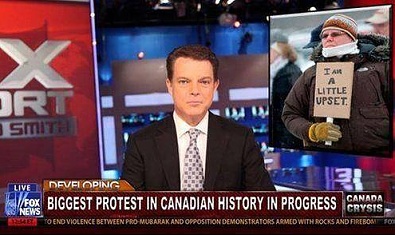 Canadians … we love our country, but that’s never stopped us from having our beefs with how it’s run. Unlike many other countries, we feel free to speak up about what angers us. For all our reputation of being a polite and respectful people, we reserve the right to disagree with those who would impose their will upon the nation.
 Many were angry at the direction we took in the last decade, under the Conservative prime minister . We now have a Liberal prime minister, and likely just as many have issues with his party. In our Canadian way, we will protest against what we dislike, and in due course, vote for the direction we would like to have in the future.
 The First Nations people have been here for over 13,000 years, and for many, the celebration of Canada Day amounts to ” celebrating resource extraction of our territories. The Indian Act is still in place. The government is not allowing First Nations to have a voice. So why would I ever celebrate?”” (Anishinaabe traditional storyteller and teacher Isaac Murdoch.)
 Their resistance movement was developed to inspire other indigenous people to reclaim what they lost during colonization; their land, language and traditional ways.
 On top of sounding the alarm over how resource extraction and pollution is hurting the environment, Murdoch said the #Resistance150 movement is also calling for the abolition of the Indian Act, which was first introduced in 1857 by the British colonial government, and reads very much like a treatise from the Southern Baptist religionists banning dancing in the 1984 film Footloose. Cruel, vindictive and petty, the Act aimed to crush the people and their culture, by any means available.
 I am proud of my country, but I know that my country has to include ALL of it’s people – those who came before us, and those who will join us in the future – to be strong and united. As a country, we can do so much better. And I have faith that we will work towards being a better, stronger, fairer country in the coming years.


 And when I think about those who continue to claim that our actions are too miniscule to have any sort of immediate impact upon the planet, I’m struck dumb by the hubris, and the inability of some to look at the damage we all regularly inflict upon the planet, and not see how integral each and every living creature’s actions are to maintaining this delicate balance. Where once we knew, instinctively and intuitively, that the lowliest butterfly snatched from our timeline could have an impact upon the food chain, we now struggle to throw off responsibility for the most damaging of indignities and raping of natural resources ever seen in human history.

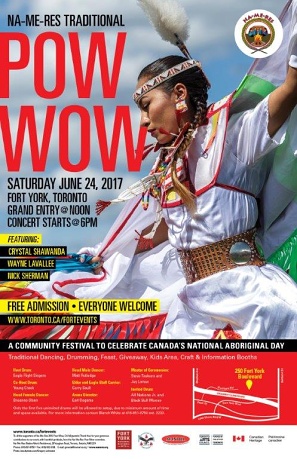 The Na-Me-Res (Native Men’s Residence) lucked out with the weather for the annual traditional Pow Wow held Saturday, June 24th, at the Fort York historical site. The day was sunny, yet breezy, and very well attended.
 We’d run into Vicki and Bill Wood (the Woodies, Eye Eye) on our way in to the Pow Wow, and spent some time chatting with them. Now it was time to begin our walkabout through the 50 craft vendor and information booths on site, chatting with old and new friends.
 With lunch on our minds, we were happy to see our friend Shawn Adler‘s Pow Wow Cafe was represented with a food booth on site. From the moment the Cafe opened, the foodies were lined up for blocks; the food IS that good. So we were lucky to see the multitalented artists, Annalee Orr and Nancy Beiman, close to the head of the very long line up for his Indian Tacos. They asked us to join them, and with little persuasion, and some apologies to those we’d line cut, we did, and soon had our plates of bannock smothered in beef, vegetables, salad and sour cream clutched in our hands.
 Dancers in full regalia drifted through the crowds, brilliant visions of colour and sound as the jingles attached to heels rang.
 And it is always a joy to encounter David DePoe, community activist, retired teacher, and Kensington Marketeer, best-known for his activities in the late 1960s as an unofficial leader of the Yorkville hippies, and founder of the Diggers movement in Yorkville.

 Since our search for housing has begun, I have passed through all the stages of grief; denial, anger, bargaining, depression and acceptance. I now accept that my entire life is on hold, and that I will be a quivering mass of anxiety and frustrated tears until this home hunting issue is resolved. Or one of us kills the other.
 As glad as I am that we are now ‘Former Scarberians, ‘ I did feel a pang at the sight of the rubble.
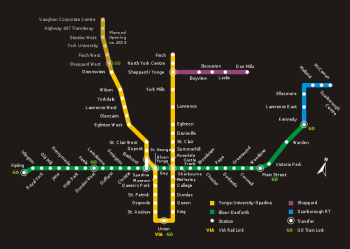 We made up a wish list of what we could and couldn’t accept in housing. Accessibility to amenities, shopping, libraries, etc was priority number one, since I don’t drive. So this palace had to be close to the subway line, and roughly west of Woodbine station, and east of Ossington station.
 Our first forays into the rental world were fun and interesting. Thirty years of home ownership had us lulled into a false confidence. Hours were spent burning out corneas, sifting through Kijiji, Craigslist, ViewIt, and countless other rental sites. We were ready and willing to explore what was out there.
 Landlords today are the Gods of the past. They can drive a grown man to tears, never mind a small French girl. They are merciless. They can not only demand more private and confidential information from you than your doctor will, they can gleefully skip over rental/tenants agreements willy nilly, banning everything from smoking, to small pets, and cooking smells. They can demand thousands of dollars in certified cheques be handed over, before they’ve even looked at your 11 page rental application.
 I no longer look forward to viewing living spaces, nor do I mentally dress them in my mind. I have no reason to expect that finding anything more than four walls and, hopefully, a roof, await me. To quote an old Monty Python sketch, I’m beginning to realize that I may soon be living in a cardboard box in the middle of a busy street. In the game of apartment hunting, I have had my tenant heart broken.
 Nor does the temporary flush of money, money, money help the landlord when he discovers that he’s rented to someone willing to cough up the extra dough so that the space can be turned into a grow op or a crash pad for six other friends. Good luck evicting bad tenants .. that’s one place where the law not only comes down heavily on the side of the resident, it’s actually followed to a fair thee well. Your squatter may be around for a very long time.
 Anyone who falls through the cracks, economically, is hopelessly disenfranchised in this battle. Kids in college, or right out of college coping with short term employment contracts, or gawd forbid, unpaid ‘internships,’ are right out of luck, along with the disabled, the elderly, the vulnerable, and those who don’t pass the scrutiny and whims of landlords. Demoralization and often, homelessness, loom in their futures.
 It’s such a treat to just walk up the street to a good restaurant, or to pop into a local bar to hear friends playing. I no longer have to pack my purse with overnight supplies before heading out to do groceries, or to visit my chums in the downtown core.
 a comfy place for those who’ve been bruised by life to relax, meet other people of like minds, or to simply sit quietly, knitting or colouring, without fear of being asked to ‘move along.’
 Musical Director Peter Kashur brought together Bob, Drew Winters, and a motley crew of Kid Carson, Craig Riddock, Connor Walsh, Annette Shaffer and myself for a rollicking 45 minute set that grew, like Topsy, into an hour and a half of bluster and blather.
 The singers, ably accompanied by pianist Michael Shand, performed for an appreciative crowd in a private home in the Annex. These salons are a wonderful way for musicians to make a living, performing in a comfortable setting, where the attendees are fans, grateful for a chance to capture an intimate moment in time with their musical icons, and even have a conversation with them after their show at the reception.

 We giggled even as we gagged, and blew the smoke out of my bedroom window. I felt very grown up, as she showed me how to ‘french inhale.’
 At that time, 50% of Canadians over the age of 15 smoked. I’m guessing it was closer to 80% in Quebec, where no macho, hockey playing, swaggering boy would be seen without a fag hanging from his lip, and a deck tucked up inside his white t-shirt’s sleeve.
 But there had been rumours coming from the United Kingdom (where 80% of males smoked) as early as 1950, that a Dr Richard Doll had discovered a link between smoking and cancer, while pursuing a possible link between the tar in road construction and patients with lung, stomach, colon, or rectal cancer. Over a period of several years, he interviewed patients, and over 40,000 British physicians, and came to the inevitable conclusion that smoking was a main factor in lung disorders, cancer, and cardiovascular disease.
 tors said Camel cigarettes were ‘toastier,’ while dentists recommended Viceroys! Clearly your health and safety concerns were just a question of finding the right brand.
 And then, about four years ago, I heard about a paid research study on nicotine addiction being done by CAMH, (the Centre for Addiction and Mental Health Care,) and decided to give it a go. They’d pay me to be in a double blind study that focused on the use of Zyban, a nicotine replacement medication. AND they’d give me the medication for free. Only thing was, I wouldn’t know if I was on the actual drug or a placebo. Still, I was game to give it a whirl.
 When I’d talk to other smokers, the males would commonly exhibit bravado about continuing to smoke, despite health concerns, while most of the women would agree that sneaking a cigarette break really meant allowing themselves to stop the world and it’s unending demands for a minute. Even though we intuitively knew that we were doing physical damage to our bodies by smoking, we still had a “this I do for me” attitude about the habit.
 However, with the clinic’s support, and a constant supply of free nicotine replacement treatments, (patches, lozenges, gums, inhalers) I struggled through the next four years, promising myself and my mentors that I would indeed quit .. soon. Just not today.
 When I returned to the clinic last fall to begin yet another six months of treatment, I desperately wanted to get off the addiction treadmill. I was sick of being sick, of seeing the effects of years of nicotine use etched on my face, and in it’s detrimental effects on my health. It had almost become a joke that I had been attending the Clinic for longer than some of their staff.
 For all my good intentions, however, and even while wearing nicotine patches that added up to 63 milligrams of nicotine replacement to my blood, I still found myself smoking to ease tensions and relax. I could tell myself that the stress of selling the house and moving gave me an ‘out.’ I DESERVED the occasional cigarette, dammit!
 I stopped smoking that day, nearly four months ago, and haven’t had a cigarette since. The tests came back, and although I’d done a lot of damage to my lungs with the smoking and the coughing, I did not have COPD. With care, and time, the damage would repair itself. All I had to do was not smoke.
 darkening sky and wonder if I have enough cigarettes to last through a snow storm. I don’t have to calculate the cost of cigarettes into my budget.
 I haven’t been to the parade in years, though I did get to be one of the rabbit stole wearing girls waving from the back seat of a convertible many years ago as the “Miss Irish St Augustines,’ in Montreal.
 as well as Catholic. Prejudices ran deep in the north and could be seen in newspaper cartoons depicting Irish men as drunkards and Irish women as prostitutes. Many businesses hung signs out front of their shops that read “No Irish Need Apply“, or “NINA” for short. The initial backlash the Irish received in America lead to their self-imposed seclusion, making assimilation into society a long and painful process.”
  ey stumbled off the boats, fleeing famine and political strife. Many of those marching in St Patrick`s Day Parades today have no interest or stake in the politics of modern day Ireland, but the urge to celebrate their heritage remains strong.
 Everyone has one – that opinionated, though largely under informed, relative, friend, or acquaintance, that we dread having a conversation with. Our kinder, gentler side tells us we need to play nice with the crazy person, after all, who else will put up with them? And so, inevitably, an occasion arises where Drunk Uncle is pity invited to join the family to dine, and somehow and inevitably, ends up commanding the room.
 And Drunk Uncle has a shit ton of things he finds offensive, everything from immigrants to the government (regardless of which party is currently in power,) to taxes, and to bicyclists. He’s angry about how much everything costs ‘these days,’ and doesn’t believe anything he hears on the ‘so called lame stream media.’
 Everything Drunk Uncle believes comes from suspect sources, and even when he does get his news from a credible source, he’s prone to disbelieving what they say. If their information disagrees with what he feels to be true, he will simply label their facts ‘fake news.’
 And so a ‘discussion’ of how immigrants are taking all of the jobs, and receiving perks far and above our own seniors or disabled citizens, resonates and resounds to Drunk Uncle, and no refutal or rebuttal can penetrate his cocoon of incensed resentment.
 Not only are the new facts rejected, even the suggestion that those in need should be treated with compassion is received with derision. For Drunk Uncle, it is not enough to proclaim dissent with his pronouncements as ‘stupid,’ the rebuttal represents a wonderful opportunity to imply that any and all generous, warm, connected, or creative suggestions are childish and foolhardy, and worthy of contempt.
 Drunk Uncle is ideologically committed to a world in which his privileges and entitlements are protected, but everyone else’s are suspect.
 History is littered with cases of warnings ignored. The victims of Mount Vesuvius‘ eruption in August of AD 79 ignored all of the mountain’s tremors as the molten rock increased within, and only marveled as all of the animals, including rats, fled the town. The wells and streams suddenly dried up, but the Pompeian’s brushed off that warning as being due to hot weather.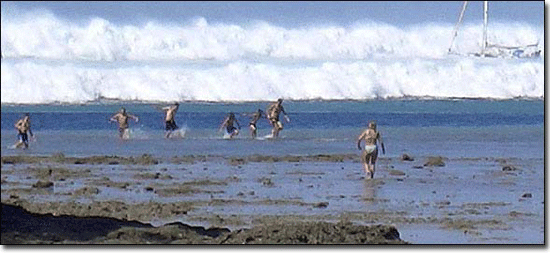
 And what of those whose ‘visions’ prompt such ridicule? If you’re not going to believe a Tsunami Warning System, you’re certainly not going to give credence to the Maoris, who believed that seeing a spirit canoe called waka wairua sailing over a lake near Mount Tarawera in New Zealand in 1886 was a sign of an impending disaster. Even several European tourists claimed to have seen the canoe, which legend said was used to transport the souls of the dead. There were physical signals as well, as the lake’s volume rose and fell rapidly, and the rocks released hot water.
 By June of 1941, Josef Stalin had received more than 100 warnings about Germany’s intention to attack. Germany, meanwhile, was assuring Russia that they were just massing troups at the Soviet border to ‘protect them against British bombing.” Oh, the lies we will believe in the name of keeping safe! The Soviet Intelligence communities had their warnings ignored., while the head of Soviet intelligence, who had also warned Stalin of Germany’s intention to invade, ended up shot.
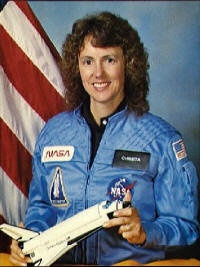 Prior to the January 28, 1986 launch, Mr. Eberling had warned that the extremely cold weather would prevent the O-rings from sealing properly and would cause an explosion. But a delay was nixed by executives under pressure to get the shuttle into space, and he was told it was ‘not his burden to bear.’
 Economist John Maynard Keynes said that the Treaty was dead on arrival. Field Marshal Ferdinand Foch, a French army commander, warned that the treaty was not the end of the war but rather a suspension of it, and that Germany would be much more formidable in a new war, invading France and staging attacks into England from there.
 Their own constitution offered all the information they needed to prevent his rise to power. Their vaunted ‘checks and balances’ produced nothing more than a last line of defence – the Electoral College – that folded like a cheap suit. Now that the fox is in the hen house, it’s going to be very difficult, if not impossible, to get him out, and will likely produce millions more victims to add to that very long list of innocents, murdered through the elected officials’ casual ignorance, or a stubborn belief in their own infallibility brought about by a controversial electoral win.
 frustratedboomers