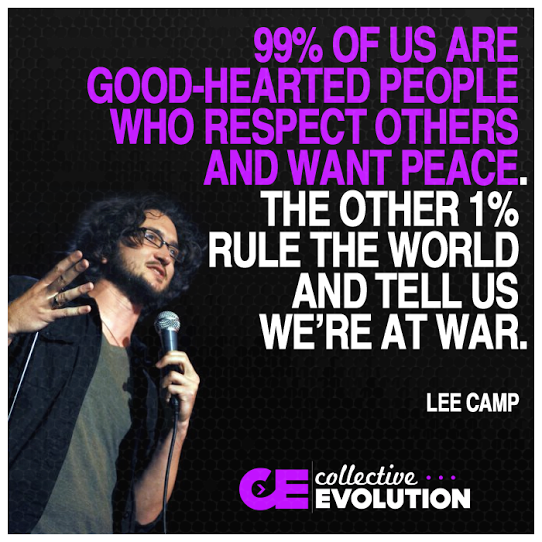
Whenever I watch anything about war, be it fiction or non-fiction, featuring North Americans, or any other soldiers on the planet, I am struck by one horrible, indefensible truth.
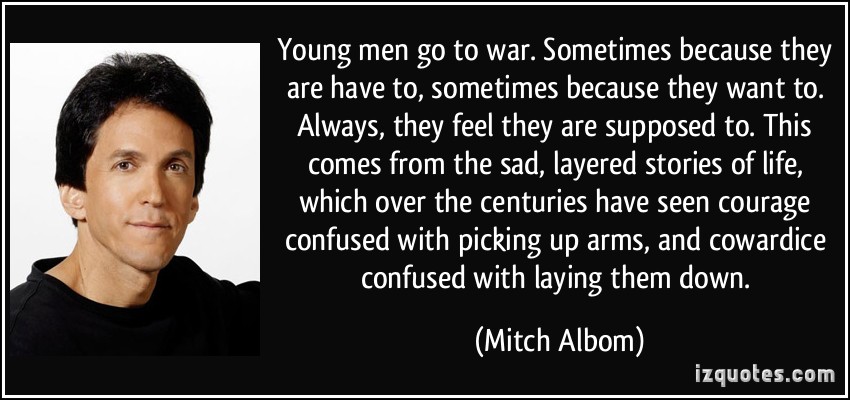
I am long past romanticizing war. The young men … the young and the foolish and brave men, barely past their teens or just into their twenties … believe with all of their hearts that they are acting in the best interests of their tribes.
Young men, whose hearts are in the right place, but who have yet to achieve total mental maturity, take up arms against others, others that they have been told either have something their country needs, or others who have a predetermined antipathy against their country.
Old men, men that could not be drafted into service, send these babes out in to the world, armed with little knowledge, but strong prejudices, drilled into them through military exercises, and constant reminders that the most honourable thing they can do is to die for their country.
Those who survive the horror of war, at least since Vietnam, come home not to respect and a grateful nation, but to a country set on denying them timely help in recovering from physical or emotional trauma. Canada and the United States are unable to cope with the wounded from the last several skirmishes. There are veterans of foreign wars living on the streets in North America, while others battle endless bureaucracy to simply get the care they were promised would be available at the end of their military tours. Some of these veterans will kill themselves in despair, willingly or through drug usage meant to dull the pain, before they finally get to the top of the treatment line.
And yet, come Remembrance Day, every politician will be piously doffing their metaphorical hats in respect, a respect in lip service only.
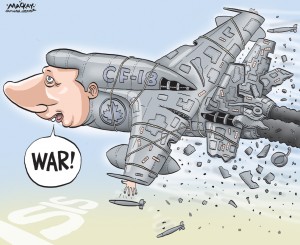
And now, this Easter weekend, Prime Minister Stephen Harper, so terrified of losing his seat in Parliament that he will inflate one drug addled, mentally ill man’s assault on the Parliament into terrorist activity, has decided to plunge Canada into what is essentially an illegal war, unsanctioned by the United Nations, and unasked of by the Canadian citizens who will be paying the bill for yet another foreign war, and sending their sons and daughters to be slaughtered to his monumental hubris, and need for power at any cost – even that of the Canadians he was elected to serve.
He has no right, and no mandate, to take Canada into a war slipped through on the eve of Easter and Passover weekend. His cadre of supporters, more cowed supplicants than devoted fellow party members, voted 142 to 129 to pass this war resolution. It is a shameful, vile moment in Canada’s long history of peace keeping.
“War is the ultimate acknowledgement of collective failure. War means that we don’t know how to confront evil by any means other than killing and dying.” Michael Enright.
In generations to come, Stephen Harper’s legacy will include this decision to side with Syrian president Bashar al-Assad, whose family has been slaughtering Syrians for decades and continues to do so. His reputation in the rest of the civilized world may never recover. But it is we, the Canadians, who will have to live with the shame and our shattered world image.
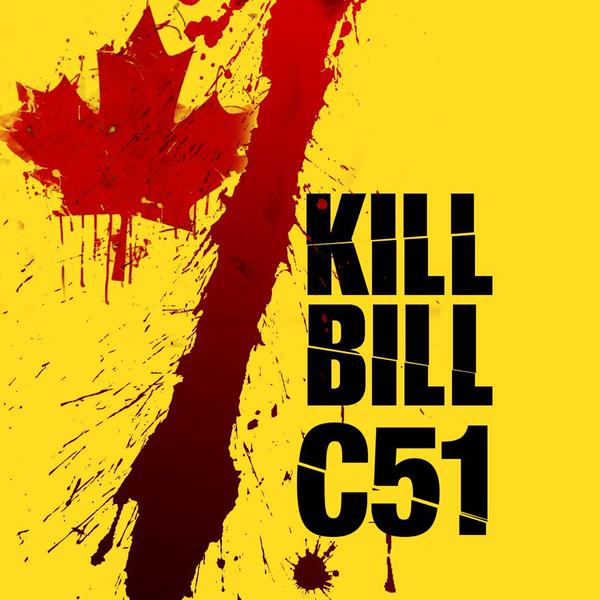
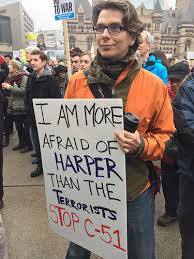
The Conservative Party would have you believe that anyone opposing the proposed Bill C-51 is a ‘conspiracy theorist.’ Most boomers believe that the Bill will never make it through Canada’s Supreme Court, chock full as it is with civil right offenses, so we should all just calm down.
Staunch Con allies, such as the Ottawa Sun, are playing the label game to, inferring that “Commies oppose anti-terror bill” in response to Canada wide marches by people who massed to protest a threat to their civil rights.
(And just to make one thing perfectly clear – The Communist Party of Canada (CPC) is a legal entity, and has “in the past been elected to the federal Parliament, the Ontario Legislature, the Manitoba Legislature, and various municipal governments. The party has also contributed significantly to trade union organizing and labour history in Canada, peace and anti-war activism, and many other social movements.” (Wikipedia)
Those who speak out against governmental overreach are used to being maligned. In 2012, the government killed its Internet snooping bill, C-30, after an online backlash and when it couldn’t recover from then public safety minister Vic Toews comparing opponents of C-30 as being friends of child pornographers.
The Liberal Party under leader Justin Trudeau has backed the legislation, which may well be the decision that nips his political career in the bud.
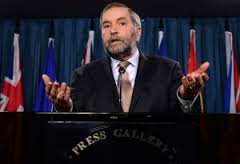
From the first moment I got wind of Stephen Harper’s proposed Bill C-51, I have been openly criticizing its very existence. Many other people agree, including some allies of the Harper government, the National Firearms Associate, Tory MP Michael Chong, The Canadian Bar Association, Leader of the Opposition NDP’s Thomas Mulcair, aboriginal groups, and Green Party Leader Elizabeth May.
Greenpeace Canada Executive Director Joanna Kerr wrote in an iPolitics post last week. “More than 100 legal experts have written to parliamentarians to say that this legislation is dangerous—that it will make it harder to effectively fight terrorism while introducing unprecedented infringements on our rights and privacy. Their concerns have been echoed by four former prime ministers, five former Supreme Court judges, the federal Privacy Commissioner, Amnesty International, the Assembly of First Nations, and a host of other organizations. Are they all terrorists?”
As the meetings and debates drag on in Parliament (on your tax dollar,) key legal voices blocked from C-51 committee debate include the Privacy Commissioner of Canada, Daniel Therrien, the Criminal Lawyers Association, Information Commissioner Suzanne Legault, former CSIS Inspector General Eva Plunkett, chair of the Security Intelligence Review Committee Deborah Gray and former SIRC chair Chuck Strahl.
The Mozilla project, the open-source software community behind the Firefox browser, has issued a statement urging the federal government not to go ahead with Bill C-51.
“C-51 is sweeping in scope, including granting Canadian intelligence agencies CSIS and CSE new authority for offensive online attacks, as well as allowing these agencies to obtain significant amounts of information held by the Canadian government. The open-ended internal information-sharing exceptions contained in the bill erode the relationship between individuals and their government by removing the compartmentalization that allows Canadians to provide the government some of their most private information (for census, tax compliance, health services, and a range of other purposes) and trust that that information will be used for only its original purposes. This compartmentalization, currently a requirement of the Privacy Act, will not exist after Bill C-51 comes into force.
“The Bill further empowers CSIS to take unspecified and open-ended ‘measures,’ which may include the overt takedown of websites, attacks on Internet infrastructure, introduction of malware, and more all without any judicial oversight. These kinds of attacks on the integrity and availability of the web make us all less secure.”
The opponents are concerned about a lack of parliamentary oversight of intelligence agencies under the bill, as well as numerous privacy and civil liberties issues. The Canadian Bar Association has argued that it contains “ill-considered” measures that erode Canadians’ civil liberties without making them safer.
The bill’s “vague and overly broad” language means it could be used to harass protesters and put a chill on legitimate dissent, the group said. The broad nature of information-sharing between government agencies would erode trust in government, and the Association described the Canadian bill as “even more concerning” than the controversial CISA bill making its way through the U.S. Congress.
From Canada’s Privacy Commissioner Daniel Therrien::” “This is really about big data, which relies on massive amounts of information that can be analyzed algorithmically to spot trends, predict behaviours and make connections.”
Canada’s foremost Internet law expert Michael Geist: “”The scope of sharing is exceptionally broad, covering 17 government institutions with government granting itself the right to expand sharing to other departments. In fact, the bill even permits further disclosure “to any person, for any purpose.” In other words, there are few limits on how information the government collects can be shared internally, with other governments, or with any entity it sees fit.”
Steve Anderson, national coordinator for internet freedom advocate OpenMedia, also brought a 100,000-person petition against C-51 and said he felt Canadians were actually well informed on the topic and should be encouraged to enter debates over it rather than be “disrespected.”
Anonymous also got into the action with its members posting a video to Vimeo and creating an anti C-51 website. (http://www.opc51.gq/)
Actually, even writing this blog has likely landed me on the ever growing list of people the Conservatives want to silence.
How bad could Bill C-51 be for Canada? Well, it’s even broader in scope than the United States’ Patriot Act, which was put into place after the events of 9/11, and has remained in place through the last 14 years and two presidents.
The bottom line of course, is that once put into place, it will stay there. It will replace the civil rights of Canadians with tyrannical surveillance.
With that in mind, we can look to what has happened in America during those 14 years. This video of an episode of VICE News discusses the impact of state-wide surveillance.
From Youtube: “Glenn Greenwald is an American journalist and author who’s best known for reporting on the leaks of classified National Security Agency documents by former NSA contractor Edward Snowden. Before he was a journalist, Greenwald was a constitutional law and civil rights litigator, and until 2012 he was a contributing writer at Salon. He has authored four books: How Would a Patriot Act, Tragic Legacy, Great American Hypocrites, and With Liberty and Justice for Some. For 14 months Greenwald was a columnist at the Guardian, where he broke the first NSA story in June of 2013.”
VICE Meets Glenn Greenwald: Snowden’s Journalist of Choice
Although the entire episode is interesting and through provoking, if you skip forward to the9.50 mark, Mr Greenwald specifically discusses what the Patriot Act has done to American civil rights.
He discusses the first report that he published of Snowden’s information about a top secret order issued by the foreign intelligence surveillance court, which forced Verizon to give the FBI metadata from millions of American’s phone calls. (Metadata is not so much communication, as it is data ABOUT communication – who you are in contact with, how often, your location, and your emails – both to and from. This supplies much more information than just eavesdropping on your actual phone calls.)
As he says, you may feel you have ‘nothing to hide,’ but if asked to give someone all of your social media and email passwords, so that that person might troll through the information, and publish whatever they found, you’d be justifiably upset.
In the U.S. the NSA has access to the central servers of nine major internet companies, including Google, Yahoo, Apple, and Facebook. The NSA wants ALL data to be public.
People who are in favour of Bill C-51, like the citizens of America, want ‘bad’ people to be watched. But most of the spying done by the NSA has nothing to do with crime or terrorism; it has to do with economic espionage and people monitoring. So much so that the government is having to build giant storage facilities to house the collected data. Uncovering any information in this giant pile of data is more akin to finding a needle in a haystack – it’s unnecessary, and it’s contrary to the stated need of anticipating terrorist activity.
What it is doing, however, is causing people to submit to authority in the name of love of country.
In relation to the Patriot Act, those who said it was “a radical piece of legislation, really dangerous, and an abandonment of all values,” didn’t anticipate that this gathering of data would affect everyone, not just terrorists. Even those painting the grimmest picture of what the act could lead to were warning that it had lowered the standard too much, from probable cause to just relevance, so that it would enable to government to target people too easily.
“But everybody assumed, even the most ardent opponents of the Patriot Act, that it was still going to be targeted investigation. Nobody ever thought the act would be distorted and misinterpreted to authorize and justify bulk, indiscriminate, suspicion less collection of the communication data of every single American Citizen. As it has been.”
“If you are somebody who exercises power, and you can know everything that everybody is doing – what they say, what they read, what they think, what they plan, with whom they’re interacting – and at the same time, build a wall of secrecy around what you’re doing, so that nobody can actually see or know what it is that you are choosing, the power imbalance becomes amazingly acute. Which is why all tyrannies instinctively use surveillance as one of their principle weapons.”
“Because the more you know about the world, and about other people, the more you can manipulate and control it. The less the world knows about you, the less leverage they have over you.
So it’s really, at it’s core, about increasing the power of the U.S. government vis a vis it’s own population and people around the world.“
When asked if America is becoming a tyranny: “I think labels are sometimes unhelpful, just because words like that are so inflammatory, and I think people are inculcated, are sort of trained to believe, that tyranny is something that happens in places like Iran and Russia, and not in nice place like America. So the minute you apply that label, people react instinctively, as though you’ve said something radical on their brain charts.
“What I can say for sure is that there are patterns that are the hallmark of tyranny, one of which is mass, indiscriminate, suspicion less surveillance, that the U.S. government is increasingly relying upon, to maintain control, and to shield itself from legitimate challenge. I mean, whether someone wants to call that tyranny or not, I’ll leave that semantic debate to others. But that power is clearly tyrannical in nature.”
It would be hard to read the above, and not ask ourselves why Canadians should open themselves to this kind of governance. But that is what our Prime Minister is trying to rush through the courts.
Can we not learn from the United States` progressively more paranoid and oppressive surveillance laws? Must Canadians learn these lessons for themselves, and repeat a failed experiment that will destroy the freedoms and civil rights they treasured?
Harper has parlayed one mentally ill drug addict’s suicidal attack on Parliament into a terrorist threat, and now wants to impose the beginnings of a Canadian police state in Bill C-51. He`ll even take Canada into a war against the Islamic States, simply to enhance the fear he`s ramped up over terrorism, despite the fact that doing so could actually make Canada a primary target.
Bill C-51 oversteps all reason. There`s no room to tinker with this flawed and dangerous bill. It has to be stopped immediately. The people have spoken, but Harper and his cabinet of trained seals couldn`t care less. They are intent on shoving this bill into law, against the express wishes of the majority of Canadians. We cannot allow this to happen.
Previously on, Survivor: After a surprise switch, Kelly was the only Blue Collar that landed up on the unimpressive new Red /Nagarote tribe with Will, Hali, Jenn, Carolyn, Max, and Shirin. The rest of the Blue Collars enjoyed a 4/3 advantage in their new Blue/Escameca tribe of Dan, Sierra, Mike, Rodney, Tyler, Joaquin and Joe. Sierra was not happy to be the only woman on the uber male team, as she disliked her former tribe mates. She hoped to connect with the three males of the former No Collar tribe.
Max won the battle for most annoying tribe member, and became the 5th person voted out of Survivor: Worlds Apart. 13 are left – who will be voted out tonight?
Shirin is devastated to have lost Max, her closest friend and confidante. She had spent all of her time with Max, until the new players arrived on the team, and now, her efforts to woo the newbies to their side has angered her past team members. No one wants to play with her, she pouts. “Is there something wrong with me?” Shirin tells us about growing up in a rich, Orange County suburb amongst kids that were white and prettier than she. She’s going to have to do now, what she did then; deal with it, adapt, fix it.
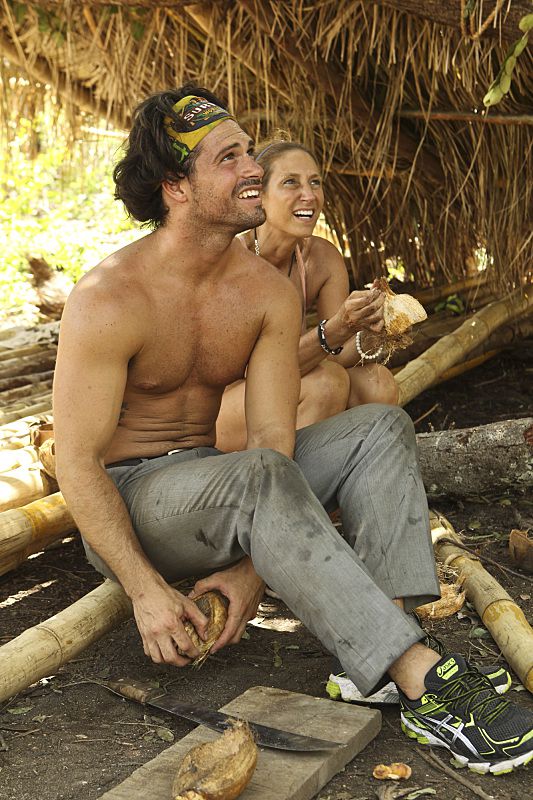
On the Escameca beach, Rodney’s looking for a new BFF. He’s sick of Dan’s stories, and even Mike, who had been his bestie last week, has been found wanting this week for not being a big enough partier. Mike goes to church on Sunday, doesn’t drink, and doesn’t have sex. So Rodney decides to start a bromance with Joaquin. Joaquin’s good with that.
With a new bestie and ally, Rodney feels like he’s king of the world. “All the fools out there who think I’m dumb and ‘oh, he talks like an idiot’—wait till you see what I have planned for this game.”
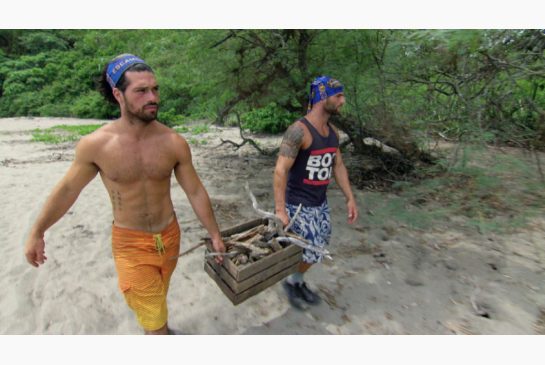
The players greet Jeff Probst at the Reward Challenge site. This week, the teams will race up a giant tower and through a series of obstacles. At the top, they will launch sand bags, one at a time, at targets out in the field. First team to hit all six targets wins reward – a trip to a turtle sanctuary, where they’ll watch turtles migrating from the sea, back to the beach where they were born, to lay their eggs deep beneath the sand. While watching, they’ll feast on beef stew, mac & cheese, and hot chocolate. Survivors ready?
Both teams race through the beginning of the trial, but things get tense when Escameca takes a 4-2 lead. Determined to win, the Nagarote players dig deep, rally, and win the challenge!
Shirin hopes that their win and reward will help her to find a way to bond with the other players. Everyone else is just excited about eating real food with real utensils! After their feast, they take flashlights to the beach where the migration of the giant turtles occurs. Out of 120 eggs lain, only one will survive. Jenn is excited by the sight and the lesson. “It made me realize that a turtle’s chances in life are way worse than me winning Survivor. I do have a 1 in 14 chance of winning as opposed to a 1 in 100 chance of living. So that’s cool.”
When Joe, Dan and Mike head off to Escameca’s beach to fish, Joaquin approaches Sierra about forming an alliance with himself, Tyler and Rodney. She’s interested, but doesn’t trust Rodney. But if she has to work with Rodney to work with Joaquin, then so be it.
Rodney now thinks he’s got the game under his control … he can already taste the win. His first move will be for the tribe to throw the Immunity Challenge, so that they can vote Joe off the island.
Rodney sells this plan to Mike, who doesn’t think it’s a great idea; historically, throwing a challenge always backfires. But he doesn’t care about the current tribe, as his real alliance is with Kelly and some other players on the other tribe. If his team throws a few challenges, Kelly’s odds of being safe on the other side increase.
So, everyone troops off to the Immunity Challenge, which is a memory tester. There are a series of items in a specific order that two opposing players need to memorize. Once they have, they pull a lever to drop a curtain on the items, and then race back to put them in the right order before their opponent to score a point. First team to three points wins immunity, and the Immunity Idol, which to me looks like a rather dissolute Mr. Peanut ™.
First up is Rodney vs Caroline. Caroline wins easily, especially as Rodney is a bad actor, who makes little effort in pretending to score the point. Hali wins the next point for Nagarote as well. The game continues, with Escameca coming back, bringing the score to 2/2, with Mike vs Kelly as the potential tie breaking bout.
Kelly is first to close the curtain, but Mike lingers, staring at the closed curtain. But Kelly can’t remember the order of the items. Mike purposely puts his items incorrectly, and they both have to go look at another set of items. Mike whispers to Kelly, “listen to me, I’m giving it to you. Listen to what I say.” He then proceeds to name all of the items, before they race back to solve the test.
Despite Mike continuing to give the order of the items aloud, Kelly again gets the order wrong. So it’s back to the curtain for a last try, this time with just five items. This time Mike tells Kelly, “I will call out the order, but I will switch the bottles.” The only way Mike could be any more helpful would be for him to actually place her items correctly by himself. And so this time, Kelly wins and Nagarote is safe from the night’s Tribal Council.
Once Kelly realizes that Mike threw the challenge, she’s surprised, but feels she can really trust him. She can’t wait to get back to her Blue Collar tribe, where she feels she belongs.
Mike, on the other hand, feels like, “a little something inside of me died today.” And he’s beginning to see Joaquin as a bad influence on Rodney. Rodney, meanwhile, is confident that he has everyone in his pocket – they’ll be voting Joe out that very night.
Mike lets Joe know that Tyler and Joaquin are gunning for him. Joe tried to reach out to them, but neither was interested. If Joe, Mike and Dan want to be safe, they’ve got to get Sierra on their side. The problem is, Sierra is still angry at Dan for being rude to her after Lindsey’s blindside.
But Dan’s willing to grovel if that’s what it takes to get rid of Joaquin. Sierra, as the swing vote, is now being wooed by both sides, unsure of whom to trust, but aware that she’s protected no matter how she votes.
At Tribal Council, Jeff wastes no time laying out where the tribe stands since the switch up. They have 4 Blue Collars, 2 White Collars, and one No Collar trying to work together. He asks Joe how the Blue Collars acted when they returned to the camp. Joe notes that they seemed one big happy family – on the surface. But that hid certain cracks in the group – dysfunctions, as Dan mentions. Tyler says they noticed a lot of bad blood and animosity, most of which revolved around Sierra.
Sierra agrees, adding that she was accused of being bad at challenges and around camp. She felt picked on, and Mike was the only person who stepped in and told the others to leave her alone. She’s felt more appreciated by the three new camp mates (Joe, Tyler and Joaquin) in three days than in the first days she shared with her Blue Collar mates (Mike, Rodney and Dan.)
With those cards on table, Rodney still can’t see the split in the tribe. He’s confident that everyone is behind him, and that he’s in a great position. Joe says that things may be changing, but as far as he knows, he’s on the very bottom of the structure, with no allies.
Jeff notes that the decision made tonight could be a very big one. And now, it’s time to vote. Jeff reads out the names – three votes each for both Joe and Joaquin. The deciding vote is for Joaquin, who becomes the 6th person voted out of Survivor: Worlds Apart.
Although Joaquin was the one blindsided, Rodney looks as though he’s just found a half worm in his apple. He’s furious! If this was a movie, he’d turn into the Hulk™ or Godzilla™ and destroy a city.
Jeff tells the others, “Your success in this game depends on your ability to exploit or repair those cracks day by day. “
Joaquin’s exit interview: “I didn’t see it coming, you know, totally got blindsided by the four, I don’t know who. I have a good guess. I’m sure, you know, Mike was obsessed with Sierra, and I was getting too close to Sierra, I was getting too close with Rodney. They were feeling like I was pulling their tribe away from them, and they were like, you know, let’s get this guy outta here. But this is my fate, and I’m gonna take it, with a smile on my face.”
Next time on, Survivor: Rodney feels betrayed by his Blue Collar family. “The people who did me wrong today are gonna pay for that ^*^%.” But in Survivor, there’s always time for revenge. The tribes merge, which prompts Rodney to decide, “I felt extremely disrespected by this group, so – me and numbers are donezo.”
My take on this episode: Throwing a challenge is bad game strategy. Has it ever actually worked in Survivor gameplay? Kudos to Mike for realizing that he’d crossed a line when he agreed to go against his own morals.
Why is Joe always being targeted by his tribes? Is it his hair, his laid back attitude, his athleticism, his great smile, his team spirit? Agreed, all of these things make him a threat, but also a great person to work alongside until closer to the end of the game. For the last several seasons, the players seem to always be working the last part of the game before they’ve understood where they are in the beginning and middle.
With the merge next week, everything may change. I think that smaller alliances will spring up, working together when necessary, but ultimately dividing the tribe further. Rodney may find himself targeted from several sides. Shirin and Tyler need to make themselves more visible with the tribe to stay in the game.
I haven’t written much lately, and there’s a reason for that; I’m deeply saddened and disappointed by much of recent human behaviour, and I’m fighting against becoming cynical.
To be inspired to write, to communicate your thoughts and beliefs, is to be aware of the world around you. Everything is grist for the writing mill, whether good or bad. You “write what you know.”
What are the messages we are receiving, from mainstream media, from social media, from our friends? What are we processing and regurgitating, aloud, in print or digitally? Are we absorbing the constant bombardment of information, filtering it through our own belief systems, and coming up with something that makes sense, or are we just letting it wash over us, as all too much to contend with?
In the face of injustice, as in blatant racism, or as in how those with money and power are treated differently to those without, many rush to justify what is clearly morally wrong. Unable or unwilling to actually parse the injustice, they make excuses, pushing aside their own moral concerns to side with the abuser rather than the abused. In time, that constant re-working of what goes against their own inner morality leaves them unable to clearly delineate right from wrong – every issue becomes subject to exceptions. Actual scientific facts become ‘unproven.’ “War is peace. Freedom is slavery. Ignorance is strength.” (1984, George Orwell)
Our cultural heroes are no longer men and women of strong moral character, willing to sacrifice for causes to improve mankind. Rather, we put pop stars and billionaires on pedestals, and worship their most banal efforts as triumphs. And, befitting this shallow mindset, we first build up these ordinary people, and then we tear them down, mercilessly.
The ‘mean girl’ caricature, once parodied and satirized, is now considered normal behaviour for many with little themselves to offer, beyond snide disapproval or belligerent tirades. Those who, through luck or machinations, are in positions where they could actually improve the lives of their fellow man, instead choose to belittle those who already have very little.
“Be assured that a walk through the ocean of most souls would scarcely get your feet wet.”
Lately this rush to demolish what took centuries of effort and sacrifice to create – a modern civilization with dreams of equality and peace – seems to have accelerated beyond all control. It’s difficult to remain positive and to continue to believe in the fundamental goodness of the human race.
And the irony of those attempting to pull down the pillars of society lies in the truth that they have no concrete plan for a new form of society beyond their only motivation; power, and to impose absolute control over everyone else’s lives.
I do believe in mankind. I also believe that we are at a turning point, a time when it’s still possible to turn the ship around, and get back on the right course. For civilization to move forward, we need to stop believing that social, political and religious differences should be met with intolerance. And we must demand of the people we have put into power that they work for the people, not against the people.
A short one today as my life is currently very complicated and conspiring against my preference to spend all of my days working out what to blog. But do you know what isn’t complicated?
Consent.
It’s been much discussed recently; what with college campuses bringing in Affirmative Consent rules, and with the film of the book that managed to make lack of consent look sexy raking it in at the box office. You may not know this, but in the UK we more or less have something similar to ‘affirmative consent’ already. It’s how Ched Evans was convicted while his co-defendant was not – and is along the lines of whether the defendant had a reasonable belief that the alleged victim consented. From the court documents it appears that while the jury felt that it was reasonable to believe that the victim had consented to intercourse with the co-defendant, it…
This has been a crazy week, so I’ve not gotten much research done. (In a nutshell – bad back, 13 hour power blackout, and more of that purging I’ve mentioned ad infinitum)
But – I did get my recap done for Starpulse – this week’s musings on Survivor: Worlds Apart(White Collar vs Blue Collar vs No Collar.)
 Old men, men that could not be drafted into service, send these babes out in to the world, armed with little knowledge, but strong prejudices, drilled into them through military exercises, and constant reminders that the most honourable thing they can do is to die for their country.
 And yet, come Remembrance Day, every politician will be piously doffing their metaphorical hats in respect, a respect in lip service only.
 Minister Stephen Harper, so terrified of losing his seat in Parliament that he will inflate one drug addled, mentally ill man’s assault on the Parliament into terrorist activity, has decided to plunge Canada into what is essentially an illegal war, unsanctioned by the United Nations, and unasked of by the Canadian citizens who will be paying the bill for yet another foreign war, and sending their sons and daughters to be slaughtered to his monumental hubris, and need for power at any cost – even that of the Canadians he was elected to serve.














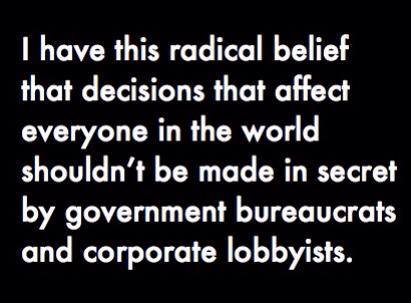


 frustratedboomers